Redlands Epoxy Floors has been installing epoxy flooring in Yucaipa for more than twenty years, and the honest thing to say about quoting here is that we cannot do it from a street name. Two houses a mile apart in this city can need two genuinely different systems, two different amounts of preparation and two different prices, and the reason is the year the slab was poured.
Most cities have a modal garage. Yucaipa does not. No single decade accounts for more than 19.2 percent of its housing, which is the widest build spread anywhere in these foothills, and the result is that a bid script that works on one street produces a wrong number on the next.
So we read the slab before we price it — surface condition, joint pattern, what has already been put on it, and a moisture number where the age calls for one. The reading goes in the proposal alongside the mil build and the product data sheet, because a number you can check is worth more than a confident guess.
Why One Yucaipa Quote Does Not Fit The Next Street
The build curve is genuinely flat
Of 19,248 housing units, 645 were built in 1939 or earlier, 1,106 during the 1940s and 2,015 during the 1950s — 3,766 units, 19.6 percent, before 1960. The 1960s are the largest single decade at 3,441 units and still only 17.9 percent. The 1970s add 3,205, the 1980s 2,003, the 1990s 2,182, and the 2000s another 3,692. Roughly two thirds of the stock predates 1980 and about a quarter was built in 2000 or later.
That is not a city with an era. It is a city with all of them at once, and the pre-1950 tier alone — around 1,751 units — is larger in absolute terms than the entire housing stock of most of the communities around it.
Three different jobs wearing the same name
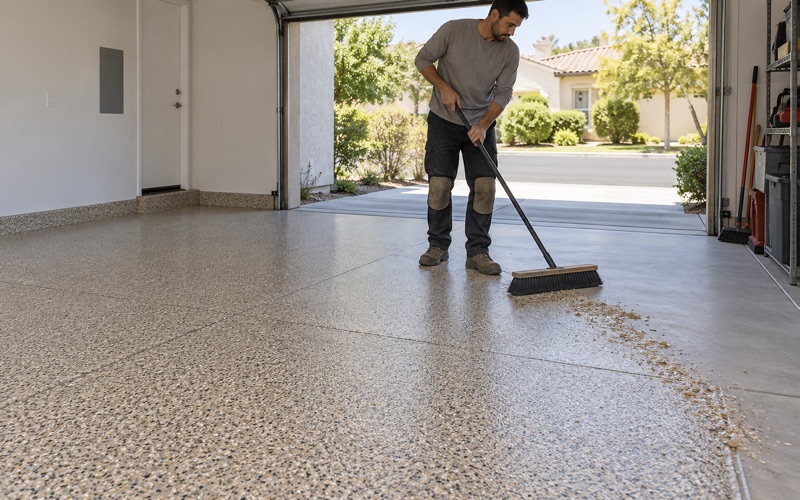
In practice that resolves into three distinct scopes. A pre-1950 detached garage on an original valley lot is a hand-troweled or float-finished slab, often without a control-joint pattern anyone would recognize today, and it is the tier where moisture is scope rather than an upsell. A 1960s or 1970s attached two-car garage — about 6,646 units between those decades — is a settled fifty-to-sixty-five-year-old slab with joint cracking and decades of oil in it. A 2000s three-car tract garage is a flat, sound, sawn slab that mostly needs opening and a decision about the apron.
Those three are not variations on a theme. They differ in preparation hours, in primer, and in whether a moisture vapor barrier is even a live question. Quoting all three off one sheet is how a bid goes wrong in this city specifically.
One in five units does not have a garage at all
Yucaipa has 3,816 manufactured homes, 19.8 percent of all housing units, and a manufactured home has a carport rather than a garage. That is not a rounding error — it means any estimate built from raw housing-unit counts overstates the garage market here by about a fifth.
The published number that actually describes this market is 10,684 owner-occupied single-family detached houses, out of 18,506 occupied units and a 73.4 percent ownership rate. That is a substantial residential base, and it is the largest in these foothills by a wide margin, but it is smaller than the population implies.
Looking for epoxy flooring closer to Calimesa? See Epoxy Flooring Services in Calimesa.
Reading The Decade Off A Slab
What the surface says before any instrument does
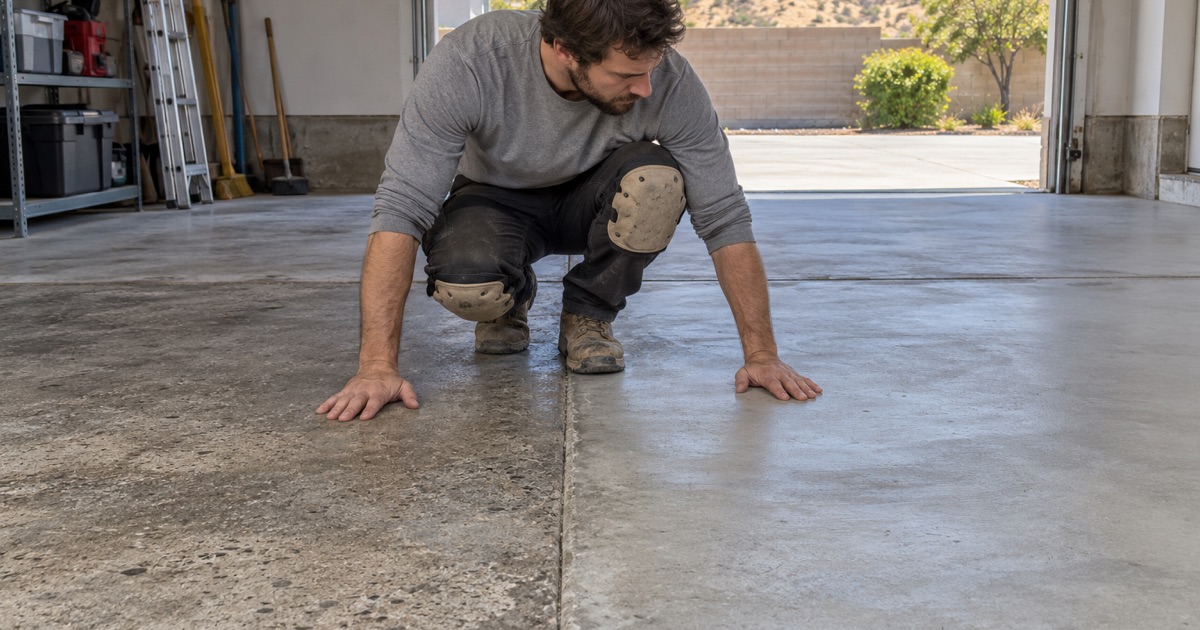
Finish tells you a lot. A steel-troweled 2000s tract slab is dense, flat and hard on the surface, and it will burnish under the wrong tooling before it opens. An older float-finished slab is softer at the top, cuts faster, and frequently hides an inconsistent surface hardness across one bay because it was placed in more than one pour.
Joint pattern is the second tell. Modern slabs get sawn control joints on a predictable grid. Older ones often have tooled joints, or none, and the cracking that resulted is what you are actually looking at.
The prior coating is a date stamp too
What is already on the floor narrows the era as reliably as anything. A thin, chalky, one-part floor paint peeling in sheets is a different removal from a chip-broadcast kit installed in the last fifteen years, which is a different removal again from a two-part industrial coating someone put down on a shop floor.
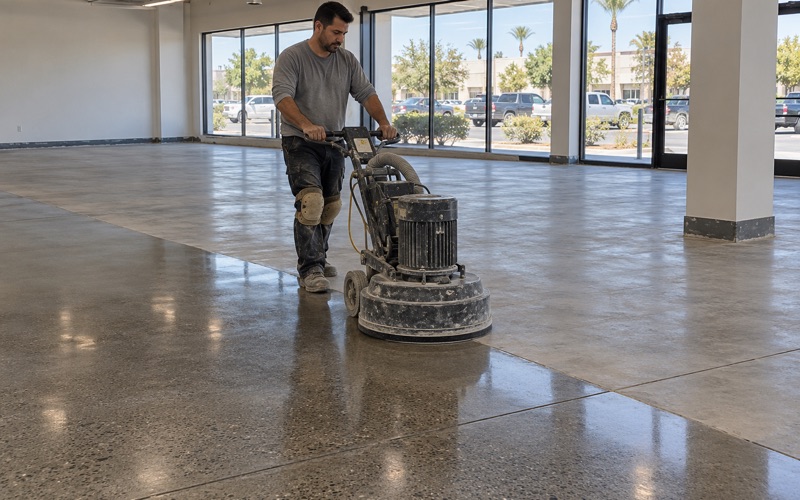
Each of those needs different tooling. Grit sequence and diamond segment bond hardness get matched to the concrete and to what is sitting on it, and the rule that surprises people holds: hard concrete takes a soft bond. Pair them the wrong way and the tooling polishes the slab instead of cutting it, which leaves a surface no coating can key into.
Profile is the deliverable, not the method
Whatever the era, the outcome we are aiming at is a named ICRI concrete surface profile — commonly around CSP 3 for a thin-film system and deeper for a heavy build. Nothing here is opened with acid. An acid-etched surface leaves a chemically softened skin that releases in sheets under a warm tire, and it cannot be verified against a profile at all.
What Actually Changes Between A 1950s And A 1990s Garage
The pre-1950 detached garage
Slabs from that era were commonly placed without an under-slab vapor retarder, which means moisture is a scope item rather than an add-on. It also frequently means the slab is thinner than a modern one, has settled differentially, and carries repairs someone made decades ago that have to be assessed before anything is placed over them.
This is the tier where a written repair-or-replace read earns its keep, including the case where the honest answer is that the slab is not a candidate and coating it is the wrong money.
The 1960s and 1970s attached two-car
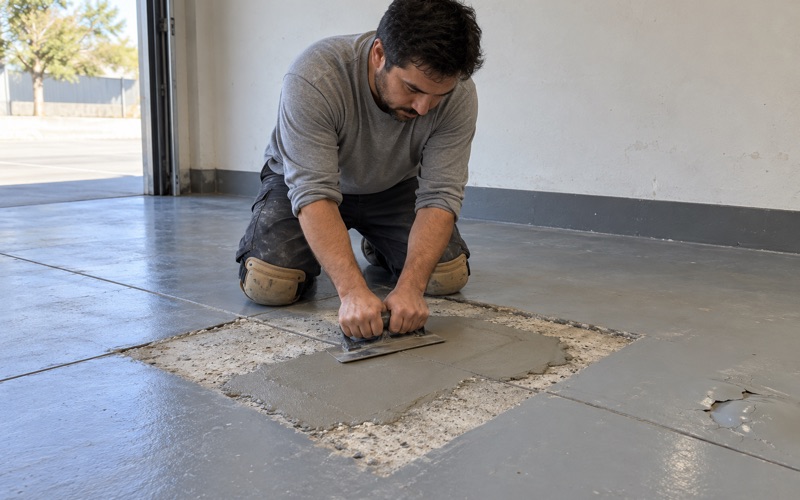
The middle tier is the volume job here, and the work is mostly removal and repair. Static cracks get chased open and filled with a semi-rigid filler so the repair carries traffic instead of reopening; a moving joint is honored rather than bridged, because a film stretched across a live joint will telegraph and split.
Oil is the other constant. Resin will not bond through contamination, so a saturated area gets degreased, ground and — where it runs deep — tested as a patch before we commit the whole floor.
The 2000s tract slab
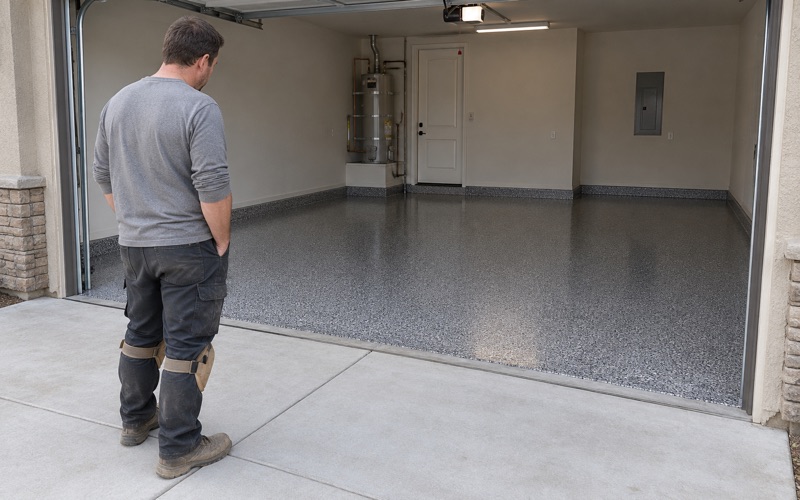
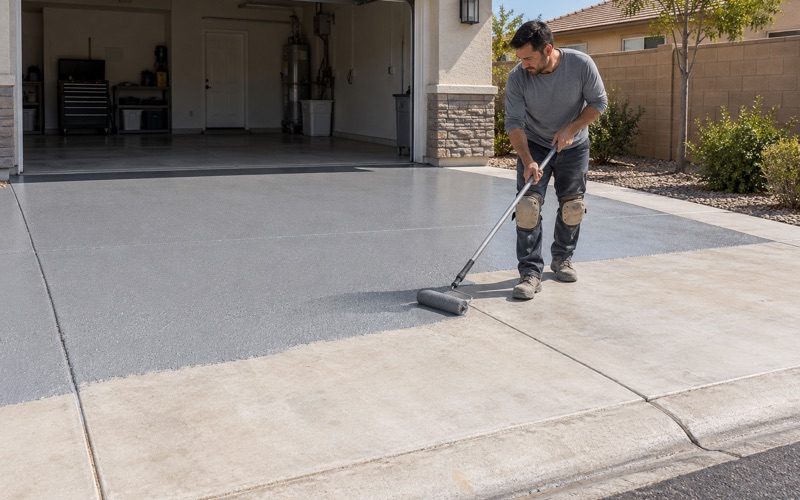
The newest tier is the easiest and the most often over-sold. A fifteen-to-twenty-five-year-old sawn slab in sound condition usually needs opening, joint treatment and a system, not remediation. The real decisions there are the apron and the threshold: running out past the door line puts the system in sunlight, which is a different product question, and an aliphatic polyaspartic holds color outdoors where an epoxy ambers.
The Industrial And Commercial Floor Inside A Foothill City
High-cube product at a Yucaipa address
It surprises people that genuine high-cube industrial buildings carry Yucaipa addresses. Pacific Oaks Commerce Center at 32335 Live Oak Canyon Road is roughly 2,054,801 square feet across two concrete tilt-up buildings on about 312.91 gross acres. Brookfield Commerce Center at 7th Place and County Line Lane is approximately 363,000 square feet of warehouse and office, and the Sorenson Building at 17th and Dunlap is a 59,200-square-foot phased manufacturing facility.
We name those as the projects they are rather than as floors we know to be in service — occupancy status is something we confirm building by building, not something we assume from an article. The point for a property owner reading this is simpler: the scale of floor that usually sits an hour away sits inside the city limits here.
The commercial mix that actually buys coatings
Day to day, the commercial work in Yucaipa is smaller and more varied: quick-service kitchens in centers like Vantage One, a car wash tunnel, self-storage such as the 781-unit, 122,150-square-foot facility on Dunlap Boulevard, urgent care and medical suites, and small manufacturing.
A food-service floor here gets specified on what it has to do — a seamless surface with an integral coved base so the floor-to-wall joint has no seam, and a texture that holds DCOF slip resistance when the floor is wet. There is no federal approval list for flooring products; 9 CFR 416.2(b)(2) is written in performance terms, so anyone selling you an approved floor is selling a claim with nothing behind it.
The institutional accounts
Crafton Hills College, established in 1972 with roughly 6,200 students, and the Yucaipa-Calimesa Joint Unified School District are the two institutional buyers here. Institutional floors are specified on cleanability, slip resistance and a hard scheduling constraint — most of the work has to fit inside a summer break or a shutdown week, which makes recoat windows and return-to-service cure the governing variables rather than an afterthought.
Testing Rather Than Assuming
Moisture, on the tier that needs it
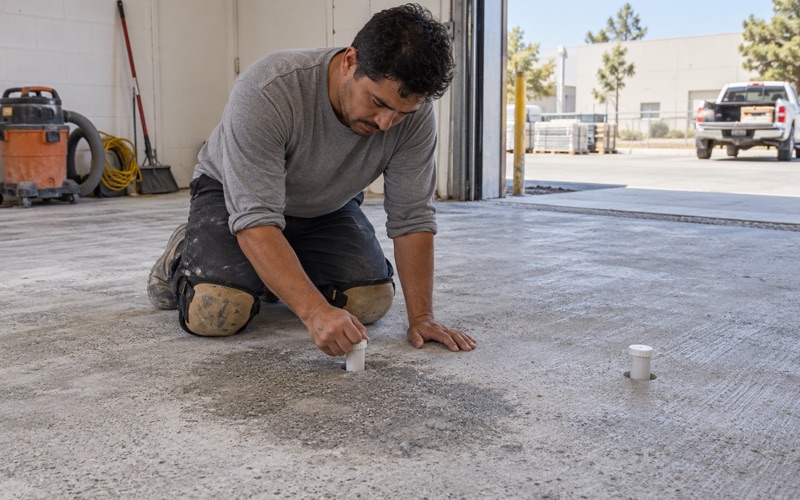
Where the era calls for it we measure rather than guess: in-situ relative humidity to ASTM F2170, which reads the state of moisture inside the slab, or calcium chloride to ASTM F1869, which reads the rate coming out at the surface. Both threshold numbers live in ASTM F710 rather than in the test methods themselves, which is where that citation most often drifts. ASTM D4263 plastic sheet is indicative only and asymmetric — a positive fails a slab, a negative proves nothing. The reading goes into the proposal before material is ordered, because moisture failure is the one thing almost every coating warranty in this trade excludes.
The season decides the product, not just the day
Yucaipa sits at roughly 2,600 feet, and both ends of its published range are operationally real. July and August highs run around 96 to 97 degrees, which pushes pot life toward the short end of the curve — roughly sixty minutes at 55 degrees down to about twenty at 95 on one published product, with the recoat minimum dropping from twenty-four hours to six. January and February lows around 40 to 41 degrees put an unheated garage below the 50-degree minimum application temperature most data sheets state for air, surface and material alike.
The underrated part at this elevation is the swing between them in a single day. A slab that is warm enough at two in the afternoon is cooling by early evening, and a cooling slab pushes outgassed air up into a wet film — which is what produces pinholes and bubbles in a foothill garage and rarely down in the valley. Placing on a rising or steady slab temperature is the fix; placing on a falling one is the failure. We also hold a 5-degree margin above dew point and an 85 percent ceiling on relative humidity before anything goes down.
Category and counter
Product selection runs against South Coast AQMD Rule 1113, which caps floor coatings at 50 g/L VOC and industrial maintenance coatings at 100 g/L and makes the two mutually exclusive. Subsection (c)(6) prohibits applying, or soliciting the application of, an industrial maintenance coating for residential use. With both a large residential base and real industrial product inside one city, that line has to be decided job by job here rather than assumed.
Yucaipa also has its own Building and Safety Division at 34272 Yucaipa Boulevard, which is worth knowing because several communities nearby are permitted through the county instead. For anything that does need a permit, that is a meaningful difference in turnaround — and we confirm current counter hours and fees with the division directly rather than repeating numbers we cannot verify.
- 20+ Years on Inland Empire Concrete
- Every Slab Moisture Tested
- Free Written Proposals