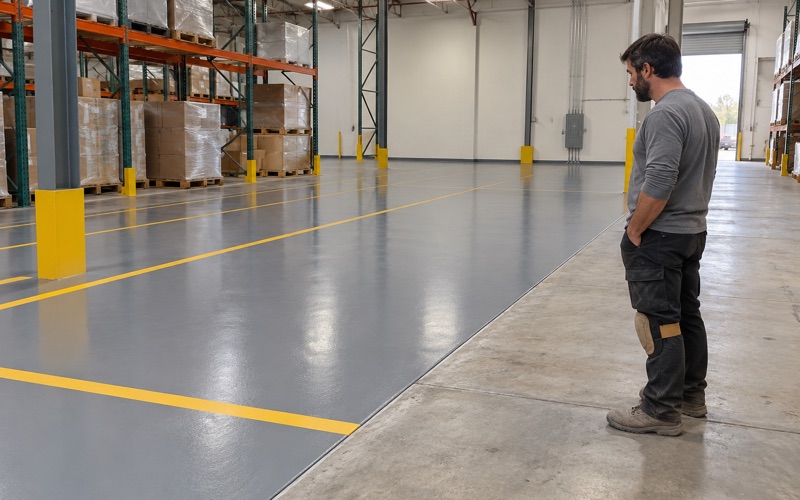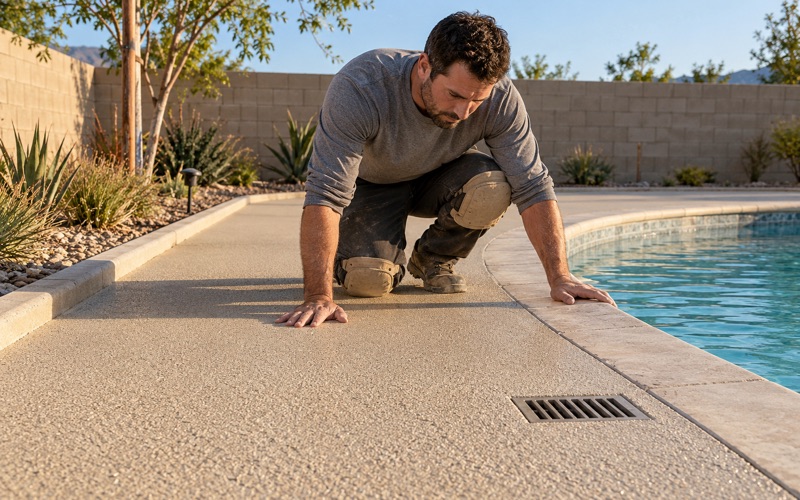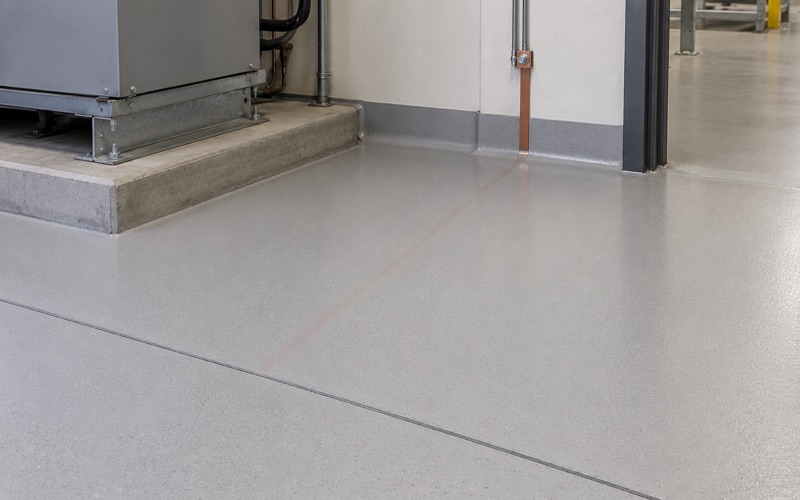
Redlands Epoxy Floors has been installing epoxy flooring in Woodcrest for more than twenty years, and on a large share of the work here the slab is not the problem — the decision is. The concrete is frequently sound, the budget is not the constraint, and what the owner is actually choosing between is finishes that will look very different across a big floor and identical on a two-inch sample chip.
That is a harder conversation than it sounds, and it is the one we spend the most time on in this community. Flake blends, quartz, pearl and metallic effects, gloss level and broadcast density all change how a floor reads at twenty feet, how it cleans, how much grip it has and how forgiving it is of a dropped tool. Those are four different questions, and the prettiest answer to the first is not always the right answer to the other three.
So we show the options as physical boards on your own slab, under your own lighting, before anything is ordered, and the proposal that follows names the system with its product data sheet attached, states the mil build as a number and states the ICRI surface profile we will grind to. One crew takes the floor from grind to topcoat with no subcontracted install, which matters more on a decorative system than on any other kind, because the finish is made by hand rather than supplied in a pail.
Where the Finish Decision Actually Gets Made
A Community of Owners, Not Renters
Woodcrest is about 90 percent owner-occupied and close to 88 percent single-family detached — roughly 4,300 detached houses — with a median household income around $153,731 and a median owner-occupied home value near $786,300. Practically, that means the person picking the floor is the person who owns the building and expects to be looking at the result for a long time, which changes what a good recommendation looks like.
A Younger Slab Changes the Conversation
Close to 30 percent of the housing here went up in 2000 or later, and only a small tail predates 1960. On that newer stock the concrete is usually sound and the specification question is genuinely about the finish rather than about repair. That is unusual for us, and it is the reason this community gets a different first conversation than most.
And No Commercial Half to Speak Of
There are only about 113 multifamily units in the entire community, so there is no parking structure, no podium deck and no shared common-area work here of any consequence. The commercial floors that do exist are retail back-of-house, school facilities and small service commercial along Van Buren Boulevard. We would rather say that than pretend to a segment that does not exist.
Looking for epoxy flooring closer to Banning? See Banning Epoxy Flooring.
Metallic and Pearl, and Why No Two Pours Match
The Pattern Is Made, Not Bought
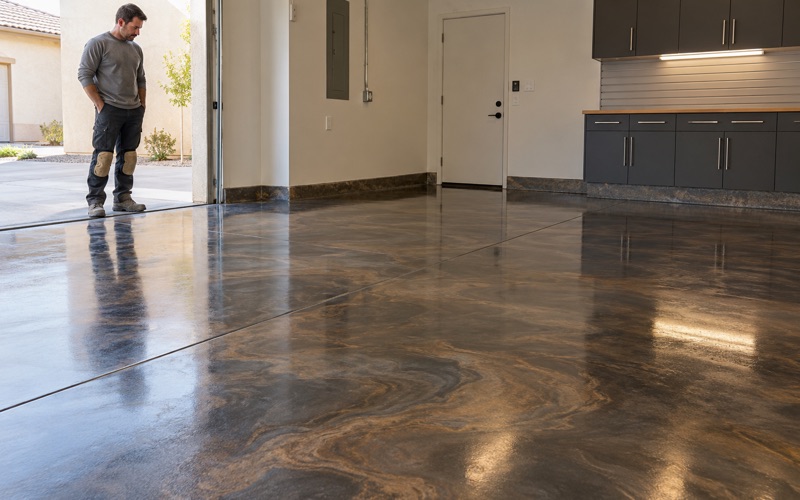
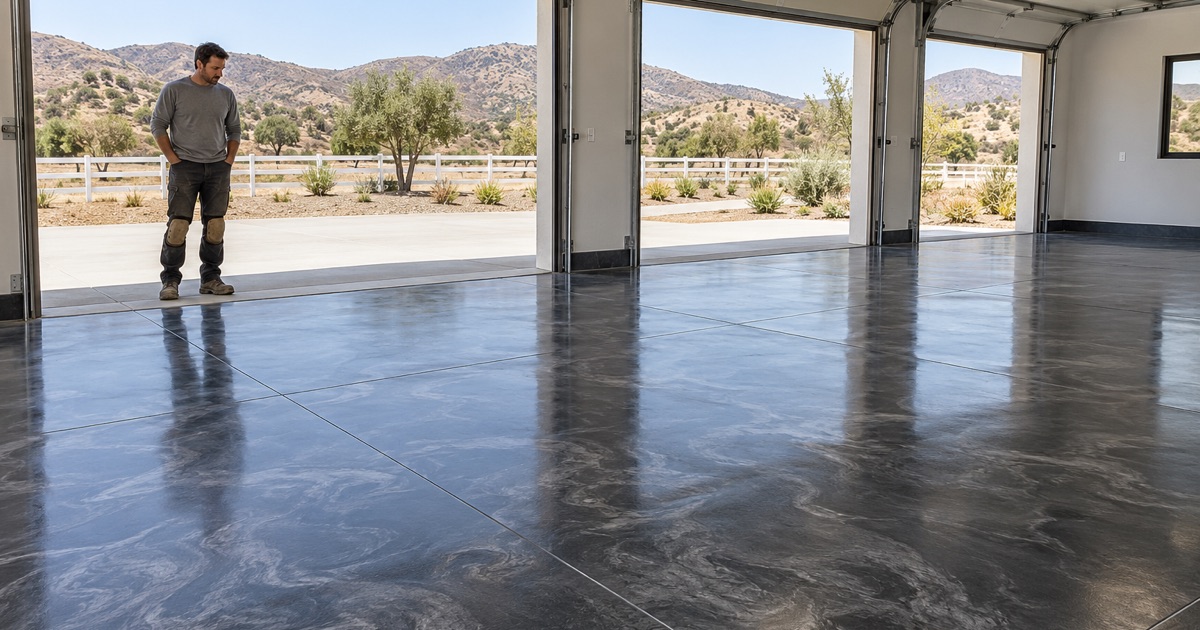
Metallic pigment dispersion moves inside the wet film, so the figure in the finished floor comes from how the material is worked — rollered, brushed, blown, worked back — rather than from what is in the pail. Two floors from the same product, the same color and the same installer will not come out the same, and that is inherent to the chemistry rather than a matter of skill. We show the technique on a board first and we will not promise a repeatable result, because nobody honestly can.
What That Means If the Floor Is Ever Damaged
The flip side of an unrepeatable finish is worth knowing before you buy it: a metallic floor cannot be spot-repaired invisibly. A patch will read as a patch, so a damaged area usually means recoating a whole visual field rather than a square foot. On a large open garage that is a real number, and it belongs in the decision rather than in a later phone call.
Where Metallic Is the Wrong Call
A high-figure metallic is a display surface. In a working shop with jack stands, engine hoists and dropped tools it will show every point load and every mark, and the depth of the effect fights the practical need to see a small dropped part on the floor. Where a building is genuinely used, a flake or quartz system is usually the better floor and we will say so, even though it is the less dramatic board on the table.
Matching a Floor to a Custom House
Lots of an Acre and Larger
Riverside County’s own area plan describes Woodcrest as a predominantly rural community generally characterized by lots one acre and larger, with a substantial estate residential enclave near Mockingbird Canyon Road and commercial uses along Van Buren Boulevard, interspersed with citrus groves. On lots that size the garage is usually visible from the house and from the approach, so the floor is part of how the property reads rather than a hidden utility surface.
Gloss Level Is a Working Decision
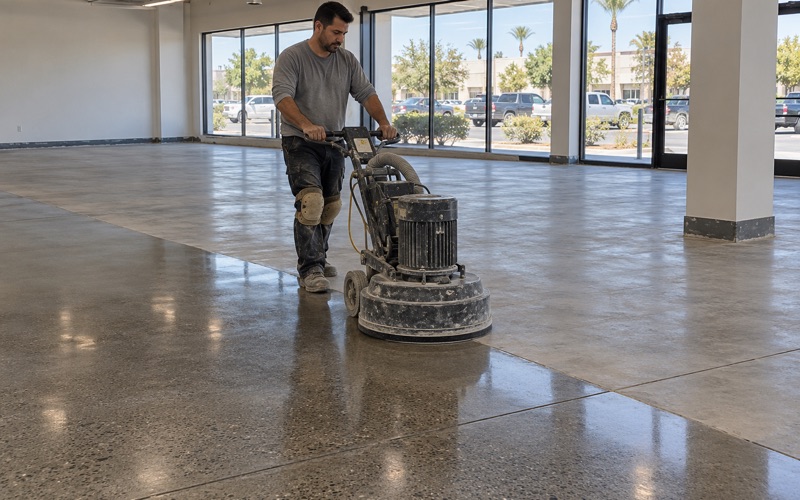
Gloss makes a garage noticeably brighter and shows every scuff, tire mark and film of dust. Satin gives back most of the brightness while hiding traffic. Matte hides the most and reflects least, which matters where a big glazed door puts direct sun onto the floor and glare becomes a genuine nuisance. On a large bay with strong daylight, we usually steer people down a step in gloss from where they start.
Reading a Blend at Twenty Feet
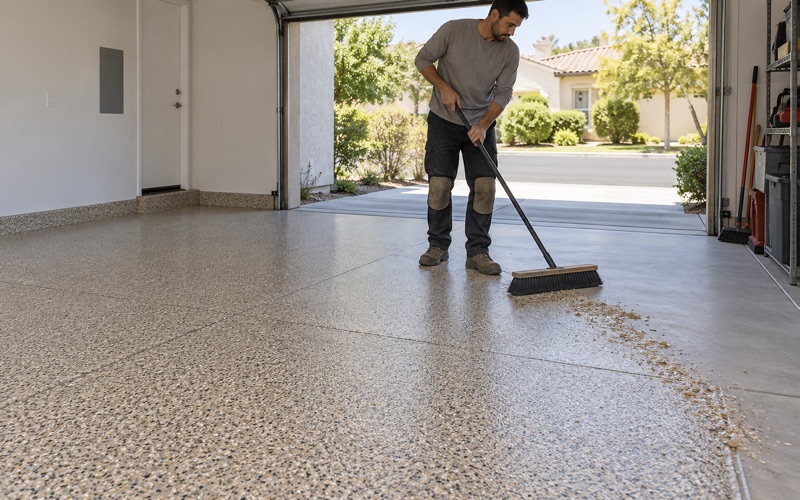
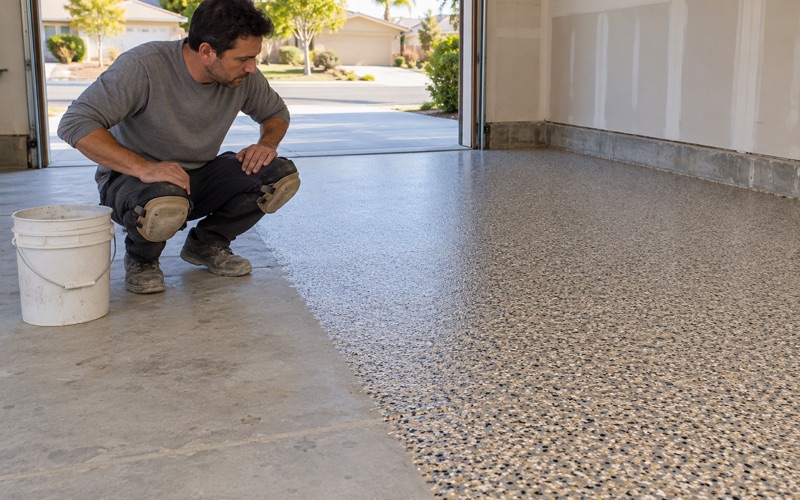
Vinyl flake is sold by blend name, and blend names are chosen to sound good in a catalog. What matters is scale: a blend that looks busy in the hand often settles into an even field across a wide bay, and one that looks calm in the hand can read as visual noise at working distance. Broadcast density is the other half of that — a full broadcast to rejection buries the slab, hides patching and builds texture, while a lighter scatter leaves base color showing and reads closer to stone.
Samples on Your Own Floor, in Your Own Light
A Screen Is Not a Floor
Online visualizers are a good way to narrow a shortlist and a poor way to make a final choice, because screen color is not floor color and no monitor reproduces the depth of a broadcast surface. We bring physical boards and lay them down where the floor is going, then look at them in daylight and again under whatever fixtures the building actually has. Garage lighting is frequently cooler and harsher than the lighting people imagine when they choose.
Mock-Ups on the Big Floors
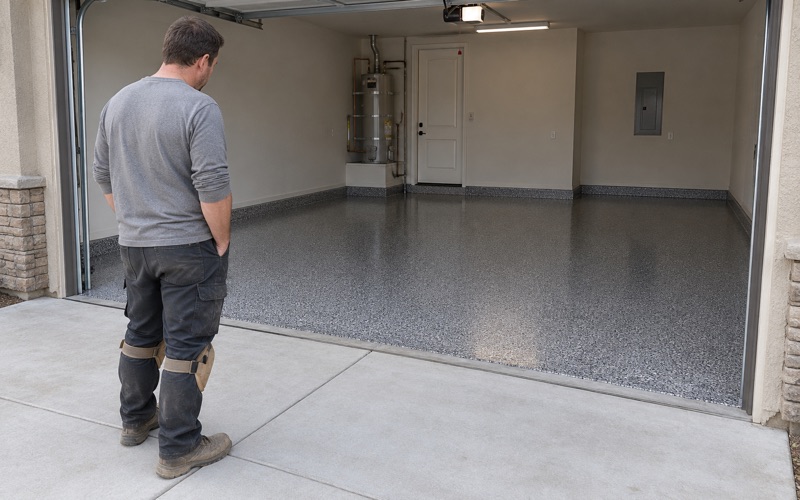
On a large shop or multi-bay garage we will place a mock-up section of the actual system rather than relying on a board at all, so what gets approved is the installed floor rather than a representation of it. That is more work up front and it removes the single most expensive kind of disagreement — the one discovered after the whole floor is down.
Ordered After You Approve
Nothing is ordered before the selection is settled. Blends, pigments and topcoats are specified into the proposal by name with the data sheet attached, so what arrives on site is what you agreed to and the mil build is a number you can hold us to rather than a range. If a product is on a long lead time, you hear that while you are still choosing.
The Workshop, the Barn and the RV Building
One Parcel, More Than One Floor
On acre-plus parcels the coating opportunity is rarely a single two-car bay. A detached shop, an RV or boat building, a barn, a tack room, a covered wash rack and a pool equipment room are all candidates, and they are frequently in worse condition than the house garage because nobody has ever finished them. Quoting only the garage on a property like that undersells the site and usually means coming back.
Barns Are a Different Specification
The county’s rural community designations here state at every lot size that limited agriculture and intensive equestrian and animal keeping uses are expected, and the county describes this area as overwhelmingly rural with a strong equestrian presence. A barn slab takes hoof traffic, urine and manure, daily wash-down and standing water — none of which is the light foot-and-tire duty an attached garage sees. That wants a heavier build, a more aggressive profile, a coved detail where the floor meets the wall so the junction can actually be cleaned, and measured slip resistance rather than an assumption about it. Where a slab was poured to agricultural rather than residential practice, it also gets a moisture reading before anything is specified.
The Legal Line That Catches This Work
South Coast AQMD Rule 1113 caps floor coatings at 50 g/L VOC and industrial maintenance coatings at 100 g/L, treats the two as mutually exclusive categories by definition, and in subsection (c)(6) prohibits applying or even soliciting the application of an industrial maintenance coating for residential use. A workshop or barn on a residentially zoned parcel is a residential property under that rule however industrial the wear on its floor, which is exactly the case that comes up here every week. We make that determination on each job rather than reaching for the product that would be convenient.
Getting Equipment to a Building Three Hundred Feet Back
Long driveways, gates set back from the road and outbuildings sited well behind the house make mobilization here a real line rather than a formality, and some of those approaches are decomposed granite or gravel rather than paved. We confirm surface, length, grade and turning room while quoting. Heat is the other operational constraint: a detached uninsulated shop or barn has no conditioned wall against it, so its slab runs hotter than an attached garage, and with pot life falling from roughly sixty minutes at 55 degrees to about twenty at 95, summer work means early starts and small batches.
Who Issues the Permit Out Here
Woodcrest is an unincorporated census-designated place with no city government and no city building department. Permits and inspections run through the Riverside County Building & Safety Department within the Transportation and Land Management Agency at 4080 Lemon Street in Riverside, filed through the county’s online permit portal, and the governing land use document is the Lake Mathews/Woodcrest Area Plan rather than a municipal code.
- 20+ Years on Inland Empire Concrete
- Every Slab Moisture Tested
- Free Written Proposals