Redlands Epoxy Floors has been installing epoxy flooring in Running Springs and the Rim communities for more than twenty years, and the first thing we will tell you about a job at this elevation is when we cannot do it. There are months of the year when no amount of scheduling makes a conventional epoxy floor cure in an unheated garage here, and saying so is more useful than selling around it.
The work itself is the same work we do in the valley. We measure the slab’s moisture before anything is ordered, we open the concrete mechanically with diamond tooling to a named ICRI concrete surface profile rather than with acid, and the proposal carries the mil build as a number with the product data sheet attached. What changes up here is the temperature the slab will actually be sitting at when the material goes down, and that single variable governs the product, the sequence and the date.
It also governs whether a slab is worth coating at all. A mountain floor that has taken decades of freeze-thaw cycling and tracked road salt can be too weak at the surface to hold any coating, and that assessment is the first scope item on the job rather than a line we add later.
A Garage That Never Warms Up
There are no published climate normals for Running Springs itself. We checked rather than assumed, and the honest position is that the severity of the season here is inferred from the nearest defensible station rather than measured in town.
Ninety-Seven Freeze Days, and Why That Station
The representative station for a ridge community at this elevation is Squirrel Inn 2, at 5,682 feet, which records 97.3 freeze days a year and six months whose mean sits below 50 degrees. It is the right comparison because Running Springs is a ridge town on the wet, south-facing front of the range rather than a basin, and basin sites pool cold air overnight in a way a ridge does not — a station a thousand feet lower can post colder lows for exactly that reason. Running Springs sits at 6,109 feet, so it runs colder than the station we are citing, not warmer.
The Slab Is a Cold Thermal Mass
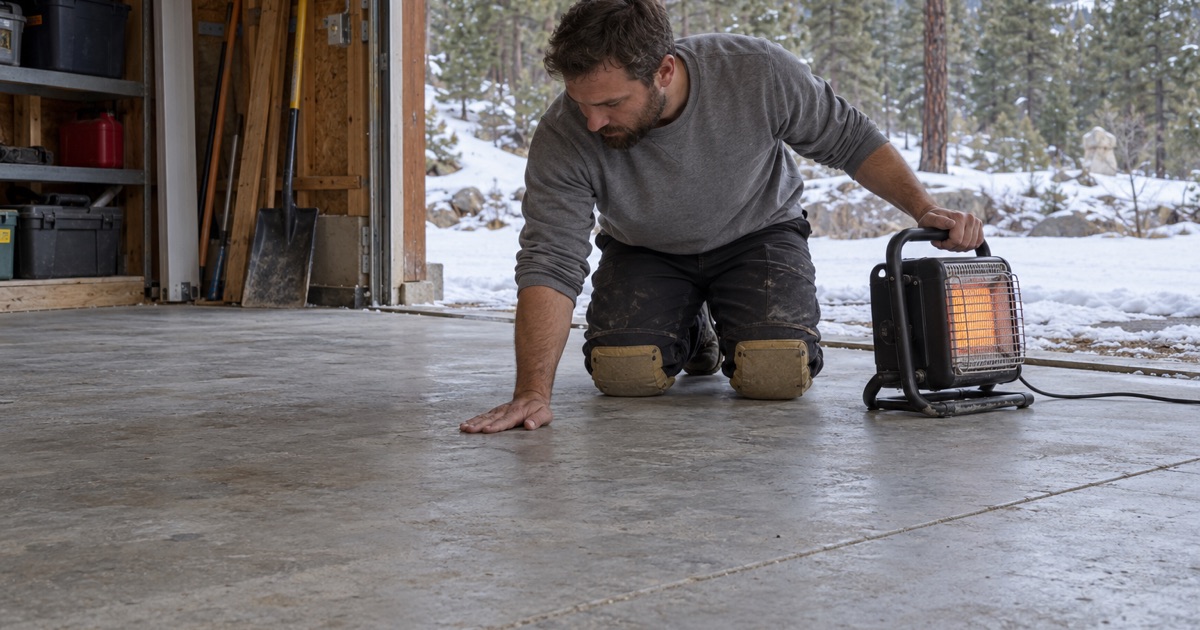
An uninsulated garage slab is not the same thing as the air in the garage. Concrete lags air temperature by hours and holds cold through a sunny afternoon, so a thermometer on the wall reading in the fifties routinely sits over a slab that has not moved out of the forties. We read surface temperature at the concrete with an infrared gun before a decision is made, because the slab is the binding number and it is almost always the lower one.
Ninety-Seven Cycles a Year Working on the Concrete
That freeze count does double duty. Each of those days is a potential freeze-thaw cycle on a slab that, on the older stock here, was very likely placed with no air entrainment at all. What it produces is scaling — flaking or peeling of the finished surface as a direct result of freezing and thawing, and moderate scaling can take an eighth to three-eighths of an inch of surface mortar with it.
Salt Arrives on the Tires
Deicing chemistry makes that worse by increasing surface saturation and multiplying the number of freeze-thaw cycles, and the delivery mechanism is mundane: magnesium-based salts used for pre-snow treatment of the highways get tracked home on vehicles and accumulate on the slab. A properly specified coating over concrete generally fails inside the concrete rather than at the bond line, which is exactly the problem — if the top fraction of an inch of mortar has been weakened by scaling, the coating leaves with it, and the failure looks like a coating defect when it is a substrate defect.
Looking for epoxy flooring closer to Oak Glen? See Oak Glen Epoxy Flooring.
What the Data Sheet Actually Requires
Minimum application temperature is not a rule of thumb in this trade, and it is not uniform across products. It is a published number on a specific technical data sheet, and it is the number that closes the season here.
Fifty Degrees, Air and Surface and Material Alike
The epoxy floor coating we specify most often publishes application conditions of 50 degrees minimum — for the air, the surface and the material in the pail, not just one of the three — along with a maximum relative humidity of 85 percent. An unheated garage at this elevation sits under that floor for a long stretch of the year, and heating the space on the morning of the pour does not fix it, because the slab will still be cold when the resin reaches it.
Five Degrees Above the Dew Point
The same data sheet requires the surface to sit at least five degrees above the dew point, and one manufacturer states the identical rule inverted — dew point five degrees or more below surface temperature. This is the requirement that catches people in spring and fall rather than in January. A cold slab in a humid garage after a storm can be below dew point while the air feels perfectly workable, and the condensation film that forms is invisible and destroys adhesion completely.
Cold Buys Working Time and Costs Return-to-Service
At the low end of the allowed range the chemistry does not stop, it slows. Pot life lengthens, which sounds like a gift, but recoat windows stretch, foot traffic pushes out and full cure runs days longer than the same product manages in a warm shop. On a floor that has to be back in service quickly, cold-end placement is often the wrong trade even when it is technically inside the published range.
Where Polyaspartic Helps and Where It Does Not
Polyaspartics tolerate lower temperatures than most epoxies, and this is the community where that matters most. It is also where the category gets oversold, so it is worth being precise about.
Two Polyaspartics, Two Different Floors
The published minimums are not a category property. One manufacturer lists low-temperature cure at 25 degrees among its product’s features; another publishes a minimum application surface temperature of 40 degrees for its polyaspartic and notes it performs best well above that. Those two floors are fifteen degrees apart, and at this elevation fifteen degrees is most of a working year. We specify by reading the sheet for the actual product, not by trusting the word on the label.
Twenty Minutes of Pot Life on a Steep Site
The price of low-temperature capability is working time. Both of those polyaspartics publish pot life in the region of fifteen to twenty minutes, against hours for the epoxy at the cold end of its range. On a site where material has been hand-carried down from a truck parked on the highway, twenty minutes is a crew-size and batch-size decision made before the job is booked, not a detail handled on the day.
A Two-Coat System Can Have Two Minimums
A base coat and a topcoat are separate products with separate published limits, and they do not have to agree. One manufacturer’s own tested system pairs an epoxy with a floor of 50 degrees under a moisture-cure urethane whose air and surface minimum is far lower, with a separate and higher minimum for the material itself and an instruction that is not hypothetical here: do not apply over surface ice. Only the base coat is the seasonal constraint in that system, which is worth knowing before writing off a whole winter.
A Low-Temperature Rating Is Not a Compliance Rating
SCAQMD Rule 1113 applies on the Rim exactly as it does in the valley — floor coatings at 50 g/L VOC, industrial maintenance coatings at 100 g/L, the two categories mutually exclusive, and subsection (c)(6) prohibiting the application or the soliciting of an industrial maintenance coating for residential use. Cold-weather products are not automatically the compliant ones. We check the category and the limit before we check the temperature, because a product that will cure in February and is not lawful on a residential parcel is not a candidate.
Booking a Season Rather Than a Week
The application window and the access window are two separate constraints here, and both have to be open on the same date. Either one can close without warning, which is why we book mountain work as a target season with a fallback rather than as a fixed day.
Highway 330 Is a Single Point of Failure
State Route 330 climbs 15.422 miles from San Bernardino to the junction at Running Springs on roughly a six percent grade with only three passing lanes, at the 2,200, 4,000 and 5,600 foot marks. It closed for months after a washout in 2010, again from late September to late November 2024 for a $9.8 million emergency repair that required nearly five miles of guardrail to be replaced, and again for ten days in February 2025 after a debris flow off a burn scar. A crew hauling a grinder and a dust-extraction trailer checks the road the morning of, and the detours are genuinely long ways around.
Chain Control Catches a Work Truck Early
Caltrans chain requirements start biting before the weather looks serious. At R-1, chains are required on everything except passenger vehicles and light-duty trucks under 6,000 pounds gross with snow tires on at least two drive wheels — and a loaded work truck pulling a trailer is over that weight. R-2 exempts only four-wheel and all-wheel drive on snow-tread tires all around, and R-3 has no exceptions at all. Caltrans also notes that a highway will often be closed outright before an R-3 condition is imposed.
The Winter That Sets the Standard
The February and March 2023 storms are the reference event, and the county’s own after-action report names Running Springs among the hardest-hit communities: roughly eleven feet of snow between February 23 and March 15, all mountain highways impassable from February 25 to March 2, and hundreds of documented rescues. Nothing comparable had happened since 1933. We do not book firm winter dates here on the assumption that a season behaves.
The One Commercial Window That Lines Up
Snow Valley Mountain Resort’s 2024-25 season ran 128 days, from late November to early April. Floor work in its lodge, rental shop and food outlets can realistically only happen outside that window — which is also the warmest stretch of the year and the only period when the published temperature minimums are comfortably met. That is the rare case where the operational constraint and the chemistry constraint point in the same direction.
The Purest Detached Market on the Rim
Running Springs is a census-designated place with no city government, so the permit authority is San Bernardino County Land Use Services, Building and Safety, rather than a city building department.
Detached Houses and Nothing Else
Of 3,677 housing units, 3,533 are single-family detached — 96.1 percent — with 144 attached and literally zero units in every other category: no duplexes, no small apartment buildings, no large ones, no mobile homes. There is no multifamily stock here at all. Every floor we are asked about is a private garage, a workshop or a small commercial space, which is unusual enough that it changes how the whole market is approached.
A Second-Home Half That Authorizes Remotely
Of those units, 1,333 sit in seasonal, recreational or occasional use — better than a third of all housing — against 1,411 owner-occupied detached houses. The absent-owner half of this market approves work by phone and photograph, gives access by lockbox, and where the property is rented short-term needs a return-to-service window that a ten-day epoxy cure cannot meet and a fast-cure system can. That is a specification consequence, not a scheduling preference.
Older Concrete Still Gets a Moisture Number
999 units here — 27.2 percent — predate 1960, and 618 of them went in during the 1950s, which is the largest 1950s share on this part of the mountain. That is concrete placed before under-slab vapor retarders were routine, so those slabs get an actual reading: in-situ relative humidity to ASTM F2170 or moisture vapor emission rate to ASTM F1869, read against the thresholds in ASTM F710, which is where those numbers live rather than in the test methods. Taping plastic down under ASTM D4263 is asymmetric and cannot clear a slab — a positive fails it, a negative proves nothing.
- 20+ Years on Inland Empire Concrete
- Every Slab Moisture Tested
- Free Written Proposals