Redlands Epoxy Floors installs epoxy flooring in Romoland, and there is one administrative fact about this community that we settle before quoting any job in it: which government has jurisdiction over the parcel. Romoland is the only place in our service area where the answer genuinely varies from one address to the next.
On October 1, 2008 a significant portion of the historic Romoland area became part of the newly incorporated City of Menifee. The rest stayed unincorporated Riverside County. Both halves still carry Romoland addresses and the same 92585 ZIP code, so a mailing address does not tell you whose building department, whose inspector or whose fee schedule applies.
Most contractors never check. It costs nothing to check and it costs real time not to.
We have more than twenty years on Inland Empire concrete and install epoxy, polyaspartic and polyurea systems. Every proposal states the system by name with its product data sheet attached, the surface profile we will grind to, the mil build as a number, and the moisture reading we measured before any material was ordered.
One Community, Two Permit Authorities
What the 2008 Annexation Actually Did
Menifee incorporated on October 1, 2008 and took in a substantial part of what had always been called Romoland. The community’s identity did not change with the boundary — the school district, the place name and the postal address all carried on — but the permitting authority did, for the parcels inside the new city limits and not for the ones outside them.
The Two Offices Involved
For the portion that remains unincorporated, permits and inspections run through the Riverside County Building and Safety Department within the Transportation and Land Management Agency at 4080 Lemon Street in Riverside. For the annexed portion, they run through the City of Menifee’s building department. Those are different counters, different submittal routes and different inspection scheduling, and neither one will process a job that belongs to the other.
Why It Matters on a Floor Coating
Most residential garage coatings do not pull a permit on their own account, so the jurisdiction question often makes no difference at all. It starts to matter the moment a job is attached to something else — a converted or reconfigured garage, a new detached shop, a slab being poured or extended, an electrical run for a compressor. At that point the coating window belongs to somebody’s inspection sequence, and knowing whose it is decides the schedule.
Looking for epoxy flooring closer to Canyon Lake? See Epoxy Flooring Services in Canyon Lake.
Why a 92585 Address Is Not Enough
The Address Follows the Post Office, Not the City Limits
Postal boundaries and municipal boundaries were never drawn to agree with each other, and here they clearly do not. A house can have a Romoland mailing address, sit inside the City of Menifee, and be served by a school district named for Romoland — all three at once and none of them contradicting the others. Reading a jurisdiction off an envelope is guessing.
The Confusion Runs Both Ways
It is just as easy to make the opposite mistake and assume a Romoland address is automatically the city’s, because so much of the surrounding growth is Menifee’s. Romoland’s own school district serves over 4,800 students across roughly 32 square miles reaching into Perris and Menifee as well, and its students go on to a high school with a Menifee address under yet another district. Overlapping service areas are normal here; assuming they line up is not.
How We Settle It
We resolve it by parcel rather than by street name — the assessor’s parcel number and the parcel’s location against the current city boundary, confirmed with whichever office it turns out to be. That happens during the estimate, before a date goes on a calendar. It is a five-minute question that occasionally saves a week.
Checking the Parcel Before the Quote
Two Kinds of Job Under One Place Name
At the 2020 census, close to 59 percent of Romoland residents lived in areas classified as urban and about 41 percent in rural areas, which is an unusually even split for a community of roughly 2,000 people across 2.6 square miles. In practice that means two very different jobs: a 1990s tract garage on a normal driveway, and a detached shop or barn on a larger parcel with a long drive and a real equipment access question. The same phone call can produce either one.
Equipment Access on the Rural Side
On a larger parcel the constraint is physical rather than administrative. A planetary grinder, a dust extraction rig, a generator and material all have to get to the building, which means driveway grade, surface, turning space at the end and whether a trailer can reverse to the door are all worth confirming at the estimate. Dry grinding with HEPA extraction is the safer default where there is no municipal supply to draw from and no drain to be careless around.
What the Written Read Includes
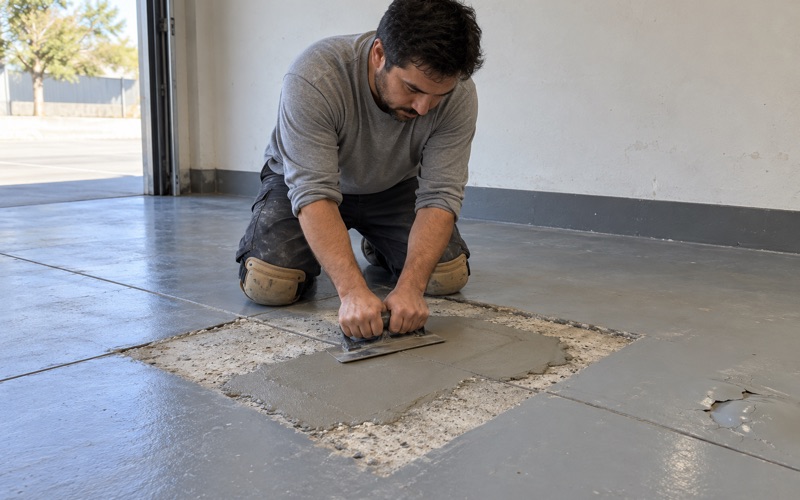
Every cracked, spalled or oil-soaked slab gets an assessment in writing before anything is sold, including the case where the answer is that coating it is the wrong money. Oil that has migrated deep into concrete keeps moving upward and breaks the bond of whatever goes over it, so on a badly saturated floor we will recommend a test patch or a partial replacement rather than take the job and hope.
A Single-Decade Housing Stock
About Forty-Five Percent Built in the 1990s
Romoland’s housing is concentrated in a way that makes the typical scope unusually predictable. Roughly 45 percent of its 668 or so units went up in the 1990s and about two-thirds date from 1980 through 1999. This is a small census place and the ACS margins are wide enough that the precise percentages should not be treated as a city-scale figure, but the direction is unmistakable: overwhelmingly detached, overwhelmingly owner-occupied, overwhelmingly late-twentieth-century.
What a 25-to-45-Year-Old Slab Presents
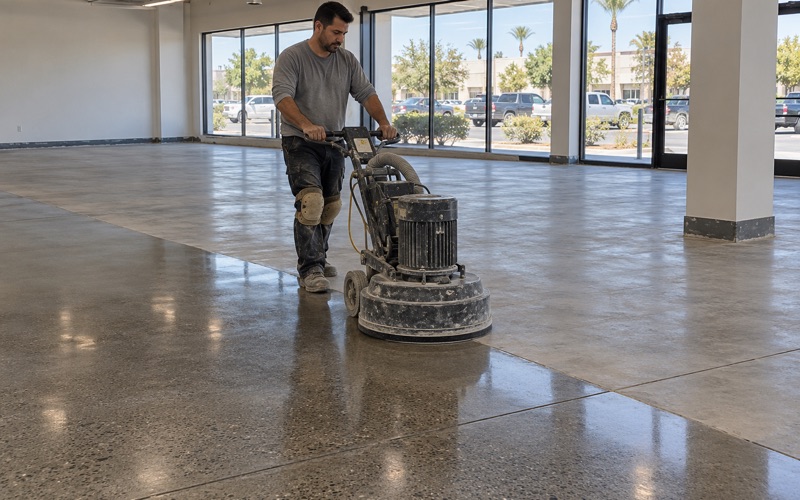
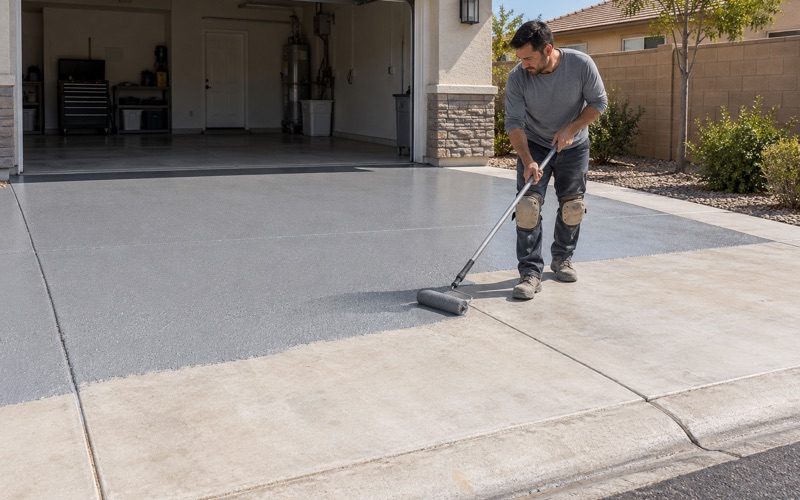
Expect a garage slab that has settled and opened at its control joints, is oil-saturated at the parking positions, and very often carries a failed one-part paint or a big-box kit from an earlier owner. Removing that prior coating is frequently the actual scope of work. PCD tooling shears a soft film off without gouging the concrete underneath, and the sequence then steps down through finer grits to leave a profile the new system can key into rather than a scarred slab that needs its own repair.
Ground, Never Etched
Nothing here gets opened with acid. Acid softens a surface layer rather than profiling it, and a coating keyed into that layer releases in sheets the first time a warm tire sits on it — which is exactly how most of the failed kits we remove came to fail. Every slab is opened with diamond tooling to a named ICRI concrete surface profile, with grit sequence and diamond segment bond hardness matched to the concrete in front of us.
Testing Rather Than Assuming
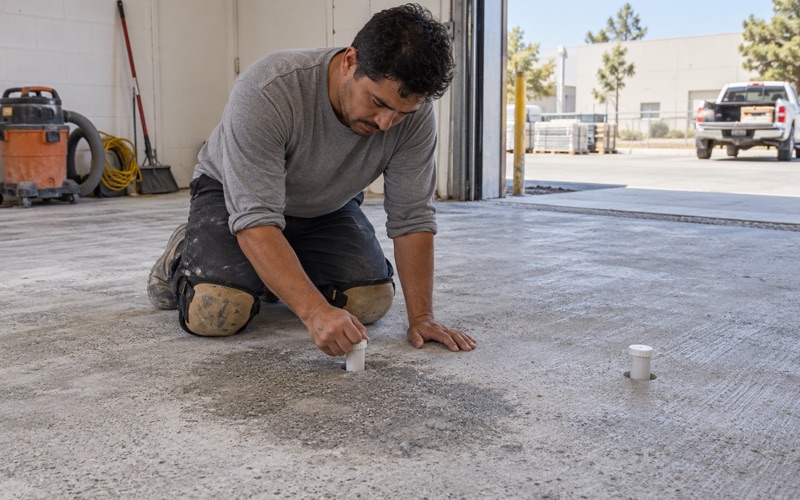
A slab of this vintage was placed after under-slab vapor retarders became routine, but that is a probability rather than a guarantee, and detailing at edges and penetrations is not visible from the surface. We take a reading either way: in-situ relative humidity to ASTM F2170, or a surface emission rate with calcium chloride to ASTM F1869, read against the thresholds in ASTM F710 — the standard that actually holds those numbers, rather than either test method. Moisture is the one failure almost every coating warranty in this trade excludes, which is why the reading goes into the proposal as a number.
The Industrial Corridor Next Door
A Neighbor’s Corridor, Not This Community’s
The nearest large-scale floor market is Menifee’s Northern Gateway economic development corridor along Ethanac Road, roughly 594 acres planned at about a 90 percent industrial mix and running from Interstate 215 west toward Goetz Road, with warehouse projects already filed. It sits minutes from Romoland and belongs to Menifee. Naming it accurately matters, because it is the kind of adjacency contractors routinely claim as their own.
New Construction Is a Different Scope
A coating on a newly placed industrial slab is not a recoat conversation. Concrete under about twenty-eight days old and concrete that has simply never been tested are two separate problems, and the two moisture methods answer two separate questions — ASTM F1869 reports a rate of emission at the surface, ASTM F2170 reports the state of the concrete at depth. Getting that distinction right, and reading both against ASTM F710, is what keeps a new-construction floor from blistering in its first summer.
The Institutional Work Attached to Romoland
The realistic repeat account here is not a warehouse. Romoland School District runs six schools across roughly 32 square miles under one facilities budget, and kitchens, custodial and mechanical rooms and maintenance shops across six campuses are maintenance-schedule work with a planning cycle rather than a homeowner purchase. There is no apartment stock, no hospital and no auto row attached to this community, and a page that invented one would be caught out by anyone who lives here.
Which Product Line Applies
South Coast AQMD Rule 1113 governs coating VOC content across this whole area, holding floor coatings to 50 g/L and industrial maintenance coatings to 100 g/L as mutually exclusive categories. That is why residential and commercial work here are quoted from separate product lines rather than from one price sheet, and why the building a floor sits in is part of the specification rather than an afterthought.
A Farming Town Under the Tract Houses
Worth knowing while standing on one of these slabs: the first Ethanac post office opened in 1900, and in 1925 the town became Romola Farms, laid out by an insurance company around small ranches growing figs and grapes. The Motte family’s Romola Farms barn off Highway 74 now operates as a museum. Most of the concrete we work on here is fifty years younger than that history, which is exactly why the scope is so consistent.
- 20+ Years on Inland Empire Concrete
- Every Slab Moisture Tested
- Free Written Proposals