
Redlands Epoxy Floors has been grinding and polishing concrete across Redlands, CA for more than twenty years, serving surrounding cities including Mentone, Highland, Loma Linda, Yucaipa and Calimesa. Polished concrete is the only floor on our list that adds nothing to your slab: no film, no mil build and no resin layer, because the finished floor is the concrete that was already there, cut open and refined until it holds a shine.
That one structural fact drives everything else. With no coating on the surface there is no bond line, which means the failure modes that dominate the rest of this trade cannot occur: nothing delaminates, nothing blisters, and no warm tire lifts anything. It also means the slab itself has to be worth exposing, because concrete polishing is subtractive work and there is nowhere to hide.
So every decision on this page comes down to two questions: how deep we cut, and how fine we finish. The slab sets the ceiling on both, and we would rather find that out on a test patch than halfway across your floor.
Polishing Is Not a Coating
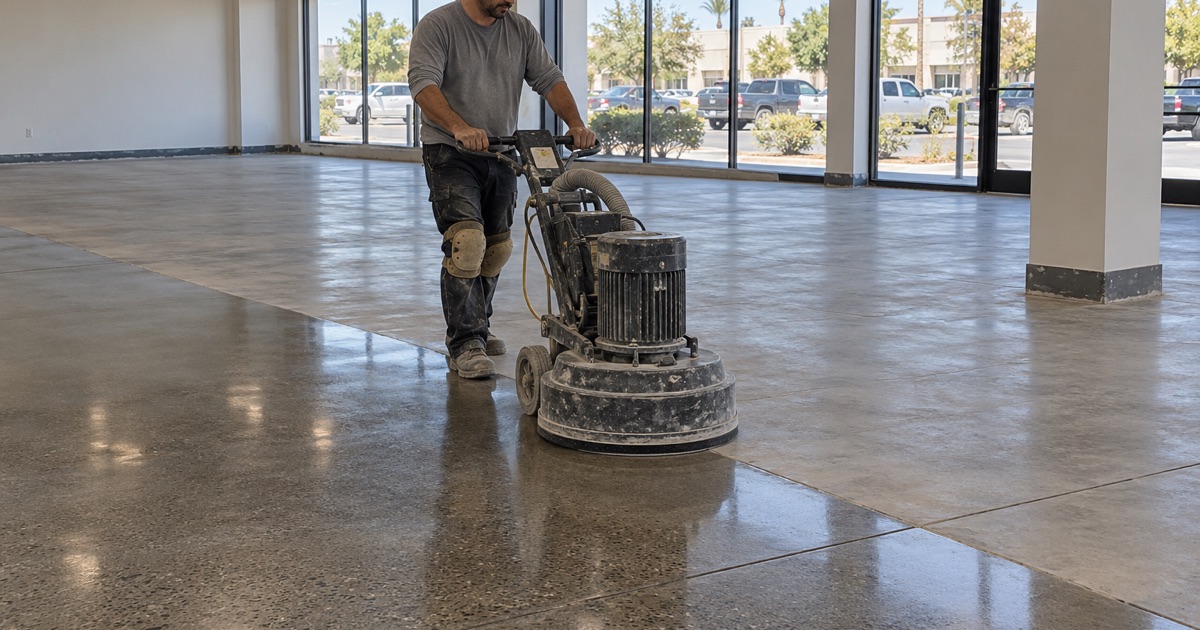
Grinding Down Rather Than Building Up
Diamond tooling removes the soft surface layer of cement paste, then successively finer abrasives cut the scratch pattern down until the surface reflects light instead of scattering it. What you see in a finished floor is not gloss sitting on top of concrete, it is concrete made flat and dense enough at a very small scale to behave optically like polished stone. Nothing was applied to make that happen.
A Densifier Is Not a Sealer
A lithium silicate densifier penetrates the surface and reacts chemically with the free calcium hydroxide left over from cement hydration, forming additional calcium silicate hydrate inside the concrete. The slab comes out genuinely harder and less porous than it went in, which is what allows the fine grits to take a polish rather than dusting the surface away. Timing matters as much as product: applied too early it closes the surface before the cut is finished, and applied too late the polish never sets up.
What Moisture Does to a Floor With No Film
A polished floor breathes. Vapor rising through the slab has nothing to push against, so a floor that failed a moisture test for an epoxy system is very often still a strong candidate for polishing. We still take the reading, using in-situ relative humidity probes to ASTM F2170 or calcium chloride to ASTM F1869 against the thresholds in ASTM F710, because the number changes a different set of decisions here. High moisture carries mineral salts to the surface as efflorescence and blotches a dyed floor.
Aggregate Exposure and Gloss Are Two Separate Choices
Cream, Salt and Pepper, or Full Stone
How deep we cut decides what you see in the floor. A cream finish barely breaks the surface and keeps the trowel history and color variation of the slab intact. Cutting further exposes the fine sand for the familiar salt-and-pepper look, and going deeper again opens the large aggregate into something close to terrazzo, which is the most dramatic result and also the least forgiving.
The Slab Sets the Ceiling, Not the Sample Board
Exposure is limited by how the concrete was originally placed. Where the cream layer is thick and uneven, a medium cut comes up patchy in one area and heavy in the next, and old trenches, patched sections and the shadows left by rebar chairs all surface as the cut goes deeper. We grind a test patch in an inconspicuous corner before agreeing an exposure, because the photograph in a brochure is somebody else’s concrete.
Gloss Is How Fine, Exposure Is How Deep
The polished concrete gloss level is set by where the grit sequence stops. Stopping early leaves a honed, matte surface that reads soft and hides traffic well, while carrying the sequence through the finest resin-bond abrasives produces a high reflection that shows every footprint until it is dust-mopped. The two axes are independent, which is why a full aggregate exposure at a matte finish and a cream finish at a high gloss are both normal specifications.
Our Step-by-Step Concrete Polishing Process
1. Test-Grind, Read and Map
We grind a patch, take the moisture reading, scratch-test the surface to gauge how hard the concrete actually is, and mark every crack, joint, patch and drain. Slab hardness drives the tooling selection for the whole job, and getting it wrong is the usual reason a rented machine spins across a floor without cutting anything.
2. Open the Floor
Metal-bond diamonds do the cutting, working through a planned grit sequence with each pass run across the direction of the last so the previous scratch pattern is removed rather than partly blended into the new one. Skipping a step saves an hour and shows up permanently, because a coarse scratch left in the surface will not lift out at the fine end.
3. Repair Once the Concrete Is Honest
Cracks and spalls are repaired after the first cut, not before, because grinding is what reveals their true extent. Control joints that hard-wheel traffic will cross get a semi-rigid joint filler so the edges are carried rather than breaking down. Patch material is matched against the newly exposed aggregate, since anything that matched the dirty slab will be wrong once the floor is polished.
4. Densify at the Right Point in the Sequence
The lithium silicate goes down when the surface is open enough to accept it and closed enough to hold it. It is spread, kept wet for the dwell time on the data sheet, worked in and the residue removed. This is the step that gives the floor its abrasion resistance, it is invisible when done, and it is therefore the step most often shortened on a floor bid on price.
5. Polish, Then Guard If It Earns It
Resin-bond abrasives take the floor through the fine end of the sequence to the gloss agreed at the start. Where the floor will see food, oil or wine, a penetrating stain guard goes on last. It is not a topcoat and does not meaningfully change the gloss; it buys cleanup time before a spill becomes a stain.
Where a Polished Floor Fits
Warehouses, Retail and Institutional Slabs
On a commercial floor the argument is life cycle rather than looks. There is no coating to recoat, no film for a pallet jack to chip, and routine maintenance is an auto-scrubber rather than a contractor with a schedule. Because a densifier is a reactive treatment rather than a film build, the coating category question under SCAQMD Rule 1113 that governs our resinous work barely arises here, and the only product on the floor with a VOC content worth discussing is the guard.
Houses, Additions and Converted Garages
Residentially, polished concrete works best where the slab was placed with polishing in mind, or where a main floor is being opened up and the existing concrete is flat and sound. It sits well over radiant heat because there is no insulating film between the tubing and the room. In a converted garage the usual constraints are the slope built into the slab toward the door and whatever trench was cut when somebody added a drain or a sub-panel.
The Slabs We Turn Down
Soft, dusty, under-cured concrete will not take a polish however many passes it gets, because the surface keeps giving way underneath the abrasive. A slab that is heavily patched, one with real unevenness across it, or one where a previous coating was taken off with aggressive tooling are all cases where the finished floor will look like what it is. We say that before you spend the money, and often a coating over a properly repaired surface is the better floor.
Living With Polished Concrete
The Care Program Is Genuinely Short
Dust mopping and a neutral-pH cleaner is essentially all of it. What wears a polished floor is grit working as an abrasive underfoot, so walk-off matting at the entries protects the finish more than any product sold for the purpose. Both alkaline and acidic cleaners dull the surface over time, and the labels almost never say so.
Acids Etch It, Because It Is Still Concrete
A polished floor is hard and dense, but it is not chemically inert. Wine, citrus, vinegar and a good number of bathroom cleaners will etch the surface and leave a dull mark that has to be polished out rather than wiped up. A penetrating guard slows absorption and buys time, and nothing available turns concrete into a material that shrugs off acid.
Concrete Still Moves
Polishing does not stop a slab from doing what slabs do. New cracks can appear in a polished floor exactly as they would in a bare one, and any repair is more visible than it would be in a rough floor, precisely because the surface around it is refined. That is worth knowing before you commit, which is why we walk the slab with you and point at the cracks.
Re-polishing Instead of Replacing
The real advantage of a subtractive floor arrives years later. A tired or scratched polished floor is re-honed and re-polished in place at the fine end of the sequence, with nothing to strip and no cure to wait out. That is a different economic proposition from a coating that has to be removed before its replacement can go down.
- 20+ Years on Inland Empire Concrete
- Every Slab Moisture Tested
- Free Written Proposals