Redlands Epoxy Floors installs epoxy flooring in Perris, and a large share of the calls we take here come from someone who will never park on the floor. Perris has roughly 3,372 renter-occupied detached houses — considerably more single-family rental stock than the neighboring cities in this ring — and the owner of a rented house buys a garage floor for reasons a resident owner does not.
That changes the specification and it changes the schedule. A landlord is buying a surface that survives tenants nobody screened for their parking habits, cleans without a routine, and does not need attention again for a long time. A property manager is buying a vacancy window measured in days, because the floor is competing with paint, carpet and a listing date.
We have more than twenty years on Inland Empire concrete, install epoxy, polyaspartic and polyurea systems, and quote residential and commercial work from separate product lines. Every proposal states the system by name with its data sheet attached, the mil build as a number, the profile we will grind to, and the moisture reading we took.
Three Thousand Rented Houses
The Two Pools Sitting Side by Side
Perris holds around 20,095 housing units, of which about 79 percent are single-family detached. Roughly 12,000 of those detached houses are owner-occupied and about 3,372 are rented. The second number is what makes this city different: it is a genuine, repeatable channel of owners who are not occupants, and it wants a different sales conversation and a different floor.
What the Owner Is Actually Buying
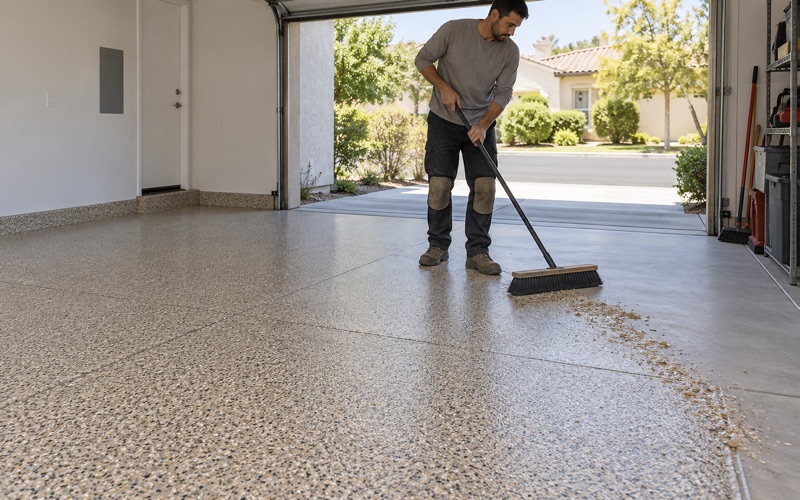
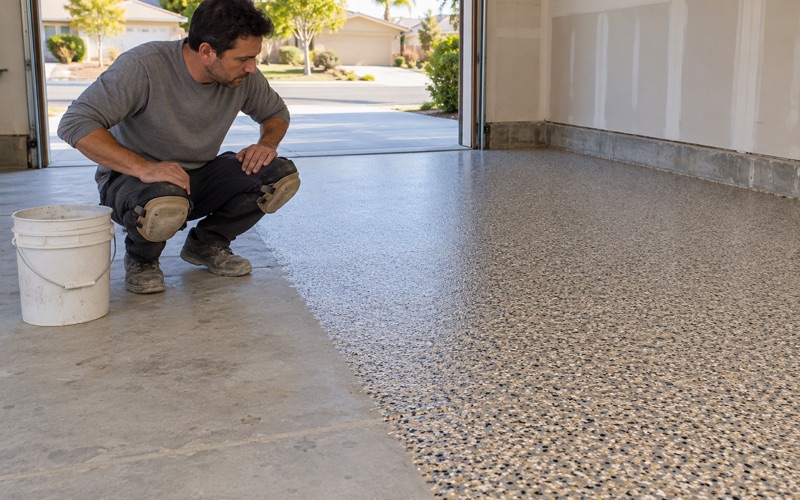
A resident owner is often buying the look of the garage. A rental owner is buying durability, cleanability and the absence of a future phone call. Flake blend and gloss level still matter, but they matter as maintenance decisions — a full broadcast hides patching, tire marks and color variation far better than a solid color, and a satin sheen keeps a garage bright while forgiving the scuffs a solid gloss would advertise.
Turnover Is the Deadline
Make-ready work runs on a clock that belongs to the listing, not to us. Where the slab is sound, a polyaspartic system with recoat windows measured in hours makes a genuinely fast turnaround possible. Where it is not — coating removal, crack work, a moisture vapor barrier primer — that adds days, and we would rather tell an owner at the walkthrough than discover it while a unit sits empty.
Looking for epoxy flooring closer to Lake Mathews? See Lake Mathews Epoxy Flooring.
Coating Between Tenants
An Empty Garage Is the Only Easy Garage
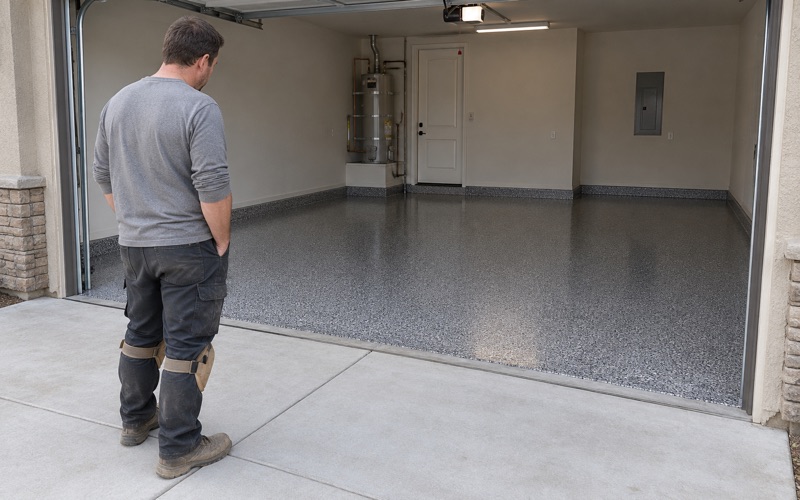
The single biggest schedule risk on occupied residential work is a slab that is not clear. Between tenants that problem disappears, which is why make-ready is the best window this work ever gets. We identify anything anchored into the floor before day one — a shelving unit, a water heater platform, a bolted bench left behind — rather than finding it when the grinder is already running.
What a Previous Tenant Left in the Concrete
Oil at the parking positions is the standard finding, and it has to be drawn out before anything is placed, because resin does not bond through contamination. We degrease, grind, and where saturation runs deep we test a patch before committing the whole floor. Where a section is genuinely beyond recovery we say so, in writing, rather than coating over it and letting the failure surface after the new tenant moves in.
Removing What the Last Owner Rolled On
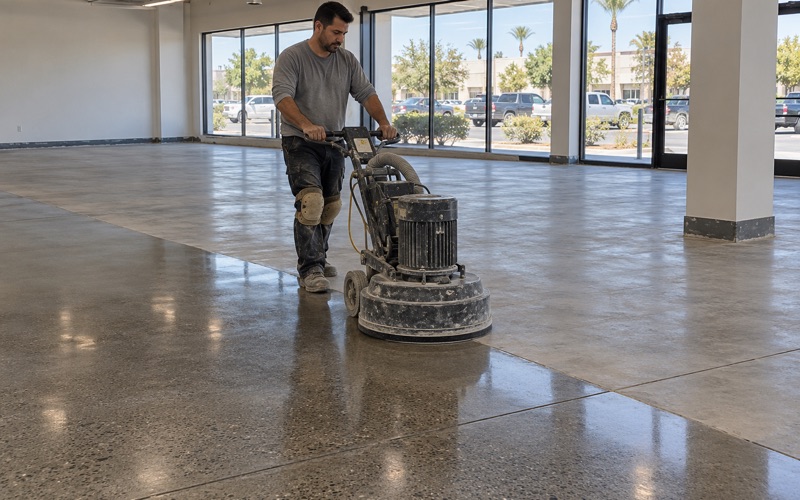
A rented garage often carries a one-part paint or a big-box kit applied by somebody in a hurry. Coating removal is a tooling problem before it is a labor problem: PCD tooling shears a soft film off without gouging the concrete, and the sequence then steps down through finer grits to leave a profile the new system can key into. Aggressive removal that scars a slab creates a second repair before the first one is finished.
What a Rental Floor Needs That an Owner’s Floor Does Not
Build, Not Beauty
Hot tire pickup is the failure that ends most rental garage floors, and it is a bond and chemistry problem rather than a thickness problem. A properly profiled slab under a 100% solids epoxy at the specified mil build, topped with a polyaspartic, resists it. A thin film over an acid-etched surface does not, which is why nothing here is opened with acid and why the mil build appears in the proposal as a number rather than as an adjective.
Texture That Survives a Mop and a Stranger
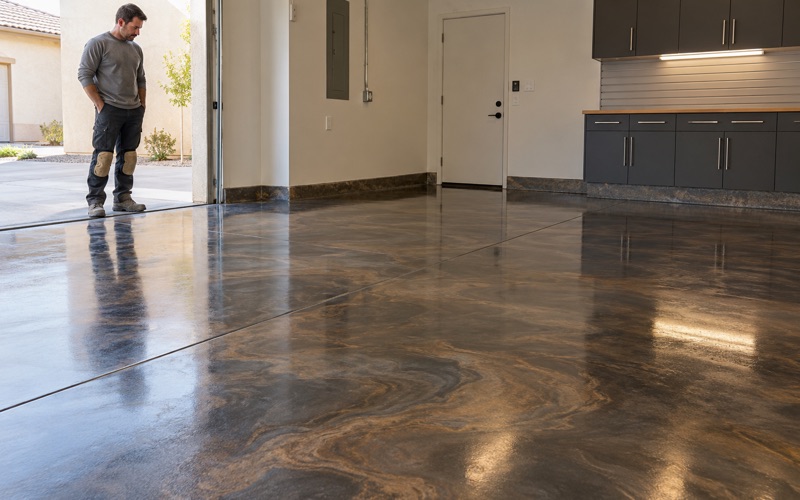
Slip resistance is a measurement rather than an adjective, and DCOF is the figure to ask for. On a rental we aim for a texture that stays safe when a washer overflows without becoming impossible to clean, because the surface has to work for whoever lives there next rather than for the person who chose it.
Documented for the Next Owner of the Problem
Property managers change, staff change, and a floor with no paper trail becomes an argument later. Our proposals carry the system name, the data sheet, the profile, the mil build and the measured moisture reading, which means whoever inherits the building can see what is on the slab and what it can be recoated with. That matters more on a portfolio than on a single house.
Working With a Portfolio Rather Than a Homeowner
Several Doors, One Specification
An owner with a handful of houses does not want a bespoke decision on each one. We will settle a standard specification — the same base, the same broadcast, the same topcoat — so units come out consistent, quotes are comparable and a repair to one floor matches the rest. Where a particular slab needs a primer or crack work, that comes out as an exception on that address rather than being folded into a blended rate.
The Common Areas Nobody Owns Individually
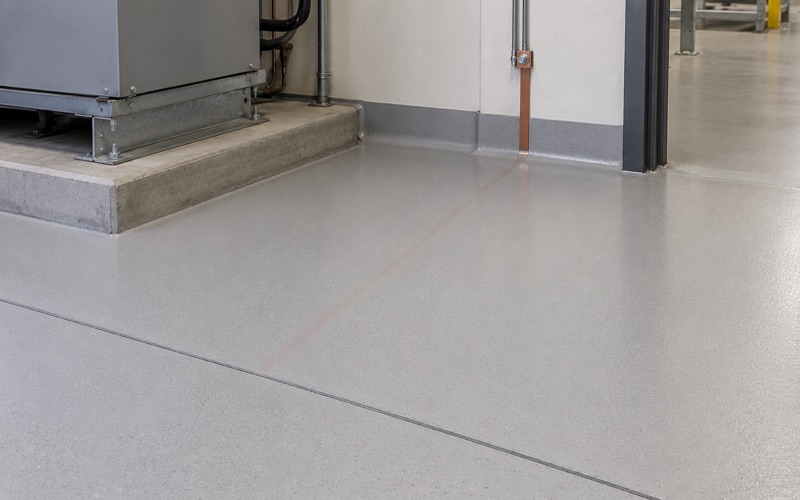
Perris also carries around 2,381 multifamily units, including roughly 692 in structures of fifty units or more, which is the largest such stock among the communities in this part of our service area. Laundry rooms, stairwells and landings, trash enclosures and maintenance shops are maintenance-schedule work with a repeat cycle rather than a one-off job, and they are quoted against an operating budget instead of a homeowner’s project.
Which Product Line a Job Falls Into
South Coast AQMD Rule 1113 caps floor coatings at 50 g/L VOC and industrial maintenance coatings at 100 g/L, treats the two as mutually exclusive, and in subsection (c)(6) prohibits applying or soliciting the application of an industrial maintenance coating for residential use. A rented house is residential; so is an apartment complex’s resident parking. A distribution floor is not. In a city carrying this much of both, that boundary gets decided job by job rather than assumed.
A Logistics Economy That Is Built, Not Planned
Warehouse Floors Are a Different Trade Problem
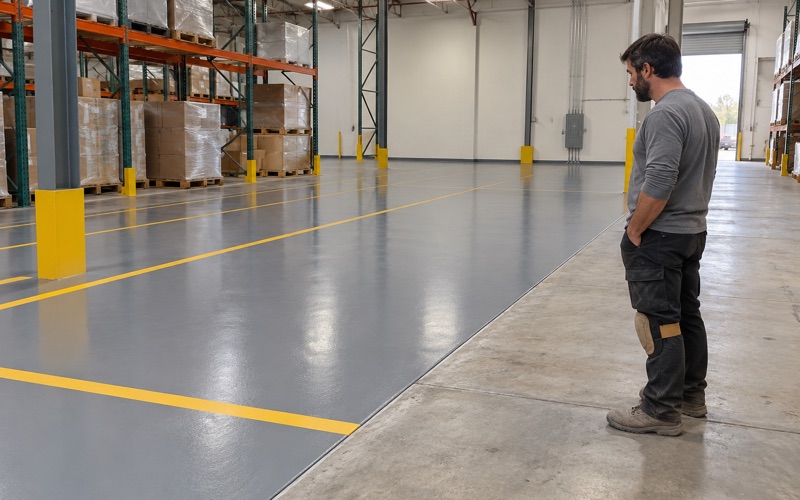
Four of the ten largest employers listed in the city’s 2022 annual financial report are distribution operations, and Ross Stores runs a Southwest distribution center here of roughly 1.6 million square feet. Those floors are a different job from a garage: joint filling and armored joints, moisture mitigation across very large slab areas, a profile specified by the coating system rather than by habit, and shutdown windows counted in hours. ICRI concrete surface profiles run 1 through 10, not 1 through 9 — CSP 10 arrived in the 2013 revision of 310.2R, and getting that scale wrong in a submittal is a tell.
Two Claims That Do Not Survive Checking
Distribution and food-handling work invites two pieces of received wisdom that are simply false. There is no USDA product approval for flooring: 9 CFR 416.2(b)(2) is written in performance terms and no federal approval list exists. And OSHA 1910.176(a) requires that aisles be kept clear and appropriately marked while specifying no stripe width and no color at all — the familiar figure comes from an interpretation letter and long convention. We would rather be the contractor who tells you that than the one repeating it.
Heat, Not Wind, Is the Local Constraint
Perris sits on the valley floor at about 1,453 feet, roughly 850 feet below Banning and more than a thousand below the pass cities, so it runs hotter in summer than either. Slab temperature is the governing variable: pot life on one published product falls from around sixty minutes at 55 degrees to forty at 72 and about twenty at 95, with the recoat minimum collapsing from twenty-four hours to six. Summer work here means early starts, small batches and a thermometer on the concrete rather than in the air. The persistent gusty wind regime that shapes scheduling further east through the San Gorgonio Pass is not a Perris condition, and we do not schedule around one that is not there.
The Widest Winter Window in This Part of the Valley
The other side of that elevation is the useful one. At 1,453 feet an unheated Perris garage is not routinely sitting below the 50-degree minimum that most systems specify for air, surface and material, or below the requirement that the surface stay at least five degrees above the dew point. Compared with the pass cities and the mountain communities, the winter application window here is genuinely the widest we work in, which makes January a practical month to schedule rather than one to argue about.
Permits and the Local Authority
Where a permit is needed, it comes from the City of Perris Building and Safety Division within the Development Services Department at 135 N. D Street, which runs plan check, permits and inspections and operates an online permit portal. Most residential garage coatings do not pull one on their own; commercial and tenant improvement work generally does, and the coating window then sits inside somebody else’s inspection sequence rather than ours.
- 20+ Years on Inland Empire Concrete
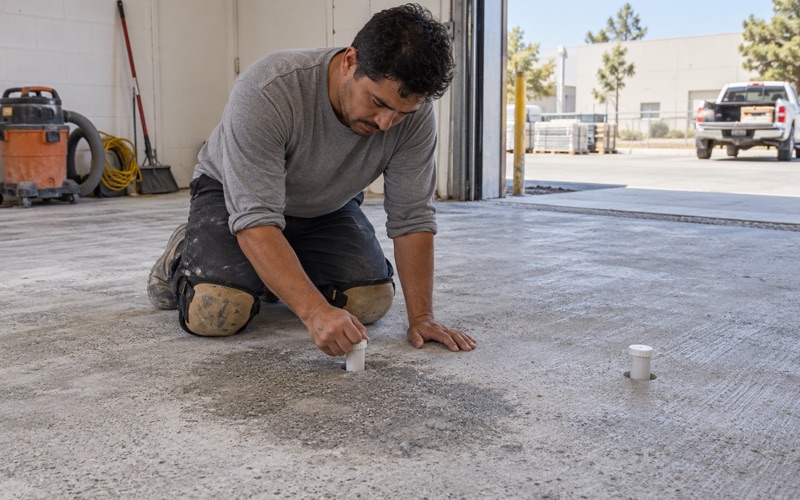
- Every Slab Moisture Tested
- Free Written Proposals