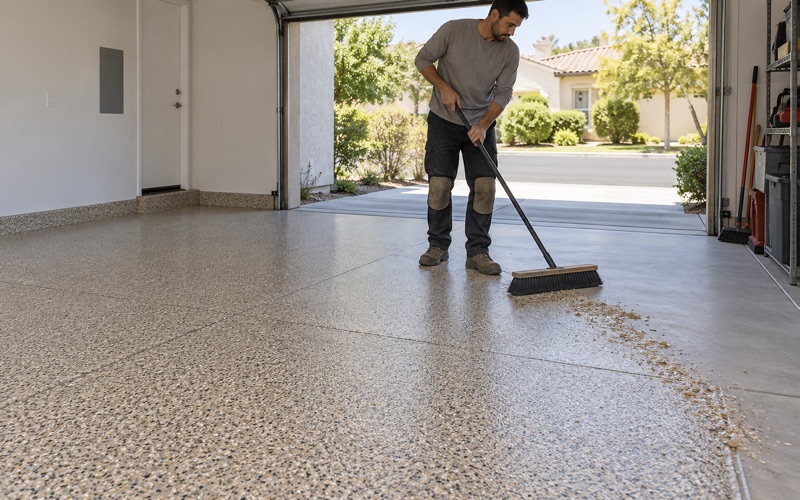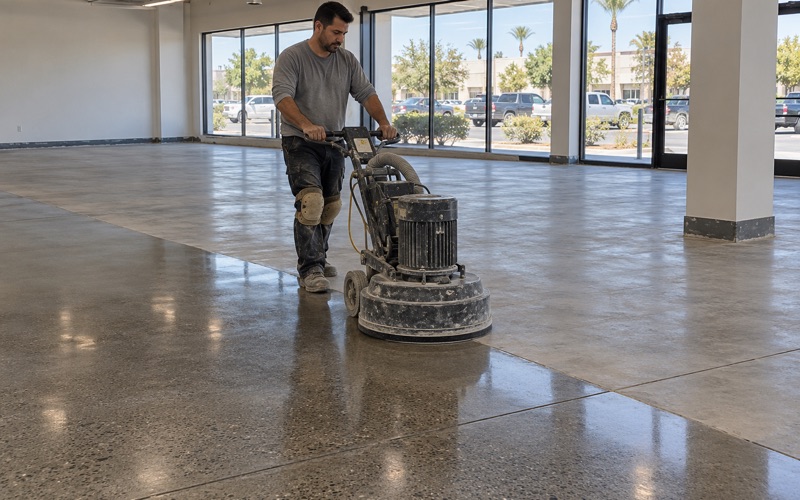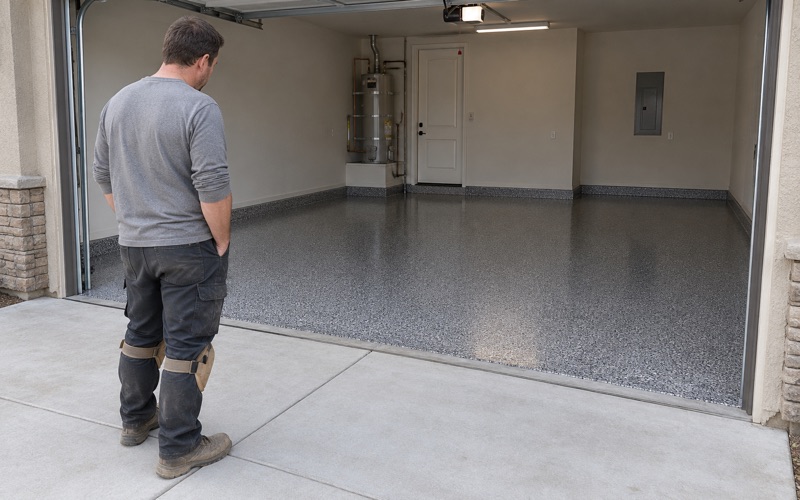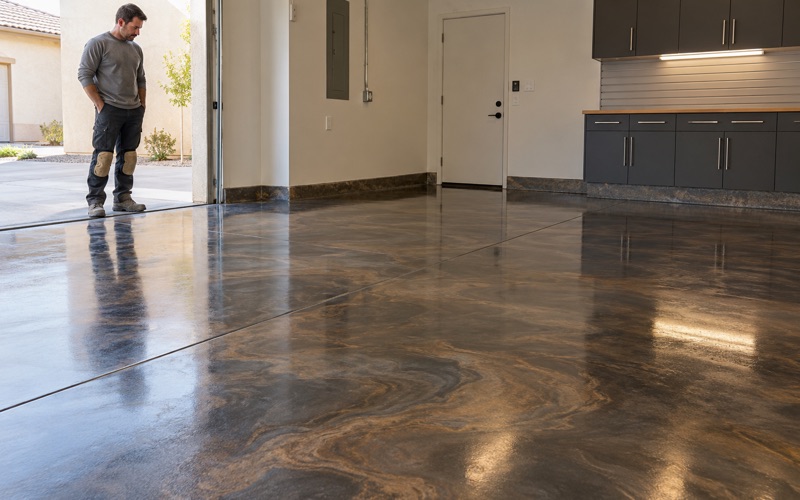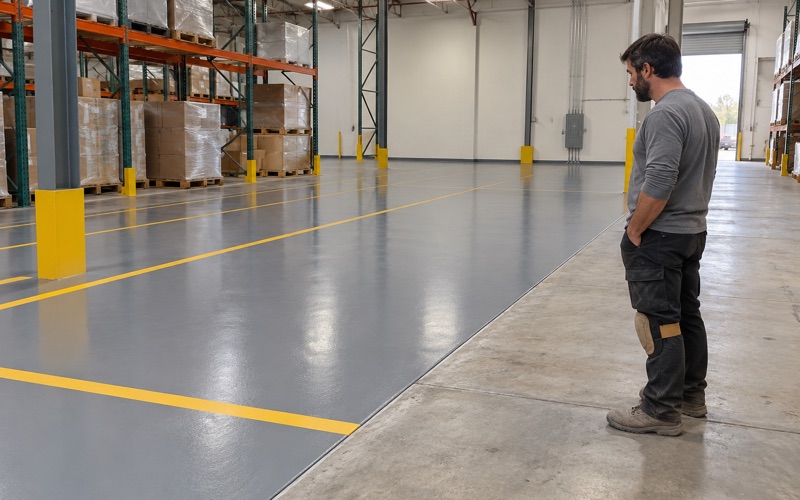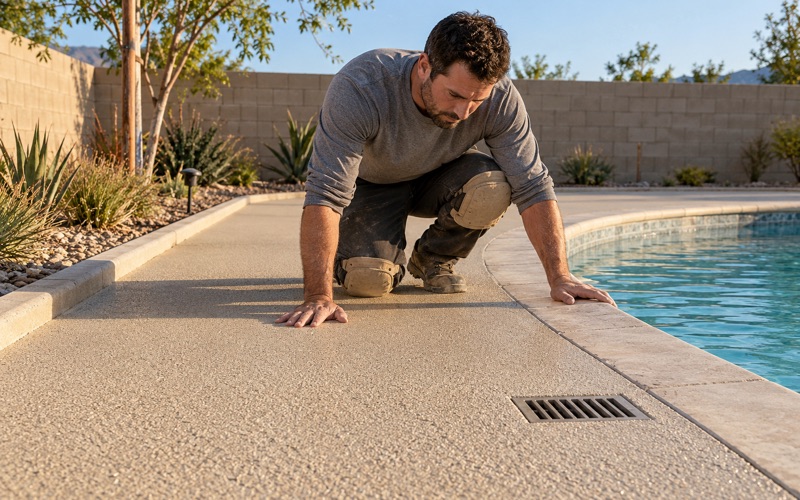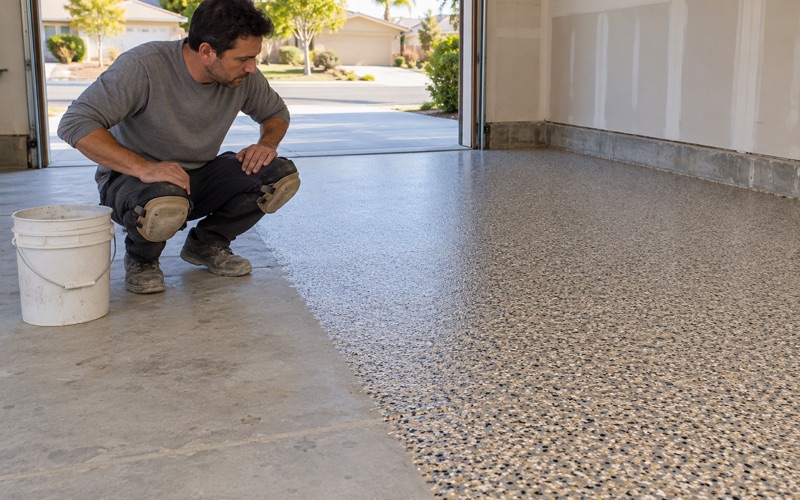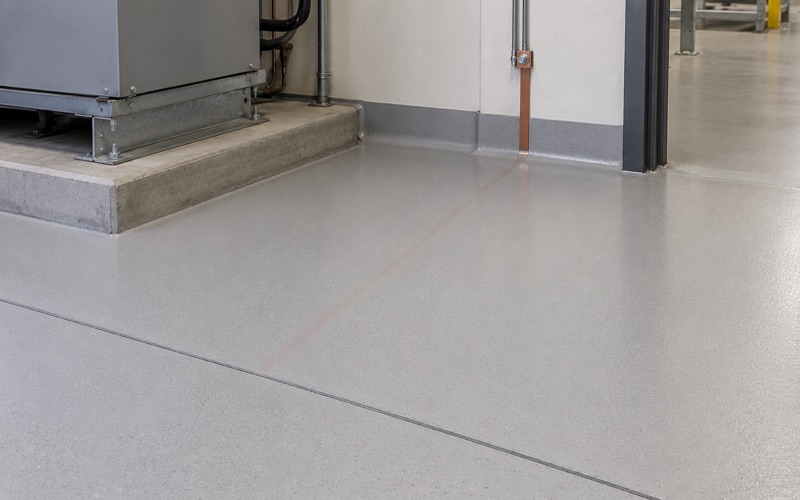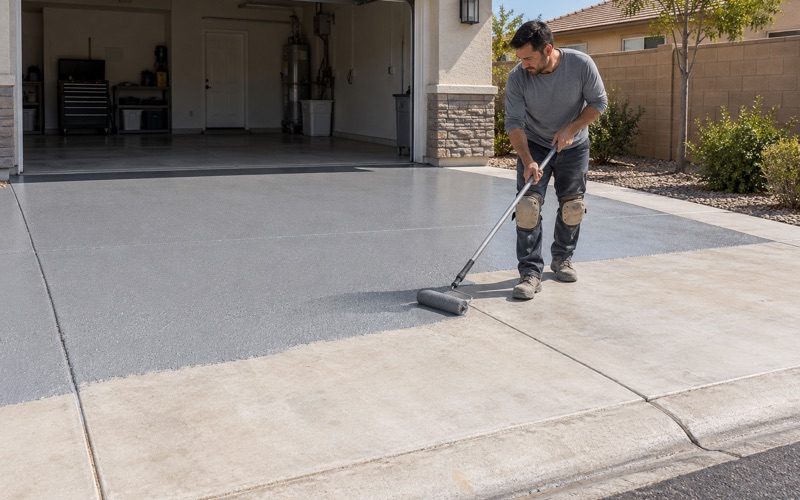
Redlands Epoxy Floors installs epoxy flooring in Nuevo, and the building we are most often asked about here is not a garage. It is a detached shop or a barn on a residential-agricultural parcel — a slab that takes a tractor, a welder, a hoist and a floor jack, and that gets treated in every practical sense like a working shop floor.
That building creates a specification problem worth being direct about, because most contractors never notice it. A shop on a residentially zoned parcel is a residential property under the air district rule that governs coating VOC content, no matter how industrial the wear on its concrete. The product that would go into a warehouse cannot lawfully go into it, and the honest version of this job is finding the floor that performs inside the category that applies.
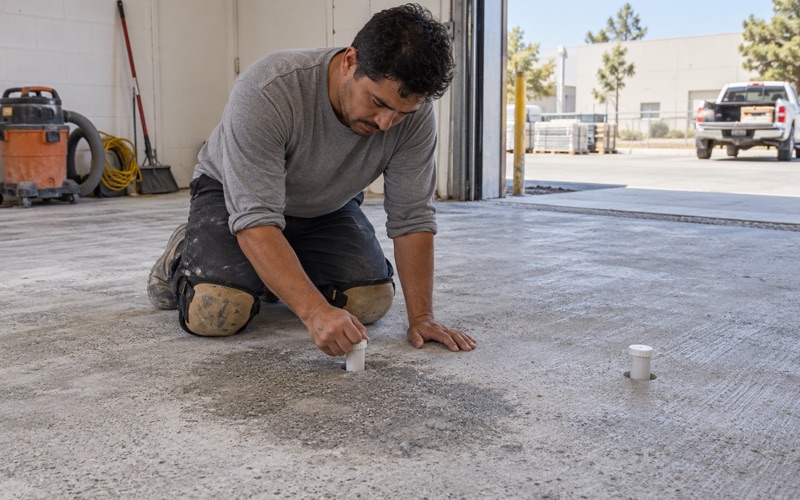
We have spent more than twenty years on Inland Empire concrete. We install epoxy, polyaspartic and polyurea systems, and every proposal carries the moisture reading we measured, the surface profile we will grind to, and the mil build as a number with the product data sheet attached.
A Workshop That Works Like a Shop and Zones Like a House
What Is Actually on These Floors
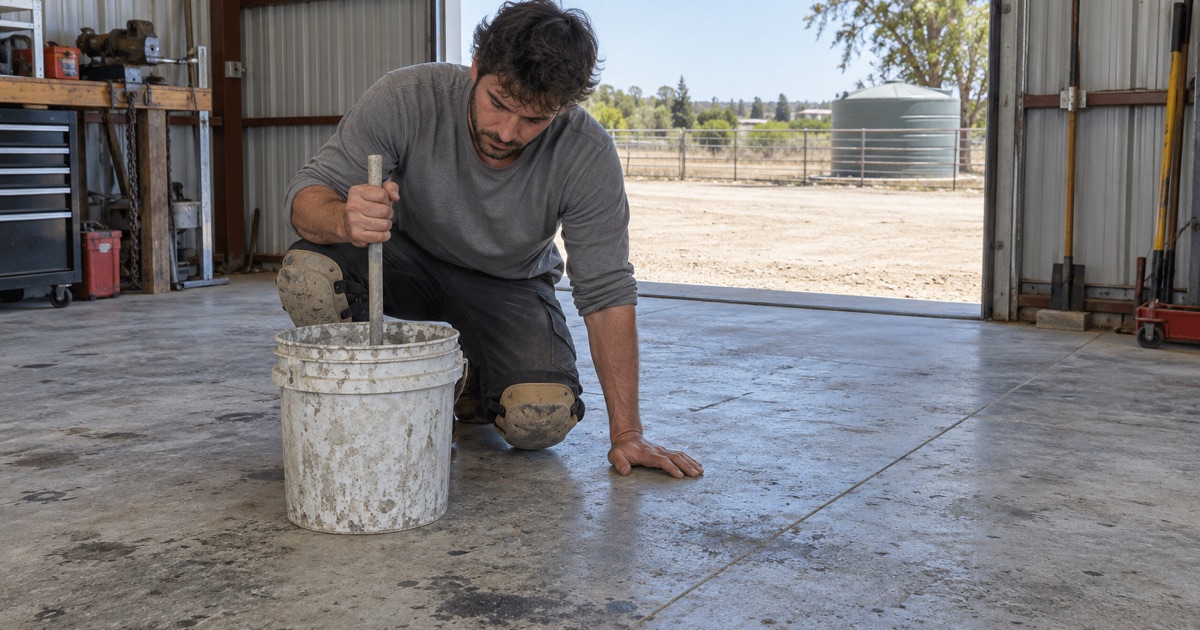
A Nuevo shop slab sees point loads from jack stands and equipment feet, dropped steel, hydraulic fluid, gear oil, solvent, battery acid and welding spatter. A barn slab sees hoof traffic, urine, manure and daily wash-down. Neither of those is a two-car garage duty cycle, and neither is served by the thin one-part paint that most of them are currently wearing.
The Slab Under the Building Is Its Own Question
An agricultural outbuilding may have been placed to farm practice rather than residential practice at any date, with an unknown subgrade and no retarder under it. That is a different situation from the house’s garage on the same parcel, and it does not follow the decade the house was built. We test the building we are coating rather than inferring from the one next to it.
Around 95 Older Units, and a Larger Modern Cohort
Only about 95 of Nuevo’s roughly 1,760 housing units date from before 1960, a little over five percent, so genuinely old residential slabs are a real but small tail here. The largest single cohort is the 2000s, at close to 27 percent. On those newer houses the slab is young and the questions are prior coatings, oil saturation and surface profile rather than age.
Looking for epoxy flooring closer to Perris? See Epoxy Flooring Services in Perris.
Why the Zoning Decides the Product
Residential Agricultural Is Still Residential
The Nuevo area carries R-A, R-A-1 and R-A-10 zoning under Riverside County Ordinance 348, with General Plan designations running to Low Density Residential and Rural Community categories under the Lakeview/Nuevo Area Plan. Those are residential designations that permit agriculture and animal keeping — in the county’s R-A zone, horses, cattle, sheep and goats may be kept on lots over 20,000 square feet and 100 feet wide. Agriculture on the parcel does not convert the parcel to an industrial use for coating purposes.
The Category Follows the Parcel, Not the Wear
This is the point most quotes miss. A coating category is determined by the property the floor is in, not by how hard the floor gets worked. A shop building on a residentially zoned parcel sits in the residential category however much abuse its concrete takes, and a specification written for a distribution center does not become permissible because the owner uses a welder.
Riverside County Is the Authority Here
Nuevo is an unincorporated census-designated place with no city government, so there is no city hall to call and no city inspector. Permits and inspections run through the Riverside County Building and Safety Department within TLMA at 4080 Lemon Street in Riverside, and the governing land use document is the Lakeview/Nuevo Area Plan. There is no gate here, no association and no architectural committee — the constraint is the county and the parcel, not a board.
Fifty Grams Per Liter, and What It Rules Out
The Two Categories and the Line Between Them
South Coast AQMD Rule 1113 caps floor coatings at 50 g/L VOC and industrial maintenance coatings at 100 g/L, and its own definitions make those two categories mutually exclusive rather than overlapping. A product is one or the other. There is no third category for a hard-working building on a residential lot, and no version of the rule that averages them.
Subsection (c)(6), Which Covers the Quote As Well
The part that matters most on a shop building is subsection (c)(6), which prohibits applying — or soliciting the application of — an industrial maintenance coating for residential use. That second verb is the reason we will not write it into a proposal even if a customer asks for it by name. Recommending it is itself the thing the rule forbids, so the conversation ends before the pail does.
What Still Performs Inside 50 g/L
None of this means a shop has to accept a weak floor. High-solids and 100% solids epoxies carry very little solvent by design, so the strongest systems in this trade sit comfortably inside the floor-coating category. Build comes from mil thickness and from what is broadcast into it, not from VOC content, and a quartz broadcast under a clear topcoat gives a shop floor real impact resistance and grip. The constraint shapes the product choice; it does not cap the performance.
Coating a Barn or Shop Honestly
Getting the Equipment to the Building
Access here is a genuine cost line rather than a footnote. Parcels are large, buildings sit well back, and there are frequently several hundred feet of unpaved or partly paved driveway between the street and the shop door. Whether a trailer can reverse to the opening, what the driveway grade is, and whether a turning radius exists at the end of it are all worth settling before a quote rather than on the morning of the grind.
Well Water, Septic and Dry Grinding
Many of these parcels run on a well and a septic system rather than a municipal connection. That changes the method: there is no municipal supply to draw from without asking and no storm drain to be careless around, so dry grinding with HEPA dust extraction is the safer default assumption on a rural parcel here, and slurry methods need a plan before they need a machine.
Wash-Down, Drainage and the Wall Joint
Any building that gets hosed out needs the floor-to-wall junction thought about, because a square corner traps soil and standing water and is the first place a floor starts failing. Carrying the system up the wall as a coved base gives a radius that can actually be cleaned, and it is built as part of the floor rather than added later as trim. Where a slab has no fall to a drain, the honest answer is often to say that the coating will not create one.
Cracks, Joints and the Trench Somebody Cut
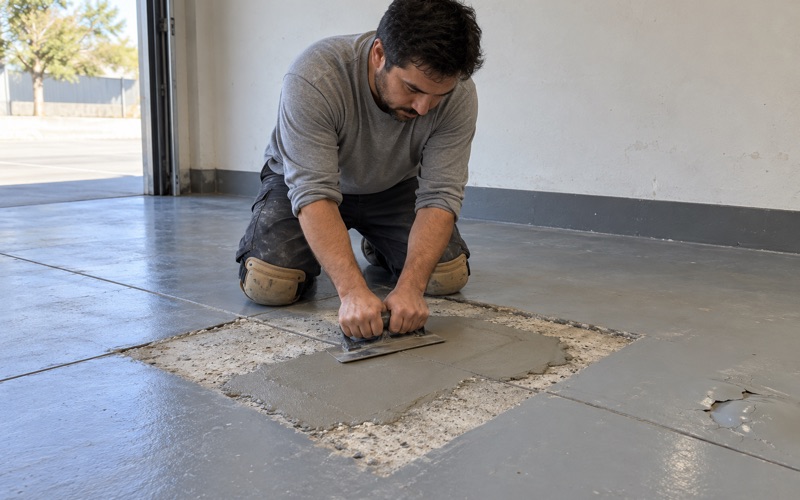
Shop and barn slabs collect history. Static cracks get chased open and filled with a semi-rigid filler so the repair carries a wheel rather than reopening under it, moving joints get honored rather than bridged because a film stretched over a live joint will telegraph and split, and a trench once cut for conduit or a drain line gets rebuilt to grade and profiled with everything around it. That work happens before any resin is opened, not after.
The Repair-or-Replace Read
Some of these slabs should not be coated, and we would rather say so at the estimate. Oil that has migrated deep into concrete keeps moving upward and will break the bond of whatever goes over it, so on a badly saturated shop floor the honest answer is a test patch first or replacement of the affected section. A written repair-or-replace read costs you nothing and occasionally saves the whole budget.
Heat Inside a Metal-Roofed Building
An uninsulated metal-roofed shop in the Perris valley in August runs far hotter at the slab than the air temperature suggests, and pot life moves with the slab: roughly sixty minutes at 55 degrees down to about twenty at 95 on the same product. We read surface temperature off the concrete, start early, mix small and keep the wet edge moving, rather than working to a data sheet figure quoted at 72 degrees.
The Highest Ownership Rate in the Valley Communities
Long-Tenure Owners, Considered Improvements
Nuevo is about 88 percent owner-occupied, roughly 1,490 of its 1,690 occupied units, which is the highest share of any community we serve in this valley. That shows up in how the work gets bought here: these are long-tenure owners improving property they intend to keep, asking what the floor will look like in fifteen years rather than what it will cost this month. It is the customer this trade is genuinely built for.
A Market of Buildings, Not Residents
The realistic market here is roughly 1,275 detached houses rather than 6,733 residents, and more than one home in four is a mobile home with a carport instead of a garage slab. The ACS also records no multifamily units at all in any structure size from three units up, so there is no apartment or common-area maintenance sale in this community. Being straight about that is the difference between a page describing Nuevo and a page describing a market that is not here.
The Landscape the Work Sits In
Nuevo covers about 6.8 square miles at roughly 1,490 feet, east of Lake Perris, on rocky rolling hills and low valleys with the usually dry San Jacinto River along its northern edge. A large master-planned proposal, the Villages of Lakeview Specific Plan, has been advanced for the surrounding area, but its approvals were vacated after litigation and it remains a proposal rather than anything built. The buildings we work in are the ones already standing on these parcels.
- 20+ Years on Inland Empire Concrete
- Every Slab Moisture Tested
- Free Written Proposals