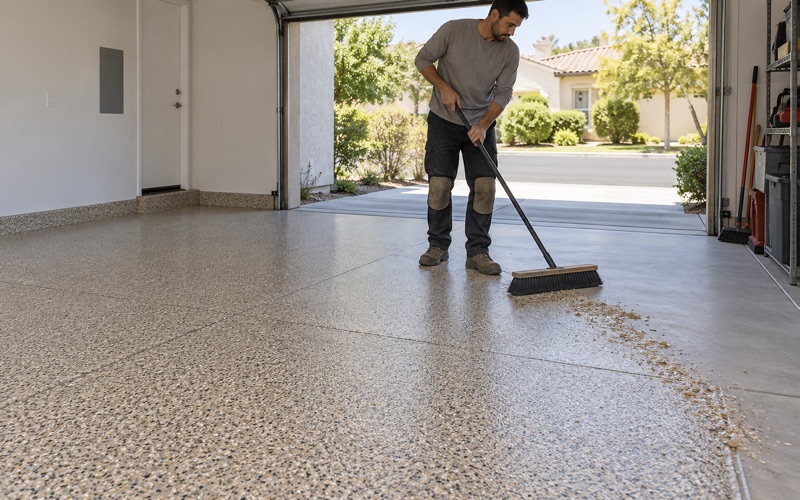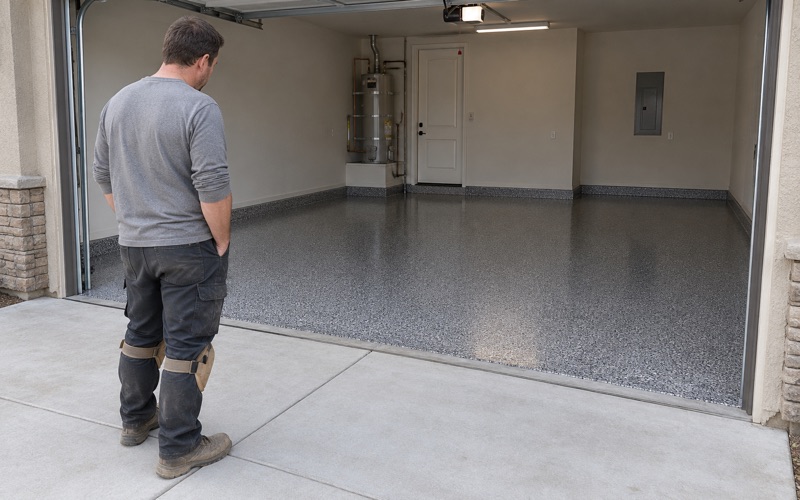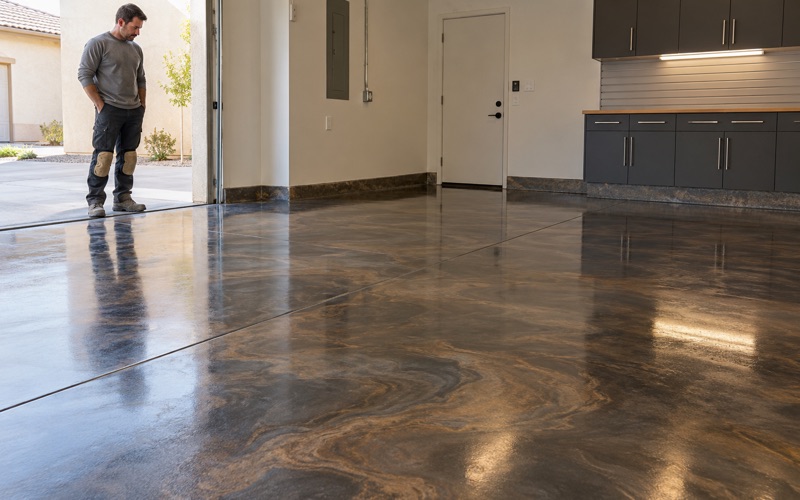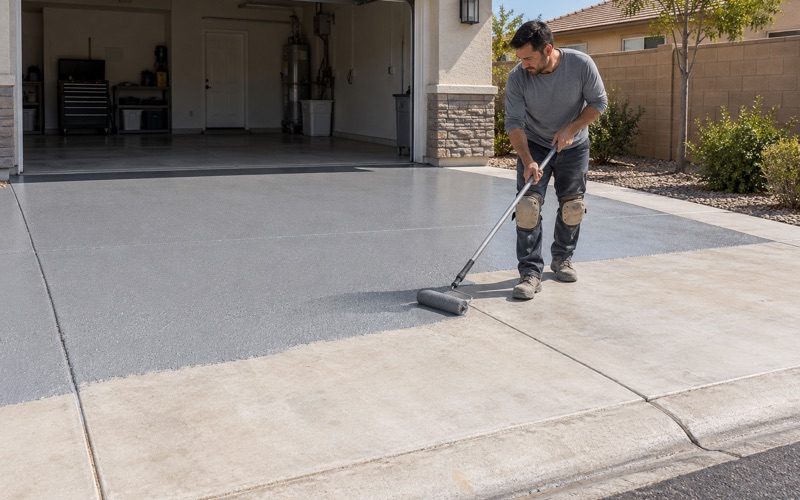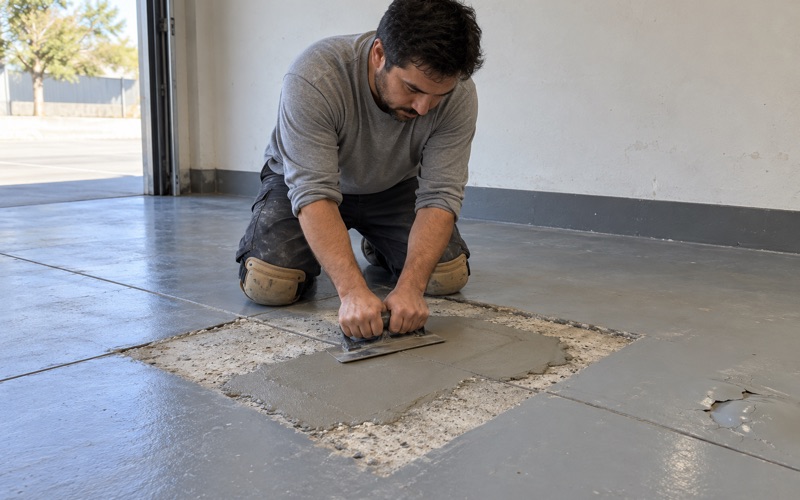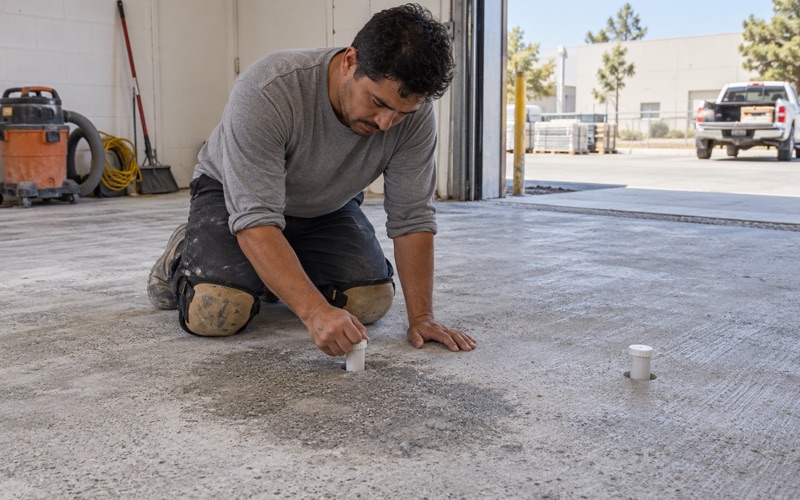
Redlands Epoxy Floors installs epoxy flooring in Muscoy on some of the oldest residential concrete we work on anywhere, and that single fact sets the whole method here. Across twenty-plus years on Inland Empire slabs we have learned that on concrete this age the question is never which color goes down — it is what is coming up through it.
So the reading comes first. Every slab gets a moisture number measured before any material is ordered, and that number is written into the proposal alongside the mil build and the product data sheet. Moisture failure is the one thing almost every coating warranty in this trade specifically excludes, which means an untested slab is a risk the owner carries rather than the installer.
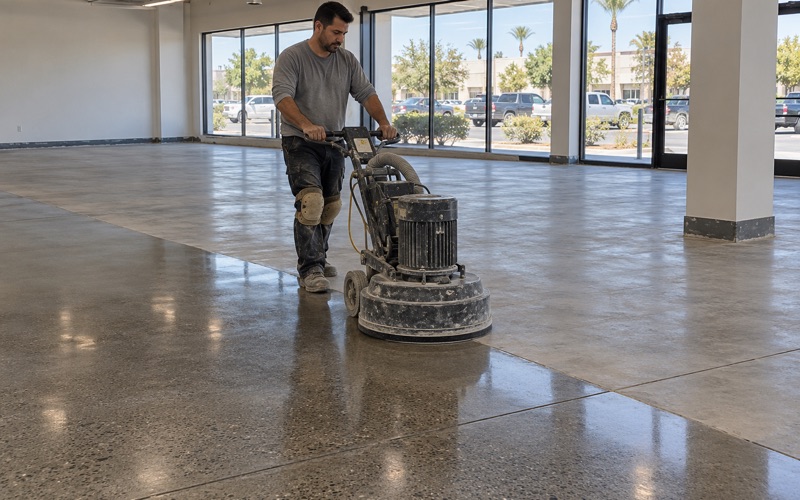
The prep is mechanical, not chemical. Floors are opened with diamond tooling to a named ICRI concrete surface profile, never acid-etched, because acid softens a shallow layer that the finished system later releases in sheets — and on a slab that has been absorbing ground moisture for seventy years, the bond is already working against enough.
The Oldest Concrete in This Part of the Valley
Of roughly 2,536 housing units in Muscoy, 1,389 — 54.8 percent — were built before 1960, and 662 of those went in during the 1950s with another 616 in the 1940s. Half of everything standing here sits on concrete placed in those two decades, and nearly two thirds of the stock predates 1970.
Nothing New Is Being Built
The other end of the range is just as clear: only 247 units date from 2000 or later, 35 were added across the whole of the 2010s, and nothing at all has been built since 2020. There is no new-construction pipeline here. Every job is on an existing slab, which means the first question on almost every quote is what has to come off before anything can go on.
What Seventy Years Puts on a Floor
The community developed in the mid-1920s as an agricultural settlement and shifted to suburban residential after the war, so a Muscoy floor has usually had several working lives. We find control-joint and shrinkage cracking, spalled edges, patches poured decades apart at different mixes, deep oil saturation in shop and shed floors, and very often a one-part paint or a hardware-store kit that has already lifted. Removing that is a tooling problem first — PCD tooling shears a soft failed film off without gouging the concrete, and the step-down through the grit sequence follows the counterintuitive rule that hard concrete takes a soft diamond bond.
Slabs That Were Never Finished to a Standard
This is not a tract-garage market. The county describes Muscoy as single-family dwellings on large lots supporting small-scale agriculture, with roads and water laid out for parcels of one to ten acres, so a large share of the concrete we are asked about is in detached outbuildings — workshops, equipment sheds and utility structures, most of them unheated. Some of those slabs were placed by an owner rather than a contractor, at inconsistent thickness and without a finished surface, and the honest read on a few of them is that coating is the wrong money.
Looking for epoxy flooring closer to Cherry Valley? See Epoxy Flooring Services in Cherry Valley.
What Was Under a Slab in 1950, and What Was Not
Under-slab vapor retarders did not become routine construction practice until well after the war. On the majority of Muscoy slabs there is very likely nothing between the concrete and the soil at all.
Concrete Is a Wick, Not a Barrier
Water moves upward through an unretarded slab continuously, as liquid by capillary action and as vapor driven by the difference between damp soil below and drier air above. The slab looks dry because the moisture evaporates off the surface as fast as it arrives. Seal that surface with a film and the evaporation stops, the vapor pressure builds under the coating, and the system that was bonded to sound concrete gets pushed off it.
What That Failure Looks Like
It shows up as blisters with water behind them, as delamination that starts in one damp corner and spreads, and as efflorescence — the white mineral crust left behind when water carries salt to the surface and then evaporates. Efflorescence is not a housekeeping problem. It is direct visible evidence of an active moisture path, and sanding it off and recoating simply traps the same water under a new film and restarts the clock.
Why This Is Scope and Not an Upsell
On a 1950s slab with no retarder under it, testing is not an optional extra we add to a quote — it is the part of the job that determines whether the rest of the quote is honest. We would rather find an elevated reading and specify for it than place a floor that gets pushed off in its second summer, and we would rather say that plainly than compete on a price that quietly leaves the risk with the owner.
Two Tests That Measure Two Different Things
There are two real moisture tests in this trade and they do not measure the same quantity. Understanding which one answers which question is most of the diagnosis.
A Rate at the Surface Against a State Inside the Slab
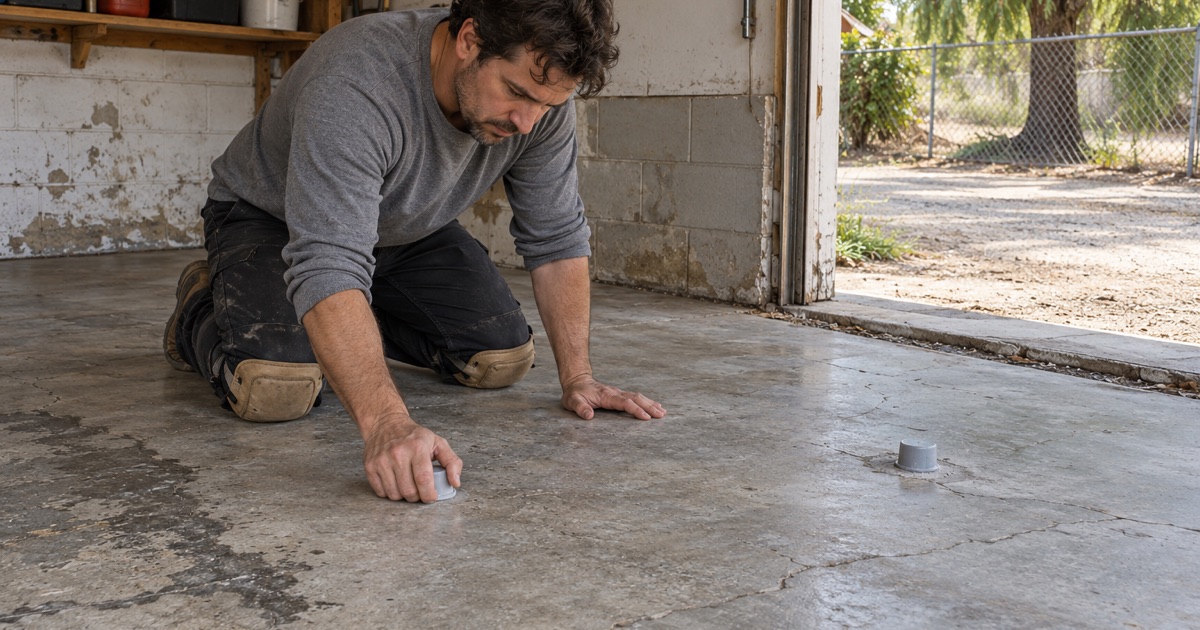
ASTM F1869, the calcium chloride test, measures a rate — how much moisture is coming out of the top of the slab over a defined period, expressed as a moisture vapor emission rate. ASTM F2170 uses in-situ relative humidity probes set into holes drilled down into the slab itself, and it measures a state: the actual relative humidity inside the concrete, where the coating has to live. The surface rate can be suppressed by a warm dry day; the internal state cannot, which is why the probe is usually the more useful number on an old slab.
Where the Threshold Numbers Actually Live
Neither test method sets a pass mark. Both threshold numbers live in ASTM F710, and citing them to the test methods instead is the most common citation error in this trade — common enough that it turns up in published specifications. We name the method, the reading and the standard the reading is judged against, so the number in the proposal can be checked rather than taken on trust.
The Test That Cannot Clear a Slab
Taping a sheet of plastic to the floor under ASTM D4263 is asymmetric, and this matters enough to be blunt about. If condensation appears underneath, the slab is failed and the conversation moves to remediation. If nothing appears, nothing has been established, because the method is not sensitive enough to clear a slab. It is a useful first look on a walk-through and it is not a basis for ordering material.
When the Primer Is the Whole Job
A high reading does not mean the floor cannot be coated. It means the specification changes, and on this stock the change is often the largest single item in the quote.
A Barrier Primer Sized to the Reading
The usual answer is a moisture vapor barrier primer — a high-solids epoxy formulated to hold back vapor drive, specified against the number we measured rather than applied as a blanket precaution. It adds material cost and at least a day to the schedule, and it changes what can go over the top of it. That trade is worth making because the alternative, on a slab reading high, is a system with a known failure date and a warranty that excludes the reason.
Getting the Surface Ready for It
A barrier primer only performs on a properly opened floor, so the grinding standard does not relax because a primer is going down — if anything it tightens, because the primer has to key into sound concrete rather than into a weak surface layer. Cracks are chased open and filled with a semi-rigid filler so the repair carries traffic, spalled areas are rebuilt to grade, and a moving joint is honored through the system rather than bridged by it.
When the Answer Is Not to Coat It
Some slabs here are not candidates, and we put that in writing. A floor with deep oil saturation that keeps migrating upward, or one broken up by settlement, or a shed slab poured too thin over uncompacted ground, will not hold a coating regardless of what goes on it. Saying so costs us the sale and saves the owner from paying twice, which is the trade we would rather make.
A Community With No Industrial Land at All
Muscoy is unincorporated, and its land use is unusually simple: of roughly 1,938 acres, about 1,562 — 81 percent — are single-family residential, and the county’s inventory records no industrial acreage whatsoever. There are on the order of 84 businesses in the whole community. The heavy floor work is over the line in the city and along the freeway corridor, not here, and it is more useful to say that than to pretend otherwise.
Half the Detached Houses Are Rentals
Muscoy is 82.3 percent single-family detached and simultaneously renter-majority, with 1,269 of 2,436 occupied units rented. Of roughly 2,049 occupied detached houses, 1,002 are rentals. That second half is a landlord market that buys on durability, turnaround between tenants and cost per turnover rather than on finish selection, and it usually wants a straight answer about how many days the unit is out of service. A fast-cure system earns its premium there in a way it does not for an owner-occupier.
Septic Fields Under the Staging Area
Muscoy is on septic tanks and leach fields rather than sewer, and leach fields sit in yards and under driveway approaches. Where a materials truck, a grinder and a dust-extraction rig get parked is therefore a question we ask the owner before the day of the job, because a loaded vehicle over a leach field is a repair that dwarfs the floor. Route planning has a second local dimension as well: motor vehicles and horses share these roads, with few pedestrian facilities and none for bicycles, so a trailer moves differently here than in a tract suburb.
Dust Containment Matters More Here
The state has designated San Bernardino and Muscoy together as an AB 617 Community Air Protection Program community, with a high cumulative air pollution exposure burden and census tracts identified as disadvantaged. Grinding dust and solvent emissions carry a higher local profile here than in an ordinary suburb, so vacuum-shrouded tooling and sealed dust extraction are how we work rather than an upgrade, and low-odor systems get a serious look on occupied properties.
One Product Category, Because the Parcel Says So
SCAQMD Rule 1113 caps floor coatings at 50 g/L VOC and industrial maintenance coatings at 100 g/L, makes the two categories mutually exclusive, and in subsection (c)(6) prohibits applying or soliciting the application of an industrial maintenance coating for residential use. In Muscoy the awkward case is the normal one: a barn, shed or workshop on a residentially zoned parcel is residential property under that rule however hard its floor is worked, so the higher-VOC category is simply off the table. Permits, where a project needs one, run through San Bernardino County Land Use Services on West Hospitality Lane rather than a city counter.
Heat and Cold in the Same Week
Muscoy sits between about 1,240 and 1,600 feet at the base of the foothills, which makes summer placement a pot-life problem and winter mornings a cure-temperature problem on the same properties. Pot life on a published system runs roughly sixty minutes at 55 degrees and about twenty at 95, and the surface has to sit at least five degrees above the dew point with a minimum near fifty degrees for air, surface and material alike. On an unheated detached shed slab that can mean waiting until afternoon in January and starting at first light in July.
- 20+ Years on Inland Empire Concrete
- Every Slab Moisture Tested
- Free Written Proposals