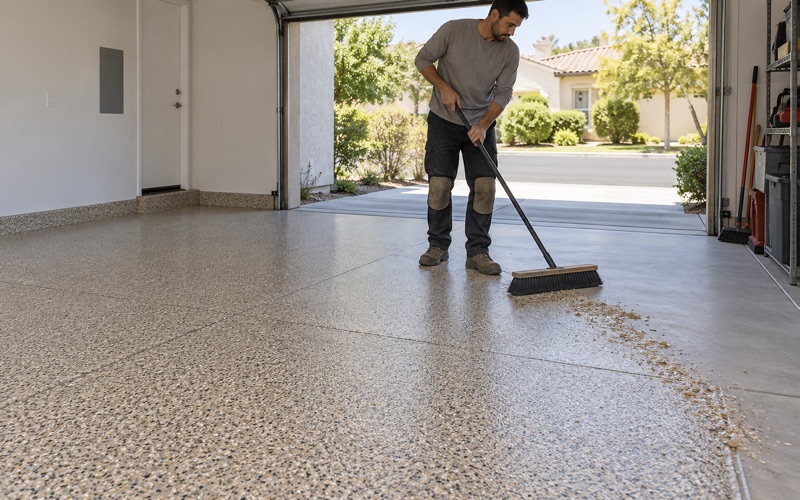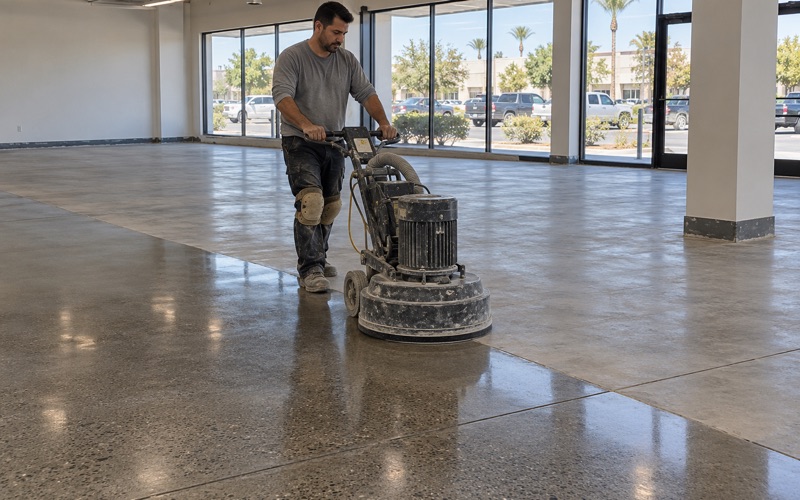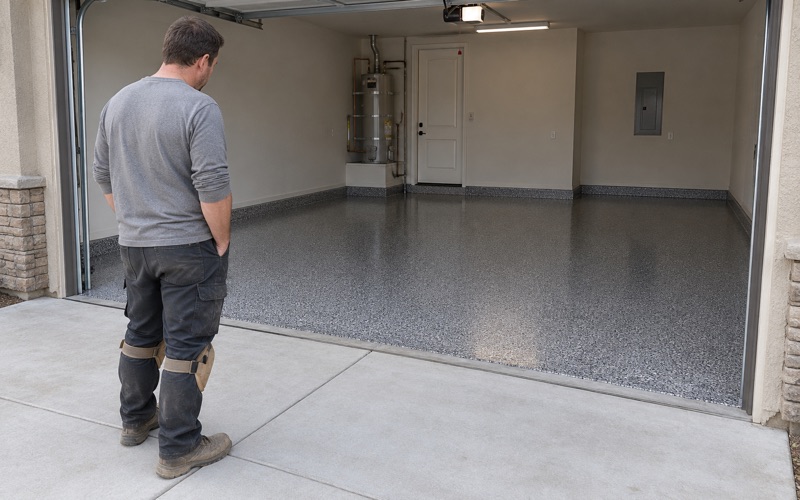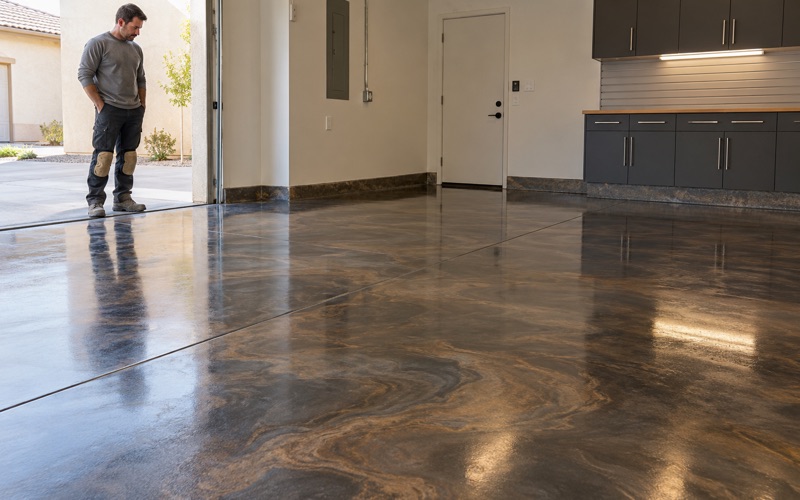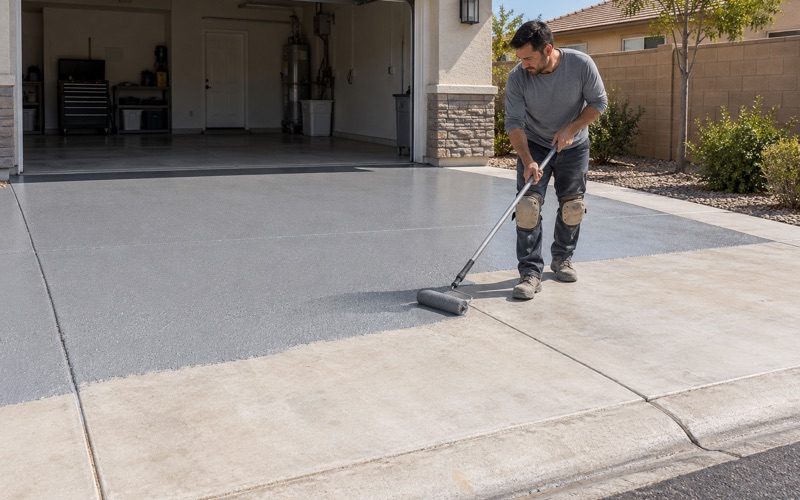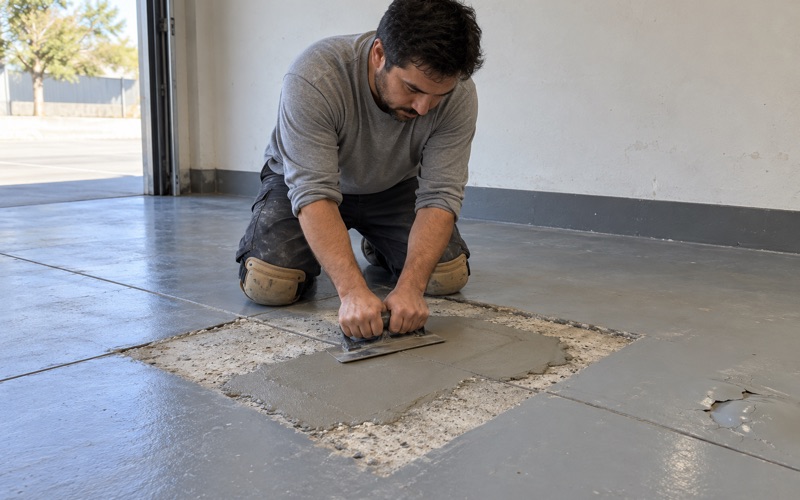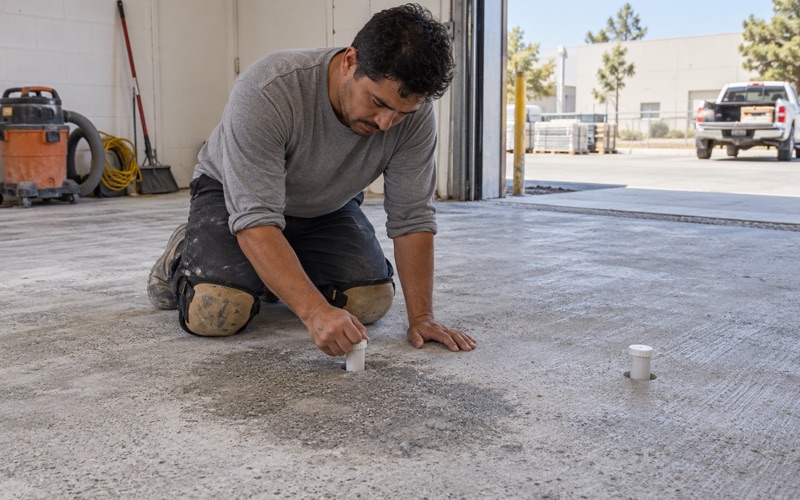
Redlands Epoxy Floors has been installing garage floor coating in Moreno Valley for more than twenty years, on tract garage slabs and on distribution floors measured by the acre rather than by the bay. We place epoxy, polyaspartic, polyurea and urethane cement systems, and we grind and polish existing concrete where a coating is not the right answer for the traffic the floor takes.
Whatever the building, the work starts the same way. We read the slab before we price it: a moisture number, the condition of the joints and cracks, how much oil has soaked in, and the surface temperature the concrete will actually be sitting at when material goes down. Every floor is opened with diamond tooling to a named ICRI concrete surface profile — never with acid, which softens a thin skin that the finished system later releases in sheets. The proposal carries the mil build as a number and the product data sheet for the system we are proposing.
The two halves of this market are quoted from separate product lines, and that is a legal division rather than a preference. South Coast AQMD Rule 1113 holds floor coatings to 50 g/L VOC and industrial maintenance coatings to 100 g/L, makes the two categories mutually exclusive by definition, and in subsection (c)(6) prohibits applying or even soliciting the application of an industrial maintenance coating for residential use. In a city with roughly forty-four thousand detached houses on one side and some of the largest warehouse floors in the region on the other, that is a product decision we make several times a week.
A City Built Inside One Decade

Moreno Valley incorporated on December 3, 1984, out of the older communities of Moreno, Sunnymead and Edgemont, and then grew by more than three hundred percent between 1980 and 1990. The concrete records that. Of 57,381 total housing units, 22,982 — 40.1 percent of everything in the city — were built in the 1980s, with another 12,144 in the 2000s, and 81.3 percent of the stock dates from 1980 or later.
Two Slab Generations Instead of Eight
A crew working residential garages here is working essentially two slab generations, and that makes the prep specification unusually repeatable. Mix designs, joint spacing, apron detailing and slab thickness cluster tightly inside a single build era, so the grit sequence and diamond segment bond hardness that cut one 1980s tract garage tend to cut the next one on the same street. We still profile and check rather than assume, but the range of surprises is narrow compared with a city whose concrete spans eight decades.
What Ages a Tract Slab Is Use, Not Age
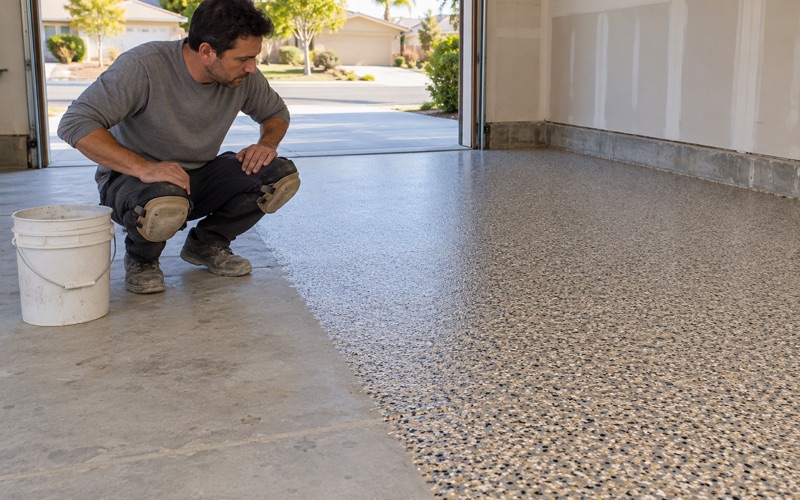
These floors are worn rather than old. What we find is control-joint and shrinkage cracking, settlement and lipping at the garage door threshold, edge curling, three or four decades of motor oil and tire-plasticizer staining, and very often a failed one-part paint or a homeowner kit that has to come off before anything new goes down. Removing a prior coating is frequently the real scope of the job, and it is a tooling problem first: PCD tooling shears a soft film off without gouging the concrete, and the counterintuitive rule that hard concrete takes a soft diamond bond governs the step-down after it.
Access Is Not the Constraint
The residential stock is 1980s and 2000s subdivisions on wide streets with standard driveways and attached two-car garages, and the industrial product is high-cube tilt-up with dock and grade doors. Getting a grinder and a dust-extraction rig onto the floor is not a limiting factor in either half of this city, which is not true everywhere in the Inland Empire. The schedule gets built around cure chemistry instead.
Looking for commercial epoxy flooring closer to San Bernardino? See Commercial Epoxy Flooring in San Bernardino.
Why the Moisture Argument Runs Differently Here
Only 2,428 units in Moreno Valley — 4.2 percent of the stock — predate 1960, against 26.7 percent in Riverside next door. Under-slab vapor retarders had become routine construction practice well before the great majority of this concrete was poured, so on a 1980s or 2000s garage slab elevated moisture is a condition to find rather than a condition to assume.
Confirm, Do Not Assume
That changes the expected result, not the procedure. We still measure moisture vapor emission rate to ASTM F1869 or in-situ relative humidity to ASTM F2170 with probes set into the slab, and we still read the result against ASTM F710 — which is where the actual threshold numbers live, not in the test methods themselves. That is the most commonly misquoted citation in this trade, and it matters because moisture failure remains the dominant failure mode and the one that almost every coating warranty in the trade specifically excludes.
The Test That Cannot Clear a Slab
ASTM D4263, taping a sheet of plastic down and looking for condensation under it, is asymmetric. A positive result fails a slab outright; a negative result proves nothing, because the method is not sensitive enough to clear one. On a young slab where we expect a clean number anyway, that distinction is the difference between a real reading and a comforting one, so the plastic sheet is a first look and never the clearance test.
The Number Goes Into the Proposal
Whatever the probe reads, the figure and the method go into the written proposal before any material is ordered. Where the reading comes back high — and on a minority of these slabs it does, usually around a landscape line, a slab-on-grade addition or a persistently damp corner — the specification changes to a moisture vapor barrier primer sized to the number. Quoting that primer is cheaper than a callback on a failure the warranty was never going to cover.
Distribution Floors Measured in Acres
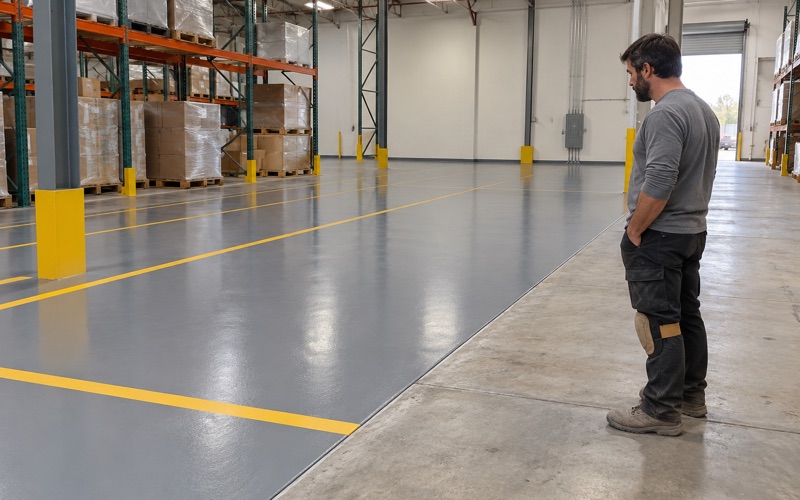
The commercial half of this city is the largest logistics concentration we work in. Amazon employs 4,854 people here in fulfillment, Skechers opened a 1.8 million square foot distribution center in 2012, Deckers Outdoor’s primary US distribution center began operating here in the fourth quarter of fiscal 2015, and Ross Dress for Less and dd’s Discounts, ALDI and Harbor Freight Tools all run distribution operations in the city. At that footprint, the method changes — not the chemistry, but the logistics of getting a uniform film across a floor that a crew cannot cross in a single pull.
Phased Areas Instead of a Shutdown
Almost none of these buildings can go dark. We sequence by bay, aisle or rack run against dock schedules and put-away patterns, working an area to completion — grind, joint work, primer, build coat, topcoat — before the next one opens, so operations lose a defined block of floor rather than the building. Where a phased approach cannot produce a clean edge, we will say so and price a weekend window instead, because a cold joint dropped in the middle of a traffic aisle is a seam that will fail first.
Pot Life Against a Slab That Is Already Hot
Moreno Valley is squarely inland, and on a large floor the material is fighting the slab as much as the air. Pot life on a published system runs roughly sixty minutes at 55 degrees and about twenty at 95, so a summer pour is small batches, early starts, and slab temperature read at the surface rather than air temperature read off a phone. The floor also has to sit at least five degrees above the dew point, with a minimum around fifty degrees for air, surface and material alike, and on a big pour a gauge rake, notched squeegee, spiked shoes and an air-release roller only work if the material is still open when they reach it.
The Manufacturing Floor Behind the Warehouse Names
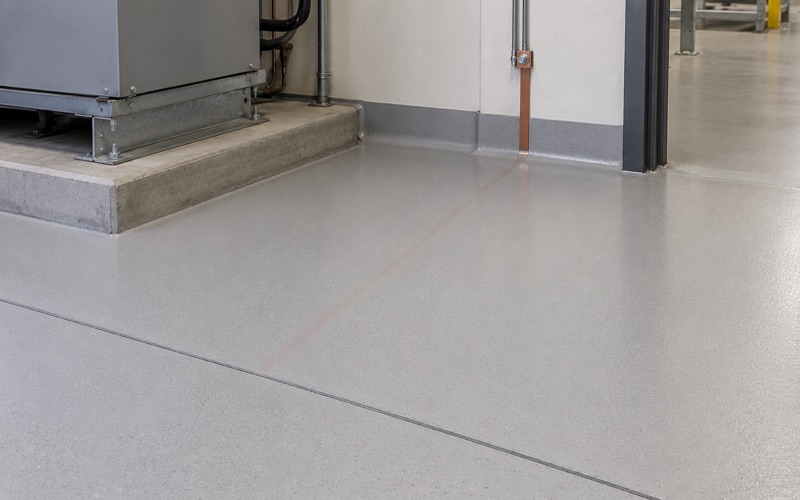
Production floors in this city get missed behind the distribution ones. WABASH, Masonite Door Fabrication, Serta Simmons Bedding, Solaris Paper, ResMed and Eurotek Windows and Doors all run manufacturing here, and a production floor takes point loads, chemical exposure and turning traffic that a picking aisle never sees. Riverside University Health Systems and Kaiser Permanente Community Hospital add a third specification again — clinical, lab, imaging and back-of-house floors, where seamless and cleanable is the requirement and appearance is downstream of it.
New Slabs Against Existing Floors
The World Logistics Center, a 2,610-acre Highland Fairview project entitled for over forty million square feet across roughly twenty-seven buildings south of the 60 Freeway, was approved by the City Council in 2015 and is planned over roughly a fifteen-year build-out. Coating or polishing a green slab in a new building is a different job from working an occupied one: no removal, no contamination, but cure age, curing compound residue and finishing schedule all become live variables. Where a floor forms part of a tenant improvement, the permit path runs through the City of Moreno Valley Building and Safety Division on Frederick Street, whose SimpliCITY portal handles plan review, permits and inspections online.
Control Joints, Saw Cuts and the Edges That Fail First
On a warehouse floor the field of the slab is rarely what fails. The joints go first, and they take the surrounding coating with them.
Why the Joint Arris Breaks Down
A hard-wheel forklift crossing an unfilled control joint loads the joint edge — the arris — as a corner rather than as a surface, and once that edge starts to spall the damage runs outward underneath whatever is coated around it. A semi-rigid joint filler placed full depth supports both arrises so the wheel rolls across the joint instead of dropping into it. Joint filling is part of the floor system on a trafficked slab, not the line item trimmed to win a bid.
Moving Joints Are Honored, Not Bridged
A construction joint or an isolation joint that is genuinely moving gets honored through the coating rather than covered by it, because a film stretched across a live joint telegraphs and then splits. Static shrinkage cracks are the opposite case: they are chased open, filled, and ground flat with the surrounding floor so the repair carries traffic instead of reopening under the first pallet jack. Telling the two apart on site is the whole skill, and getting it wrong is visible within a season.
Dock Areas Take a Different Specification
The apron inside a dock door is the most abused concrete in the building — impact from dock plates, point loads from jacks, thermal cycling every time a door opens, and standing water tracked in off trailers. We treat that strip as its own system rather than continuing the field coating into it.
Marking a Working Floor
Line striping and aisle marking are usually specified last and are the part of the floor an operations manager looks at daily. They are also where a great deal of confident misinformation circulates.
What the Regulation Actually Says
OSHA 1910.176(a) requires that aisles and passageways be kept clear and appropriately marked where mechanical handling equipment is used. It specifies no stripe width and no color at all. The two-inch yellow line that everyone quotes comes from an interpretation letter and long industry convention, repeated often enough that it now sounds like a rule — so we mark to what your traffic patterns, your racking and your own safety program actually require, and we will tell you plainly that nobody is holding you to a number.
Striped Lines Against Saw-Cut Inlay
A striped line sits on top of the floor and wears at the rate of the traffic crossing it, which in a turning zone can be fast. A saw-cut inlay is cut into the concrete and filled, so the line becomes part of the slab and survives the wheel that would have scrubbed a stripe away. Inlay has to be laid out before grinding, because the cutting happens while the floor is still open — which means the marking plan is an early conversation, not a late one.
The Right Product for the Right Building
Everything placed in these buildings is selected against Rule 1113 as an industrial maintenance coating where that is lawful, and everything placed in a Moreno Valley garage is selected as a floor coating under the 50 g/L limit. A workshop on a residentially zoned parcel is residential for this purpose no matter how hard the floor gets worked. We would rather explain that boundary than quietly borrow a warehouse product for a house and leave the owner with a coating that was never legal on the parcel.
- 20+ Years on Inland Empire Concrete
- Every Slab Moisture Tested
- Free Written Proposals