Redlands Epoxy Floors has spent more than twenty years installing epoxy flooring in Mentone, and the work here reads differently than it does almost anywhere else we go. More of it is service bay than showroom. The question that decides the specification on a Mentone floor is usually not what the floor should look like — it is what is going to be spilled on it.
That makes chemical exposure the governing input rather than a footnote. A coating asked to hold a warm tire for a week is resisting heat and a bond load; a coating under a parts washer or a brake job is resisting chemistry. Those are two failures with two causes, and the system that answers one does not automatically answer the other.
So we specify from the exposure list first, the slab second and the color last. Every floor gets a moisture reading before material is ordered, a profile opened with diamond tooling rather than acid, and a mil build written into the proposal with the data sheet attached — because on a shop floor the gap between the coating you were sold and the one you got is measured in thousandths of an inch.
The Shops Along Mentone Boulevard
An automotive cluster in a community of under ten thousand
Mentone’s business mix is unusually concentrated. Seventeen named automotive businesses operate here — body and collision, muffler, tire, engine building, suspension fabrication, RV paint and powder coating — in a census-designated place of 9,557 people, most of them on or just off one boulevard.
That concentration changes what a quote has to answer. In a general suburban market the commercial question is how a floor will look to a customer walking in. On this stretch it is whether the floor is still intact after three years of drips, dropped tools and a lift set and reset in the same four square feet.
Not everyone on the street is a customer
C&S Powder Coating and Jim Baker Concrete Inc. both operate out of Mentone, and it would be a misread to treat every business on the boulevard as a lead. A powder coater and a concrete contractor are trades adjacent to ours, and in a community this size they are as likely to be a referral or a supplier as a prospect.
There is no city hall to call here
Mentone is an unincorporated census-designated place, so there is no city permit counter and no local building department. Permits run through San Bernardino County Land Use Services, Building and Safety Division, at the County Government Center, 385 N. Arrowhead Ave. in San Bernardino — roughly fifteen miles west.
Most flooring work is a coating rather than a structural alteration and pulls no permit at all. But where a job touches drainage, a trench or a change of use, no contractor can promise a same-morning counter visit the way they could inside an incorporated city.
Looking for epoxy flooring closer to Highland? See Epoxy Flooring Services in Highland.
What Actually Gets Spilled On A Service Bay Floor
Hot tire pickup is a bond failure, not a wear failure
Hot tire pickup is the failure most shop owners have already seen: a car comes off the road with warm tires, sits, and when it pulls out the coating leaves with it in patches. It is not caused by the floor being too thin. It is caused by a plasticizing tire compound softening a film that was never mechanically keyed into sound concrete in the first place.
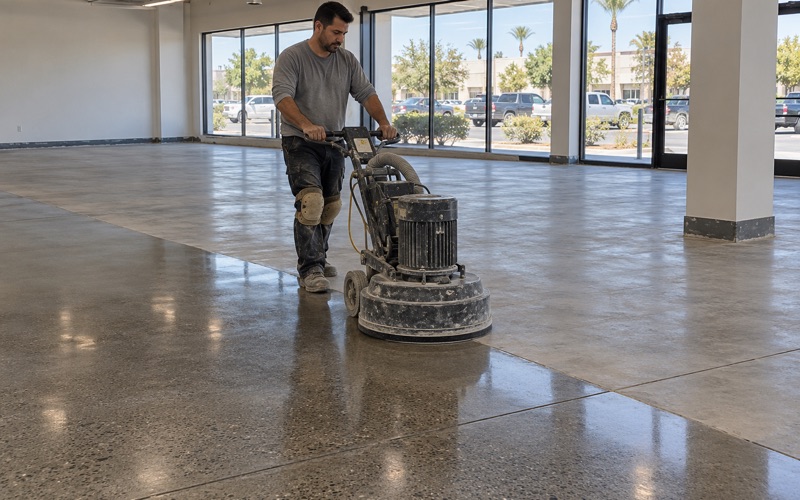
That is why nothing here is opened with acid. An acid-etched slab gives resin a chemically softened skin to sit on, and the skin is what releases. We grind to a named ICRI concrete surface profile — commonly around CSP 3 for a thin-film system, deeper for a heavy build — so the key has a depth we can state rather than a bond we hope for.
The oil that soaked in years before we arrived
A twenty-year-old service bay has oil in the concrete, not just on it, and resin will not bond through contamination. Degreasing and grinding remove most of it, but where saturation runs deep under a lift point or an old drain we test a patch before committing the whole floor.
Sometimes the honest answer is that a section has taken so much oil that no coating will hold and the concrete needs replacing. We put that in writing when it is true — finding it out at the quote is inconvenient, finding it out four months after paying for a floor is expensive.
Brake fluid, gear oil and solvent are three different problems
Trade shorthand lumps these together as “chemicals,” but they attack a coating differently and on different timescales. Glycol ether brake fluid softens and swells a film where it dwells; gear oil is mostly a staining and creep problem at joints and edges; solvents from a paint or body operation can attack the resin itself if they pool rather than flash off.
Dwell time therefore matters as much as the substance. A splash wiped up in a minute and a puddle left under a bench overnight are not the same exposure, and a specification that ignores which one your shop produces is guessing.
Matching Resistance To The Chemistry In The Building
A chemical resistance chart is a starting point, not a warranty
Every resin manufacturer publishes a chemical resistance chart, and it is genuinely useful — but it is a laboratory result at a stated concentration, temperature and exposure time, on a coupon at full cure. It is not a promise about your floor. We use it to narrow the field, then ask what your bays actually see and for how long it sits.
No coating is immune to all of it, and a contractor who says otherwise is telling you something about their sales script rather than about the floor. We name the exposures we specified against, hand you the data sheet, and say plainly where the system has a limit.
Where each resin family earns its place
A 100% solids epoxy builds thickness and bonds hard into a prepared slab, which makes it the base coat on most shop floors. Polyaspartic and polyurea cure fast and hold color under UV, so they do the topcoat work and make it possible to return a bay to service quickly.
Urethane cement is a different animal — a thick, thermally tolerant system for wash bays and areas taking steam or hot water, where a thin-film epoxy is the wrong tool. MMA resin covers the case where a floor has to be back in service in hours, at the cost of odor during install. Naming the tradeoff is more useful than naming a favorite.
Which product line the building is legally entitled to
South Coast AQMD Rule 1113 holds floor coatings to 50 g/L VOC and industrial maintenance coatings to 100 g/L, and the two categories are mutually exclusive rather than a sliding scale. Subsection (c)(6) prohibits applying — or even soliciting the application of — an industrial maintenance coating for residential use.
For a market this weighted toward small automotive shops that line matters constantly. A commercial bay on the boulevard and a detached workshop behind a house half a mile away are not the same legal category, however similar the wear on the two floors. We quote residential and commercial work from separate product lines because the rule draws that boundary, not because it makes a better sales story.
Working Around A Shop That Cannot Close
Pot life at 1,650 feet in August
Mentone sits at roughly 1,650 feet, on the south bank of the Santa Ana River, and it is the lowest and hottest of the east foothill communities we work in. Everywhere upslope the cure problem tilts cold; here it tilts hot, and in summer the shortened pot life is the constraint the whole day is built around rather than a caveat at the bottom of a proposal.
The numbers are specific rather than rhetorical. On one published product, pot life runs roughly sixty minutes at 55 degrees, about forty at 72 and about twenty at 95 — and the recoat minimum drops from twenty-four hours to six across the same range. An uninsulated slab in a Mentone summer can approach the 160 degree maximum surface temperature a data sheet allows. So we read slab temperature rather than air temperature, start early, and mix small batches, because a batch that gels in the bucket halfway across a bay is a floor you pay for twice.
Sequencing bays instead of closing the shop
Almost no shop here can give up its whole floor for three days. The workable pattern is bay by bay: clear and coat a section, let it reach the recoat window and then a return-to-service cure, and keep moving while the rest of the floor earns. Fast-cure topcoats make that realistic, since foot traffic often returns the same day even when vehicle traffic does not.
What we will not do is compress preparation to protect a sequence. If a slab needs a moisture vapor barrier primer to cure out, the date moves. One crew runs the job from grind to topcoat, so the person who saw what the concrete looked like when it was opened is the person making the call.
Getting a grinder onto a boulevard frontage
State Route 38 is Mentone’s only real through route, and on weekends it carries canyon and mountain recreation traffic on top of local trips. Staging a grinder and a dust extraction rig on a two-lane state highway frontage is not the same as backing into a cul-de-sac, so we schedule around it rather than find out with a truck blocking a lane.
The Older Slabs Behind The Boulevard
An 1887 townsite means pre-war concrete
Mentone was established in the late 1880s and laid out for citrus, and the housing stock still shows it: 914 of its units predate 1960 and 515 predate 1950 — the oldest tail of any community in this part of the valley. Under-slab vapor retarders were not routine practice that early, so on a pre-1950 garage the moisture question is part of the scope rather than an upsell.
What the moisture tests actually tell you
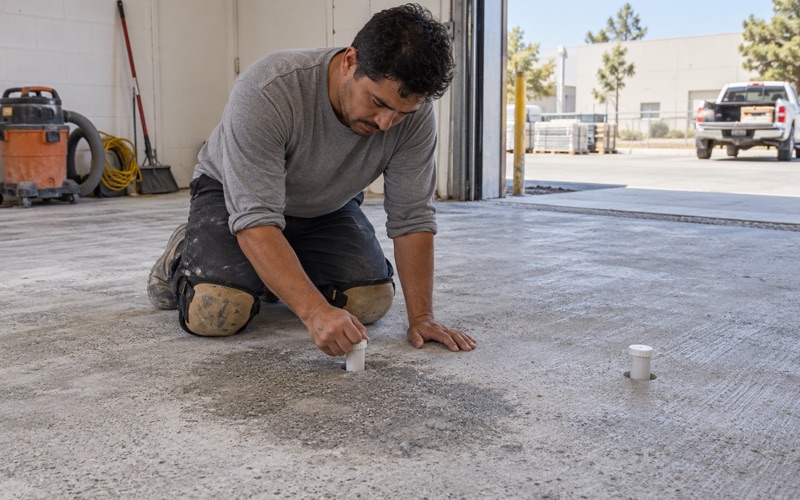
We measure with in-situ relative humidity probes to ASTM F2170, which reads the state of moisture inside the slab, or calcium chloride to ASTM F1869, which reads the rate coming out at the surface. Both threshold numbers live in ASTM F710 rather than in the test methods themselves, which is where that citation most often drifts. The ASTM D4263 plastic sheet test is indicative only and it is asymmetric: a positive result fails a slab, and a negative one proves nothing at all.
The reading goes into the proposal in writing before material is ordered, because moisture failure is the one thing almost every coating warranty in this trade excludes. If the number calls for a moisture vapor barrier primer, that is a cost and a day we would rather quote than a callback nobody is obliged to honor.
The workshop on a residential parcel
Toward the eastern end of Mentone, past the flat townsite grid, parcels get larger and older and often carry a detached shop that sees genuinely industrial wear. The floor may be doing a shop’s work, but the parcel is residentially zoned, and under Rule 1113 that makes it residential property regardless of what is parked on it.
That constrains the product honestly rather than conveniently. It does not mean the floor cannot take abuse — a compliant floor coating at a proper mil build over a properly profiled slab is a serious system — but we will not borrow a commercial product to solve a residential job, and anyone offering to is offering you a rule violation as a feature.
Ownership, And Who Can Actually Say Yes
Mentone’s ownership rate is 68.1 percent, and 382 of its detached houses are rentals. On a garage floor the person who signs has to own the property, so the honest addressable market here is 1,923 owner-occupied single-family detached houses, not 3,690 housing units and not 9,557 residents.
That shapes the quote. On a rental the decision lands at turnover and is priced on durability and turnaround. On an owner-occupied house with thirty years of tenure the repair-or-replace read is worth more than a fast number — including in the case where coating the slab is the wrong place to spend the money.
- 20+ Years on Inland Empire Concrete
- Every Slab Moisture Tested
- Free Written Proposals