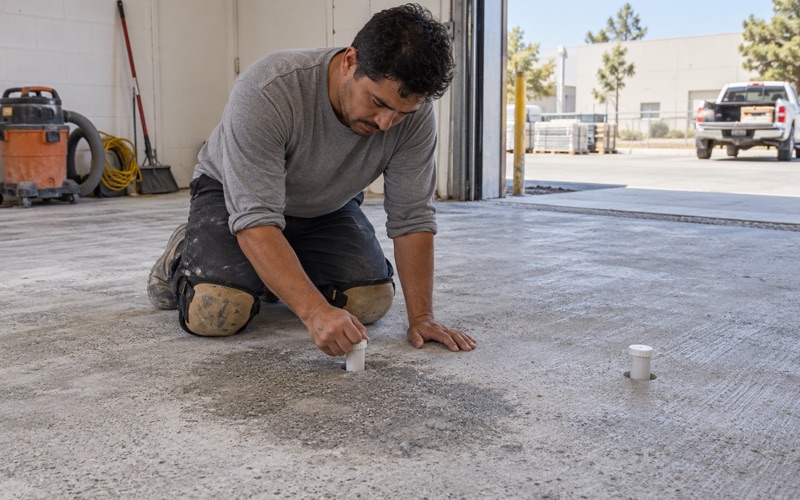
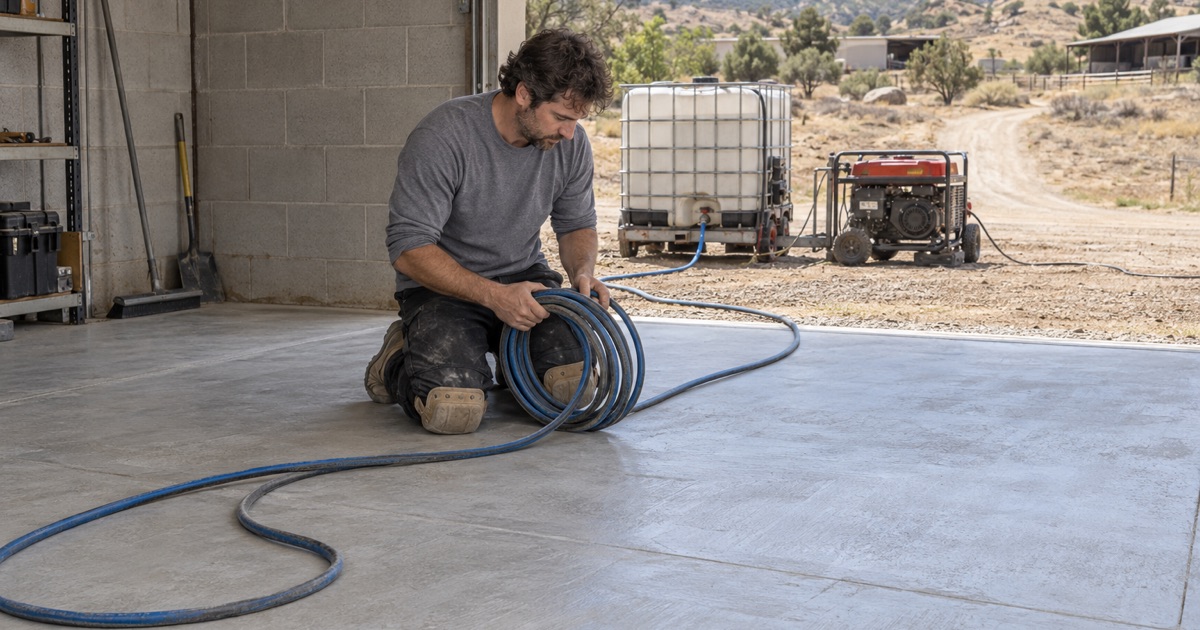
Redlands Epoxy Floors has been installing epoxy flooring in Mead Valley for more than twenty years, and out here the job starts well before the slab does. A planetary grinder, a dust extraction rig, a generator and enough material for the floor all have to physically arrive at a building that is often several hundred feet back from a road the county has not paved. Getting that right is the difference between a crew working by eight in the morning and a truck sitting in soft ground.
So we quote mobilization here as a real line rather than as a formality. We ask what the driveway is made of, how long it runs, how steep it is, whether a truck and trailer can turn around at the end of it, and what happens to that surface after rain. We would rather ask four questions on the phone than send a rig down an approach it cannot come back up.
We also arrive assuming nothing is waiting for us. Water, power and dust containment come on the truck, and the specification itself is written from readings taken on site: the slab’s surface temperature, its moisture reading, and the profile we can open it to. The proposal states the system by name with its data sheet attached and the mil build as a number, so what you are buying is legible before anyone drives out.
Getting a Grinder Down an Unpaved Road
The Infrastructure Gap Is Documented, Not Assumed
This is not an impression formed from a windshield. Riverside County’s own Unincorporated Communities Initiative targets communities like this one for street lights, paved streets, water lines and sidewalks, and county reporting describes residents living in homes off unpaved roads here. The county’s District 1 supervisor has publicly described the community as lacking services, amenities and infrastructure. We plan the work around what is actually on the ground rather than around what a map implies.
Long Driveways to Buildings at the Back of the Parcel
The residential parcels here are large, and the building we are coating is frequently not the house. County land use designations across the community expect limited agriculture and animal keeping, and the county’s own environmental review of a local site describes existing conditions as large-lot single-family homes with ancillary structures and outdoor storage. A detached shop, barn or equipment building at the back of an acre-plus parcel is the normal job, and every piece of equipment has to travel that distance twice.
What We Confirm Before the Truck Is Loaded
Surface, length, grade, turning room, overhead clearance and gate width, plus where a trailer can be parked without blocking anyone. On an unpaved approach we also want to know how it drains, because a driveway that is fine in August can be impassable for a loaded rig two days after a storm. None of this is exotic; it is simply the part of the job that gets skipped by people who quote from a satellite image.
Looking for epoxy flooring closer to Woodcrest? See Epoxy Flooring Services in Woodcrest.
Water, Power and What the Crew Has to Bring
We Grind Dry, With Extraction
Opening concrete produces either dust or slurry, and out here dry grinding with HEPA extraction is the right answer for practical reasons rather than aesthetic ones. It does not require a water supply we cannot assume exists, and it does not generate slurry that has to go somewhere on a property whose drainage and disposal arrangements are not ours to guess at. The dust is captured at the tool and leaves with us.
Sewer Service Is Arriving, Slowly
The scale of that constraint is easy to state. Eastern Municipal Water District only broke ground in fall 2024 on the Cajalco Corridor sewer project — roughly 11,500 feet of new gravity sewer along Cajalco Road, partly funded with American Rescue Plan Act money administered by the county, and built to accommodate future growth. Much of the community remains unsewered. That is a live, recent infrastructure fact, and it is one reason we do not plan work around washing anything down.
Power Gets Checked, Not Assumed
Grinding concrete with dust extraction is not a single-circuit operation, and an outbuilding is often fed from the house on a run that was never sized for it. We confirm what a building can actually supply before the day rather than tripping a breaker at nine in the morning, and where the answer is not enough, we bring our own generation. Same principle as the water: nothing about the job should depend on the site providing something nobody checked.
What the Buildings Here Actually Are
Population Is the Most Misleading Number Available
There are around 19,286 people here and about 2,530 detached houses. Manufactured homes are a very large share of the housing — well over a third of all units — and those carry carports rather than garage slabs, so sizing this market by population overstates it by roughly two to one. We say that plainly because it explains why we treat this community as a place for specific, well-scoped jobs rather than volume.
An Old Tail That Makes Moisture Testing Scope
Roughly a quarter of the housing here predates 1970 and a meaningful slice predates 1960, with a few hundred units going back before 1950. Under-slab vapor retarders were not routine practice that far back, so on that stock a moisture reading is scope rather than an upsell. We measure in-situ relative humidity to ASTM F2170, which reads a state inside the slab, or calcium chloride to ASTM F1869, which reads a rate at the surface, and compare the result against the thresholds — which live in ASTM F710, not in either test method. Taping down plastic, ASTM D4263, works in one direction only: a positive fails a slab, a negative proves nothing.
Where the Legal Line Falls Between Neighbors
South Coast AQMD Rule 1113 caps floor coatings at 50 g/L VOC and industrial maintenance coatings at 100 g/L, treats the two as mutually exclusive categories, and in subsection (c)(6) prohibits applying or even soliciting the application of an industrial maintenance coating for residential use. In a place where a warehouse and a horse property can share a fence line, that produces a genuinely local complication: a shop or barn on a residentially zoned parcel is a residential job however industrial the wear on its floor, and the same crew can be legally constrained on one side of a street and not the other. We make that call deliberately on every quote rather than by habit.
Heat in a Building With Nothing Conditioning It
An Uninsulated Shop Is Worse Than a Garage
An attached garage borrows some stability from the conditioned house next to it. A freestanding metal or uninsulated shop at the back of a parcel borrows nothing, so its slab tracks solar gain directly and can run well past what an air temperature reading suggests. We take the surface temperature of the concrete before mixing, because that reading is the one the product data sheet actually cares about.
Pot Life Is a Curve, Not a Number
On one published product, working time runs roughly sixty minutes at 55 degrees, about forty at 72 and about twenty at 95, while the recoat minimum collapses from twenty-four hours to six. An uninsulated inland slab in summer can approach the 160-degree surface maximum that data sheets set as an upper limit. Practically that means early starts, small batches and more hands on a big floor — a scheduling and crew-size decision rather than a product decision.
The Floor and the Ceiling Both Matter
The other end of the range still applies out here on a cold morning: air, surface and material all need to be above the fifty-degree minimum, the surface has to sit at least five degrees above the dew point, and ambient humidity has to be at or below 85 percent. Those are measurements we take rather than conditions we assume, and we will move a start time rather than place material into a window that is closing.
The Industrial Edge, Described Accurately
A Corridor Along the Eastern Boundary
The commercial half of this market is genuinely large and genuinely growing. The Mead Valley Area Plan designates 999 acres of Light Industrial and 524 acres of Business Park, with a substantial industrial strip running along almost the entire eastern edge of the community west of Interstate 215. Riverside County’s Board of Supervisors approved the Cajalco Commerce Center on October 21, 2025 — a little over 1,003,510 square feet of warehouse with 152 loading dock doors on roughly 44.74 net acres, together with nearly $38 million planned for flood control, drainage and road improvements.
New Slabs, Dock Aprons and Maintenance Bays
That pipeline is new construction rather than turnover, and the floor work that comes with it is a different animal from a residential job: joint filling and semi-rigid filler on freshly cut control joints, dock approach repair, sealers and hardeners across large fields, and coated maintenance and battery-charging bays with the chemical resistance those actually require. It is also work sequenced around a general contractor’s schedule and a slab’s own cure age, which is a conversation to have early.
Where the Boundary Really Runs
One honest caveat, because a lot of published material blurs it: the Mead Valley Area Plan covers considerably more ground than the census-designated community itself and extends into incorporated city land. Plenty of large industrial buildings carry an address inside that plan area while sitting outside the community proper. We will tell you which side of that line a building is on rather than claiming a corridor that is next door.
Who Issues the Permit
There is no city government and no city building department here. Permits and inspections for unincorporated Riverside County run through the Riverside County Building & Safety Department within the Transportation and Land Management Agency, at 4080 Lemon Street in Riverside, with applications filed through the county’s PLUS Online portal. Land use is governed by the Mead Valley Area Plan rather than by a city general plan, and knowing which counter to call is worth more than it sounds when there is not a local one.
- 20+ Years on Inland Empire Concrete
- Every Slab Moisture Tested
- Free Written Proposals