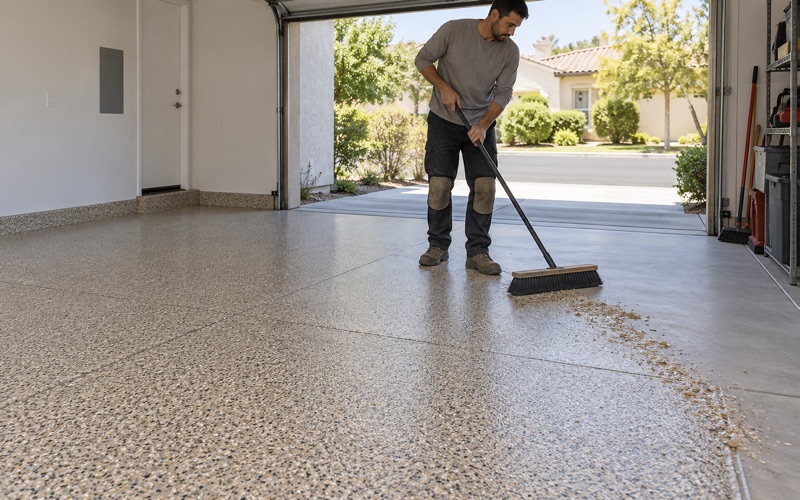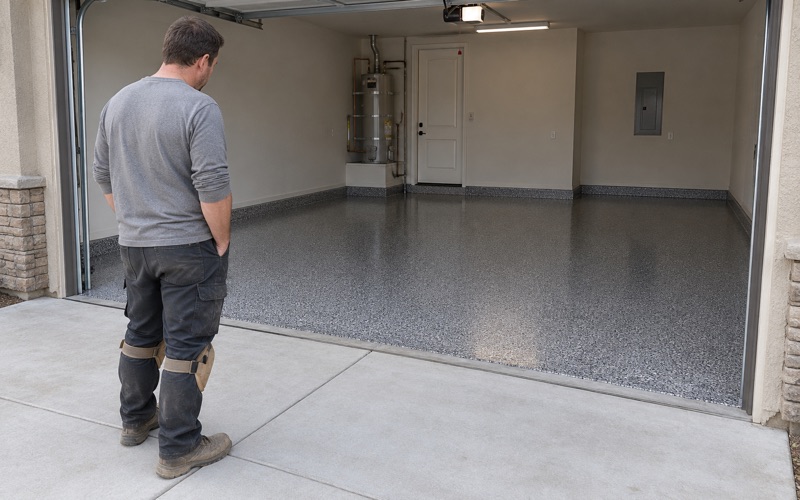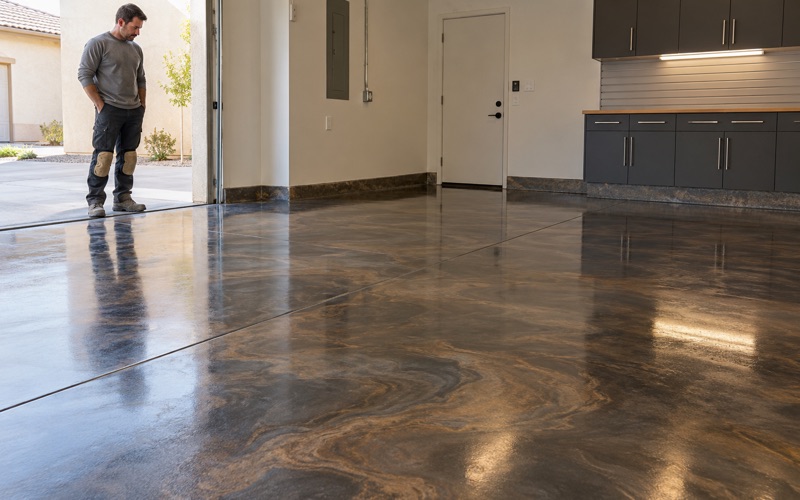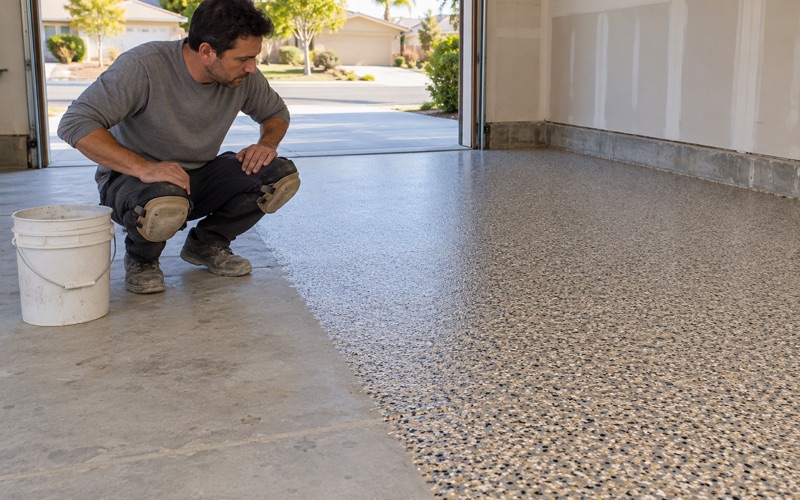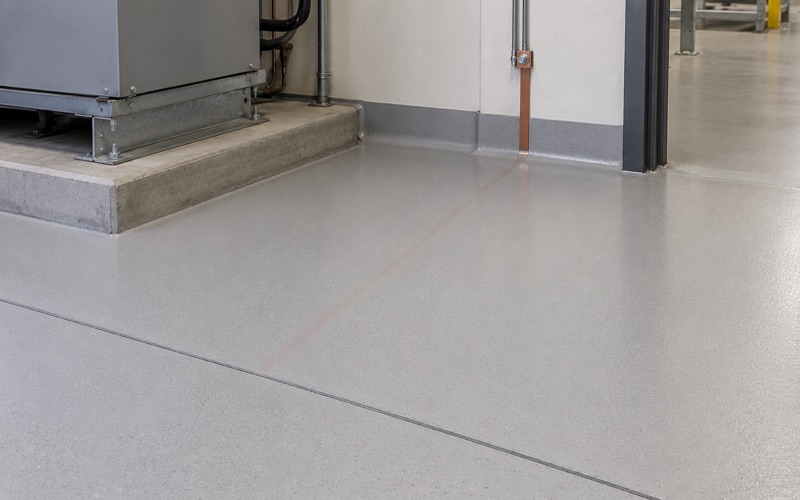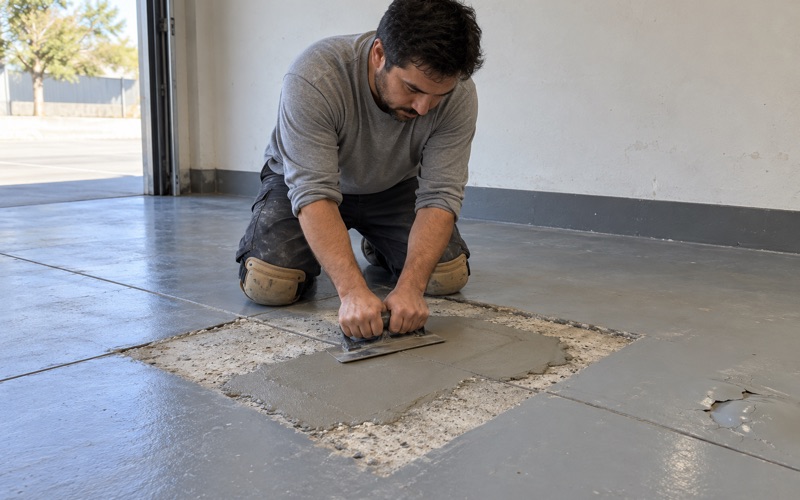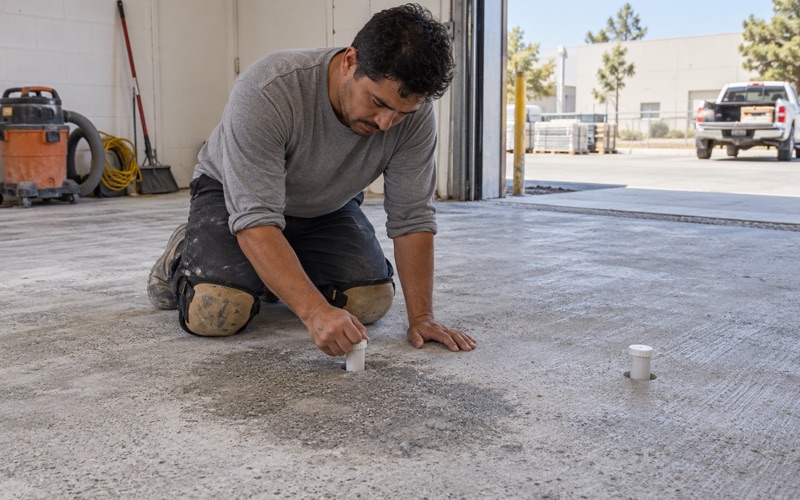
Redlands Epoxy Floors installs epoxy flooring in March ARB, and every job we have quoted in this geography has been a hangar deck, a shop or maintenance floor, a business park slab or a warehouse floor. Over twenty-plus years on Inland Empire concrete we have learned which places support a residential book of work and which do not, and this is firmly the second kind.
So the plain version first: there is effectively no homeowner market at March ARB. Owner-occupied housing here is so scarce that it cannot be counted reliably at all, and the occupied stock is overwhelmingly rented. Anyone presenting this as a garage-coating market is describing something that is not there, and we would rather be the page that says so.
What is here is commercial, industrial and institutional floor area, on ground with an unusually complicated authority structure. The method we bring to it is unchanged — a moisture reading taken before material is ordered, concrete opened mechanically with diamond tooling to a named ICRI concrete surface profile rather than acid-etched, mil build stated as a number in the proposal with the product data sheet attached — but the procurement, the access and the permitting all work differently, and knowing which regime a building sits in comes before quoting it.
A Census Place That Is Mostly an Airfield
March Air Reserve Base has been a military installation since 1918 and covers roughly 2,075 acres. It hosts the Air Force Reserve Command’s Fourth Air Force headquarters and the 452d Air Mobility Wing, along with units from the Army Reserve, Navy Reserve, Marine Corps Reserve, the California Air National Guard and the California Army National Guard.
From Active Duty to Reserve, and 4,400 Surplus Acres
The base was selected for realignment in July 1993 and converted from an active-duty installation to a Reserve base effective April 1, 1996, releasing on the order of 4,400 acres as surplus. That release is the origin of everything commercial in this geography. The buildings a coating contractor is likely to work in are either on the remaining installation or on land that came out of it thirty years ago and has been developed since.
A Small Resident Population on a Large Footprint
The census-designated place recorded 809 residents in 2020, down from 1,159 in 2010, across roughly 850 housing units — and every one of those counts carries a wide margin of error, so they are useful for shape rather than for arithmetic. A place with that little housing and that much acreage is, for our purposes, a concentration of commercial and institutional floor rather than a community with garages in it.
Looking for epoxy flooring closer to Bloomington? See Epoxy Flooring in Bloomington.
Who Holds Authority Over Which Ground
This is the single most useful thing to understand before pricing anything here, and it has changed recently. Three separate regimes cover ground that looks continuous from the road.
The Active Installation Is Federal
Work on the installation itself is federal contracting rather than city- or county-permitted construction. There is no city government and no city building department, because March ARB is a census-designated place rather than an incorporated city. That changes the paperwork, the lead time and who signs, and it is not a detail that can be sorted out after a quote is accepted.
The County Took the Reuse Land in July 2025
Effective July 1, 2025, Riverside County’s Transportation and Land Management Agency became the land use authority for approximately 3,600 acres of former March Joint Powers Authority territory outside the airport, under a newly adopted March Area Plan in the County General Plan. That authority had sat with the March Joint Powers Authority since March 11, 1997, and the JPA voted in 2024 to relinquish it. Businesses on that ground are now directed to the county for planning and permitting. It is worth noting that the county’s plan area and the census place are different geographies with no clean crosswalk between them.
The Airport Stayed With the Joint Powers Authority
The March Joint Powers Authority — formed in September 1993 by Riverside County and the cities of Riverside, Moreno Valley and Perris, and federally designated as the local redevelopment agency for the realigned base — retains the airport through the March Inland Port Airport Authority. That is a joint-use aviation facility of roughly 350 acres in the southern portion of the field, capped at 21,000 civilian operations a year with military operations taking priority, and running well under that cap in practice. The air-cargo operator that had been using it departed in May 2025.
What Actually Gets Coated Here
Three categories account for nearly all of it, and none of them is a garage. Each carries a different specification and a different procurement path.
Business Park and Industrial Floors
The county’s own land use accounting for this territory is lopsided in a way that tells the whole story: on the order of 1,109 acres designated Business Park and 800 acres Industrial, against 61 acres of historic district residential. Meridian Business Park is the built product on that land, with McLane Foods, Fresh and Easy, Kia Motors and Sysco Foods among the tenants that have taken space there over the years, including a 500,000 square foot Sysco facility. Those are polished concrete, joint filling, dock-area coating and marking jobs, sequenced by bay against an operating schedule rather than done in a shutdown.
Hangar and Maintenance Decks
A working airfield puts hangar floors, shop decks and equipment bays on the table, and that is a category almost no local contractor names at all. Those floors are specified against fuel, engine oil, solvents and hydraulic fluid, against point loading from jacks, stands and tow equipment, and where fueling or avionics work happens, against a surface resistance range that has to be measured on the installed floor rather than taken off a data sheet. A chemical resistance chart is a starting point, since concentration, temperature and dwell time change every entry on it.
Older Institutional Slabs
There is a genuine historic-slab story here, and it is institutional rather than residential. The March Field Historic District was listed on the National Register on December 6, 1994, laid out by the architect Myron Hunt in Mission Revival style to 1920s City Beautiful planning principles, with a period of significance running from 1928 to 1943 and much of its construction using hollow-wall concrete methods. Concrete of that era predates routine under-slab vapor retarders entirely, so those floors get a measurement: in-situ relative humidity to ASTM F2170 or moisture vapor emission rate to ASTM F1869, judged against the thresholds in ASTM F710 rather than against the test methods. Taping plastic down under ASTM D4263 is asymmetric and cannot clear a slab — a positive fails it, a negative establishes nothing.
Base Access Is the Schedule
On the installation, site control is a security question rather than a question of street width or driveway grade. Base access and clearance procedures add lead time that no ordinary commercial job carries, and material deliveries, dust extraction equipment and crew rosters all have to be arranged around them. We build that into the program up front, because a crew that cannot get through the gate on the agreed morning has lost the pour, not just the day.
Being Honest About a Thin Market
It would be easy to write this page as though March ARB were a suburb. It is not, and the numbers say so clearly enough that pretending otherwise would be a straightforward misrepresentation.
The Census Cannot Find Owner-Occupiers
Of roughly 596 occupied units, about 22 are recorded as owner-occupied — with a margin of error wide enough that the true figure is statistically indistinguishable from zero — against roughly 574 renter-occupied. That is a 96.3 percent renter share and an addressable homeowner pool of at most a few dozen households. It is not a market, and a page built on the pretense that it is would collapse the first time a reader checked.
Green Acres Is a Managed Enclave, Not a Homeowner Base
The one named residential sub-geography worth knowing is Green Acres, constructed as base housing and carrying a dedicated Historic District land use designation over 61 acres at two dwelling units per acre. County policy restricts it to continued residential occupancy or limited service and retail uses that maintain the district’s historic integrity, and states that no additional development is permissible. That is a property-management or government-contract conversation about a fixed, design-restricted stock — not a homeowner sale, and not a place where a decorative finish decision is being made unit by unit.
Rule 1113 Still Draws the Line
SCAQMD Rule 1113 applies here as everywhere in the basin: floor coatings capped at 50 g/L VOC, industrial maintenance coatings at 100 g/L, the two categories mutually exclusive by definition, and subsection (c)(6) prohibiting the application or the soliciting of an industrial maintenance coating for residential use. That subsection needs care precisely because the residential stock here is institutionally owned — a dwelling is residential property under the rule regardless of who holds the title, so the commercial product line is not available for it.
The Slab Still Sets the Hour
Cure conditions are the same inland conditions as the rest of this region. Pot life on a published system runs roughly sixty minutes at 55 degrees and about twenty at 95, so a summer pour on a large deck means small batches and an early start with slab temperature read at the surface rather than air temperature read off a phone. The floor has to sit at least five degrees above the dew point, with a minimum near fifty degrees for the air, the surface and the material alike, and on an uninsulated slab in July those two constraints close the working window well before the workday ends.
- 20+ Years on Inland Empire Concrete
- Every Slab Moisture Tested
- Free Written Proposals