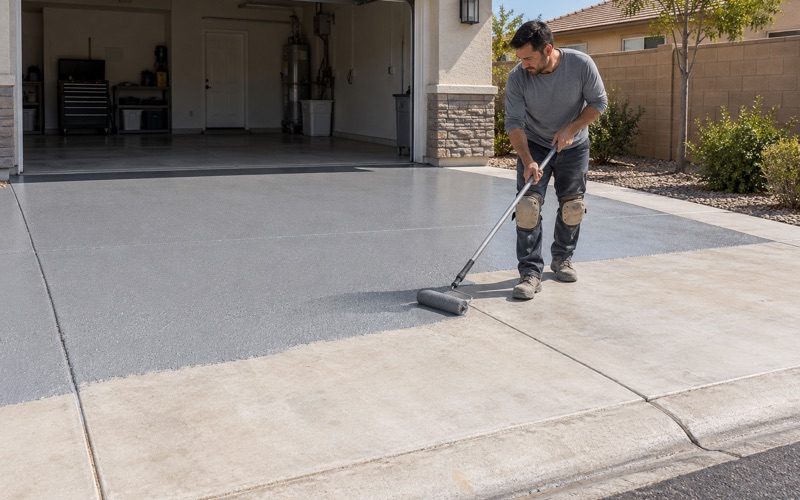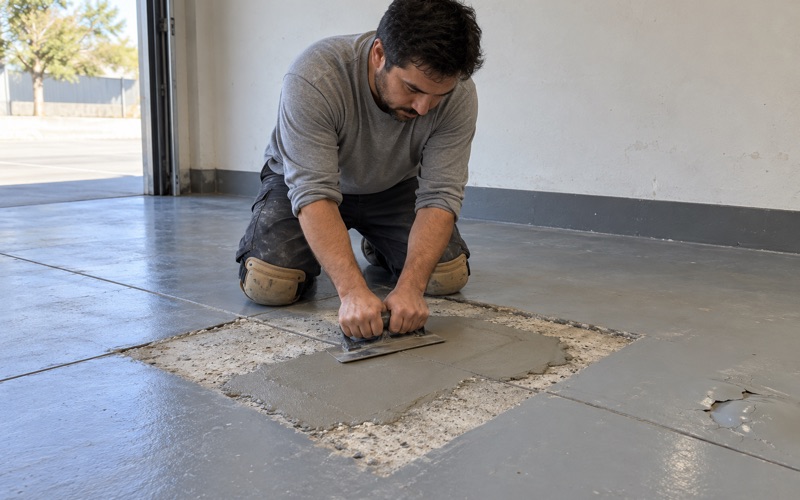
Redlands Epoxy Floors has been installing epoxy flooring in Lakeview for more than twenty years, and the first thing worth saying about this community is that a lot of the concrete here is not inside a garage. More than a third of the homes are manufactured, which means a carport rather than an enclosed bay, and the slab we are asked to look at is usually open to the weather on two or three sides.
That is a different specification, not a smaller version of the same one. A floor with walls around it is protected from ultraviolet light, rain, wind-blown grit and the daily temperature swing that an exposed slab takes all year. A carport pad, a patio and a walk are exposed to every one of those, so the system that belongs on them is chosen for exterior service rather than borrowed from a garage job and hoped for.
We tell people plainly which of their concrete is a good candidate and which is not. Some exterior slabs out here want a full resinous system, some want grinding and a densifier and nothing more, and some are past the point where money spent on the surface makes sense. That read goes in writing before anything is ordered, alongside the system name, its product data sheet, the mil build as a number and the moisture reading we measured.
A Community Where Most Homes Have No Garage
Manufactured Housing Changes the Whole Question
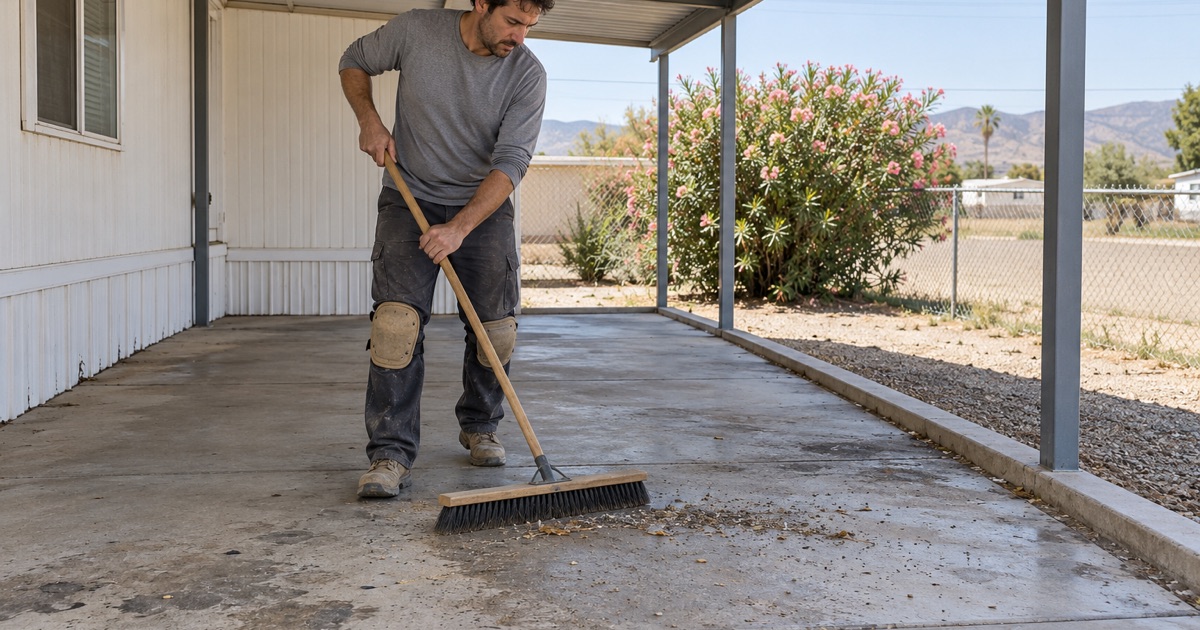
Manufactured homes are more than a third of the housing stock here, the highest share we encounter anywhere we work. Those homes come with a carport and an awning, not with an enclosed garage, so the usable concrete is the parking pad, the walk from it, the patio slab and whatever pad was poured for a shed or a water softener. A contractor who assumes a garage behind a Lakeview address is wrong about better than one home in three.
Detached Houses, and Nothing Above Two Stories
The rest is single-family detached — somewhat under three hundred houses in total — with no attached houses and no multifamily buildings of any size anywhere in the community. There is nothing here that resembles a shared parking structure or a common-area floor. It is individual owners with individual slabs, and the ownership rate is high, so the person we are quoting is almost always the person who will use the floor.
A Small Market, Described Honestly
The population is under two thousand and has been drifting down rather than up. There is one small retail center in a largely undeveloped commercial zone, and effectively no industrial base at all. We would rather say that than dress this page up as something it is not — the work here is residential and exterior, and that is genuinely what we come out for.
Looking for epoxy flooring closer to Mead Valley? See Epoxy Flooring in Mead Valley.
What a Carport or Patio Slab Actually Needs
Sunlight Is the Constraint a Garage Never Has
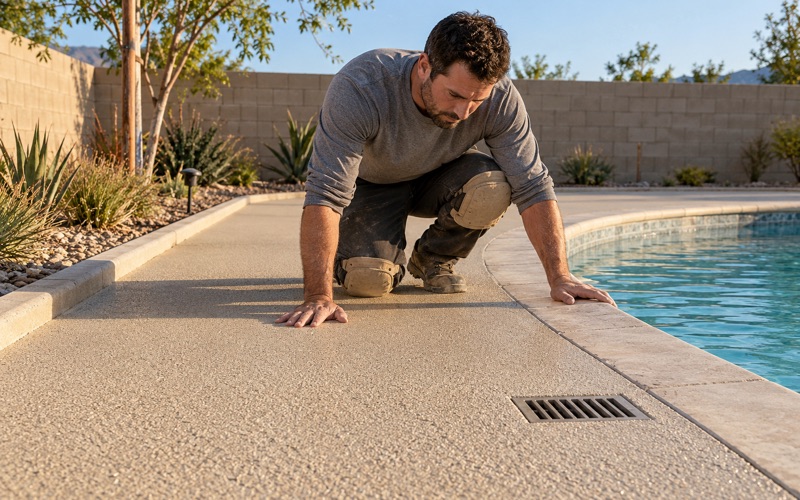
Standard epoxy ambers under ultraviolet light. In an enclosed bay that does not matter much; on a carport pad in full southern-exposure sun it matters within a season or two, and it is the most common reason an exterior coating out here looks tired long before it has worn out. An aliphatic polyaspartic holds color under UV, which is why exterior slabs get one as the wearing surface rather than an epoxy left exposed.
Grip Where the Slab Gets Wet
An exterior slab is a wet slab several times a year, and it is walked on in ordinary shoes rather than work boots. Slip resistance is a measurable property, and DCOF is the figure to ask for rather than an adjective, with texture controlled by broadcast rate and aggregate size. A quartz broadcast builds genuine texture where a patio or a carport approach needs grip; a smooth, glossy finish that looks striking in a photograph is unpleasant and unwise underfoot in the rain.
Color as a Temperature Decision
On a slab in full sun in this valley, color is about surface temperature before it is about appearance. Infrared-reflective pigment keeps a patio or pad measurably cooler underfoot than the same shade formulated without it, which is why the conversation about an exterior slab starts with how hot the surface actually gets and only then moves to what shade it should be.
Edges, Awning Posts and the Line Where Concrete Stops
An exterior slab has free edges, and a coating that stops in an untidy line at one will lift there first. Edges get cut and detailed rather than feathered out, coating is carried properly around awning posts and column bases instead of stopped short of them, and where a slab meets dirt or gravel the termination is treated as a detail to design rather than a place to run out of material.
Coating Concrete That Lives Outdoors
Heat Governs the Working Day
Slab temperature, not the calendar, decides when material can go down. The same product with roughly sixty minutes of pot life at 55 degrees can have about twenty at 95, and a bare pad or a metal-roofed shop in this valley in August runs hotter than an air-temperature reading suggests. That means early starts, small batches and a surface reading taken before mixing rather than a scheduled time somebody committed to a week earlier.
The Dew Point Rule Cuts Both Ways
The surface has to sit at least five degrees above the dew point when material is placed, and air, surface and material all have to be above the fifty-degree minimum, with ambient humidity no higher than 85 percent. Outdoors those conditions move through the day rather than staying put, so an exterior job is scheduled inside a window rather than across a whole day, and we will stop rather than place material into a condition that guarantees a bond failure.
When the Honest Answer Is Less Coating, Not More
Not every exterior slab should be coated. A badly cracked patio that is still moving, a pad that spalls under a screwdriver, or a walk that will be replaced in three years is not a candidate, and grinding plus a lithium silicate densifier — hardening the concrete and leaving it as concrete — is often the better spend. We will say that, and we would rather lose the sale than place a system on a slab that was never going to hold it.
The Oldest Slabs in This Part of the Valley
An Old Tail Under a 1970s Bulk
Most of the housing here came out of the 1970s, but there is a genuinely old tail underneath it: roughly one unit in six predates 1950, and a meaningful share of that goes back before 1940. Those are original slabs — likely unreinforced, poured before under-slab vapor retarders became routine practice, and carrying prior repairs of unknown composition that a new system may or may not bond to.
This Is the One Place the Moisture Argument Is Load-Bearing
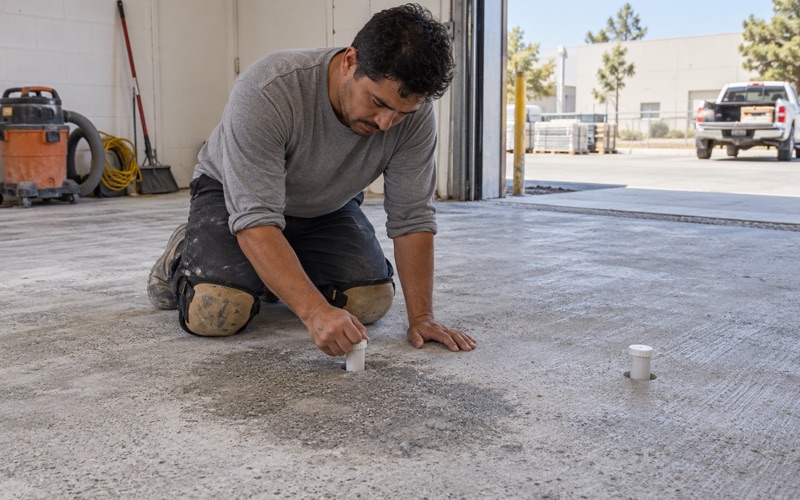
On stock that old, a moisture reading is not an upsell, it is the thing the specification turns on. We measure in-situ relative humidity to ASTM F2170, which reads the state inside the slab at depth, or calcium chloride to ASTM F1869, which reads a rate at the surface, and compare the result against the thresholds — which live in ASTM F710 rather than in either test method. The number goes into the proposal, because moisture failure is the one thing almost every coating warranty excludes.
What the Plastic Sheet Can and Cannot Tell You
Taping a sheet of plastic to a slab and looking for condensation underneath is ASTM D4263, and it works in exactly one direction. A positive result fails the slab outright. A negative result proves nothing at all, because the method is not sensitive enough to clear one. It is a useful ten minutes as a first look on an old floor and useless as a clearance test, whatever a search result may say.
Ground, Never Etched
Every slab we coat is opened with diamond tooling to a named ICRI concrete surface profile, with grit sequence and diamond bond hardness matched to the concrete itself. Acid etching leaves a softened skin that a coating keys into and later releases from in sheets, and on a weathered exterior slab that is a particularly poor gamble. Where a slab is genuinely old, the first grinding pass is also a diagnostic — sound concrete cuts differently from concrete that has been quietly deteriorating.
Getting to the Job, and Who Issues the Permit
Long Approaches and Unpaved Driveways
The parcels north of the Ramona Expressway are dairy land and run far larger than the residential lots, which means long driveways, gates and equipment yards are ordinary here. A grinder, a dust extraction rig and a generator all have to physically reach the building, so we confirm driveway surface, length, grade and turning room while quoting rather than discovering the problem with a loaded trailer on a soft approach.
Well and Septic, So We Grind Dry
On the larger rural parcels the working assumption is a well and a septic system rather than a municipal connection. That means there is no supply to draw from and no storm drain to be careless near, and it is a good reason to grind dry with HEPA extraction rather than using any wet method. We bring our own water and power and we take the slurry-free dust away with us.
There Is No City Hall to Call
Lakeview is an unincorporated census-designated place with no city government, so the building authority is the Riverside County Building and Safety Department within TLMA, at 4080 Lemon Street on the ninth floor in Riverside, open Monday through Friday from 8:00 AM to 5:00 PM. Land use runs through the county’s Lakeview/Nuevo Area Plan. Naming the right counter matters, because there is not a local one.
The Product Has to Suit the Parcel, Not Just the Building
South Coast AQMD Rule 1113 caps floor coatings at 50 g/L VOC and industrial maintenance coatings at 100 g/L, treats the two as mutually exclusive categories, and in subsection (c)(6) prohibits applying or even soliciting the application of an industrial maintenance coating for residential use. Out here that produces a case worth thinking about rather than assuming: a workshop or outbuilding on a residentially zoned parcel is a residential job however hard its floor gets worked, and on a parcel zoned agricultural the classification is worth confirming before a product is chosen rather than after.
- 20+ Years on Inland Empire Concrete
- Every Slab Moisture Tested
- Free Written Proposals