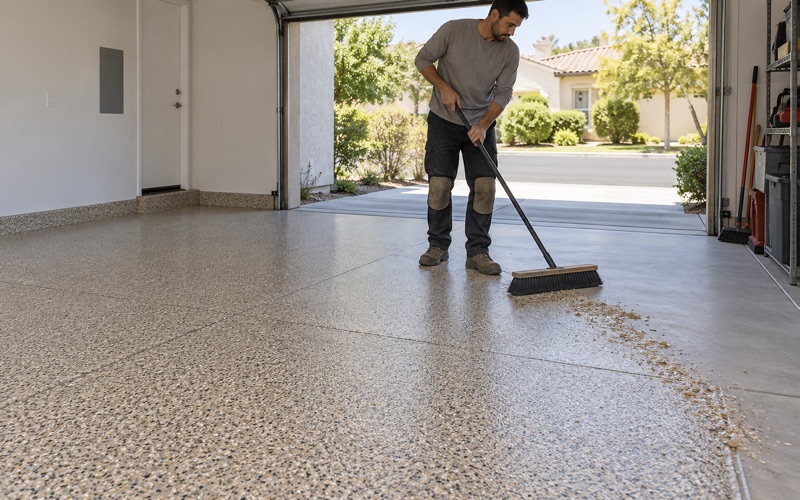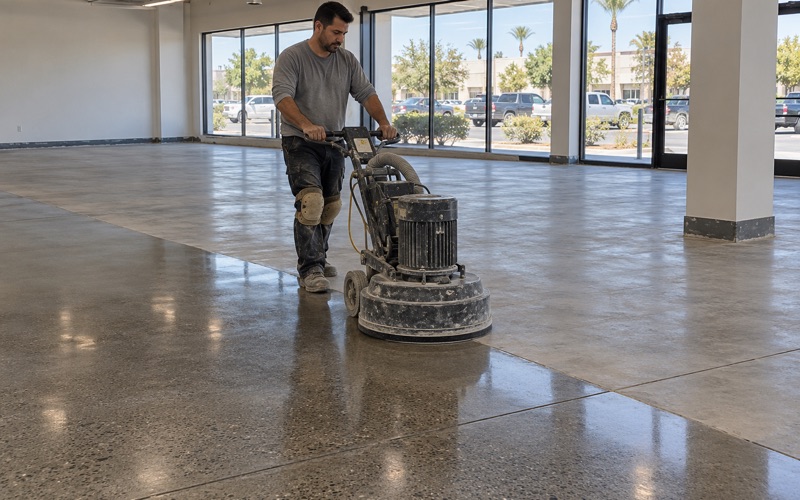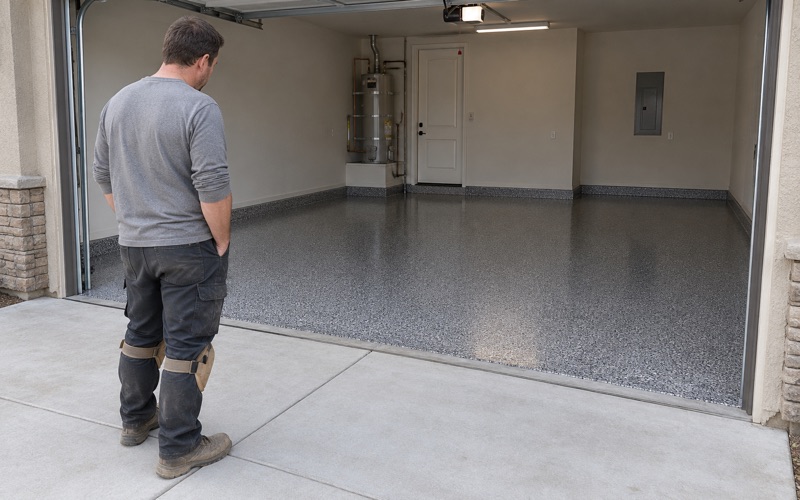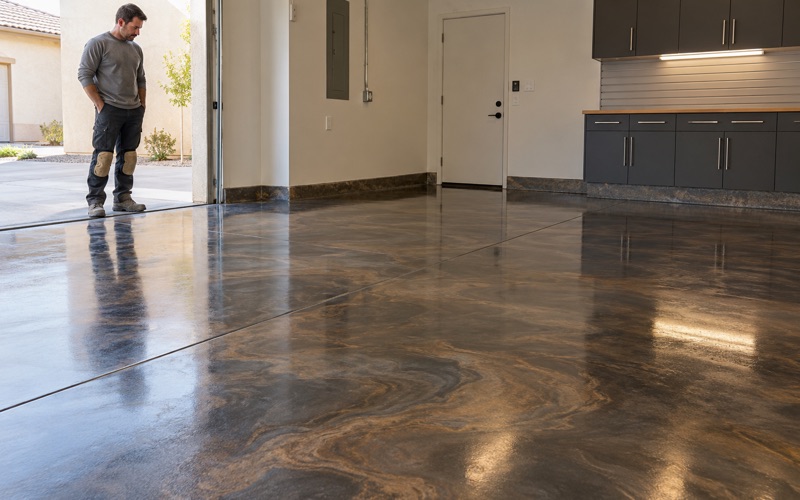
Redlands Epoxy Floors installs epoxy flooring in Lake Mathews, and the most useful thing we can tell you about this market before anything else is what it does not contain. There is no commercial half to it. Not a small one — none.
So this page is about residential work on acreage, and we would rather be specific about that than pad it out. We have more than twenty years on Inland Empire concrete, we install epoxy, polyaspartic and polyurea systems, and every proposal carries the moisture reading, the surface profile and the mil build as numbers with the product data sheet attached.
A Community Organized Around a Reservoir
Land, Water and Habitat Before Buildings
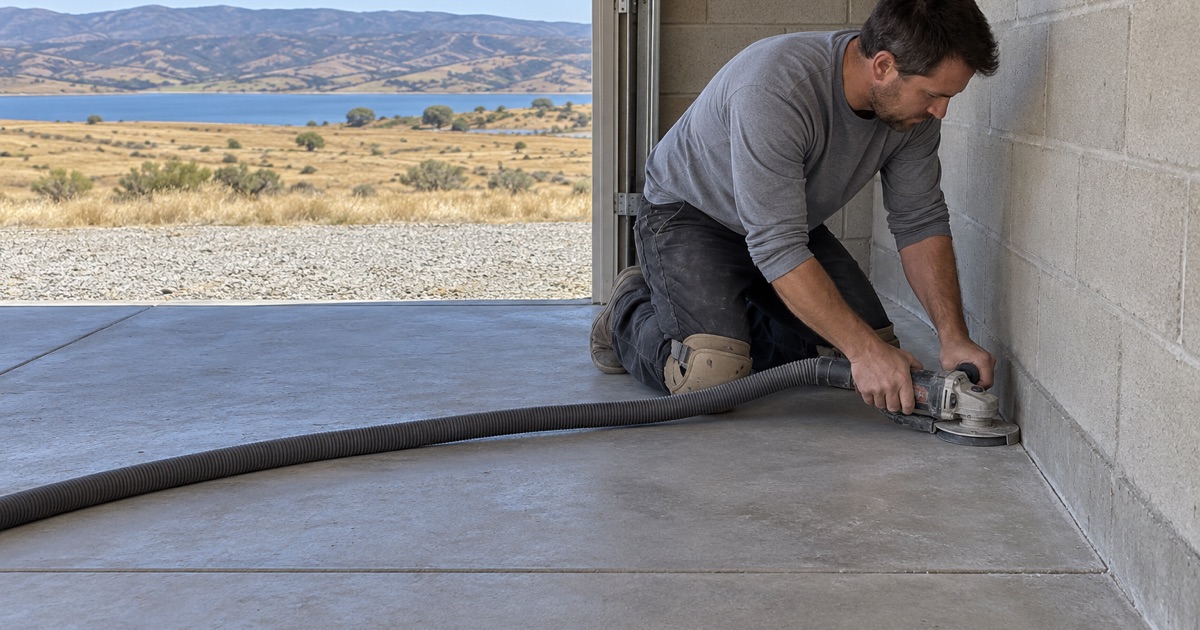
Lake Mathews is an unincorporated census-designated place of roughly 15.9 square miles at about 1,775 feet, and the reservoir at its center covers around 2,800 acres and is closed to public access. It is the terminal reservoir and western terminus of the Colorado River Aqueduct, holding on the order of 182,000 acre-feet for the Metropolitan Water District. Around 13,000 acres of the Estelle Mountain Reserve sit along the western and southern shores as habitat land, and Harford Springs Wildlife Reserve occupies a further 325 acres off Gavilan Road.
Roughly 1,300 Detached Houses in Total
The housing stock is small: on the order of 1,673 total units, with about 77 percent single-family detached and roughly 22 percent mobile homes. Owner occupancy runs near 79 percent. Those ACS estimates carry a wide margin — the unit total alone is plus or minus 280 — so the shape of the distribution is reliable while the individual counts should be read as approximate rather than exact.
Nothing New Is Coming
There is no development pipeline of consequence to plan around. ACS records no units at all built since 2020 and only about 45 across the whole of the 2010s, which is consistent with a planning area where a third of the acreage is designated open space and the minimum lot sizes on the residential designations run to five and ten acres. The work here is on buildings that already exist.
Looking for epoxy flooring closer to Romoland? See Epoxy Flooring in Romoland.
Why There Is No Commercial Work Here
The Property-Management Sale Does Not Exist
The American Community Survey records zero housing units in every multifamily category here, from two-unit structures right through structures of fifty units or more. The county’s own area plan allocates 16,059 acres to open space, 56 acres to commercial retail, 2 acres to commercial office, 146 acres to light industrial, and nothing at all to heavy industrial or business park. Podium decks, subterranean parking, apartment laundry rooms and stairwells, warehouse floors — the property-management and industrial work that carries most of this trade elsewhere simply has nowhere to happen here.
In most cities this trade’s repeat revenue comes from buildings with a manager: common-area floors, parking decks, maintenance shops, trash enclosures, and a maintenance budget that renews. With zero recorded multifamily units of any size, none of that is available in Lake Mathews. Nor is there an industrial belt, a hospital campus or a grocery-anchored center — the nearest retail sits outside the CDP boundary entirely, at Woodcrest Plaza on Van Buren Boulevard and the Gavilan Hills market on Gavilan Road.
What That Means for How We Quote
A contractor who needs a commercial anchor to make a day work will either skip this area or pad a residential job to cover the drive. We would rather price the mobilization honestly and say what it is. When a crew comes out here it is for a specific building on a specific parcel, and the travel and setup are a real line rather than something hidden inside a square foot rate.
The Coating Category Is Settled Before We Arrive
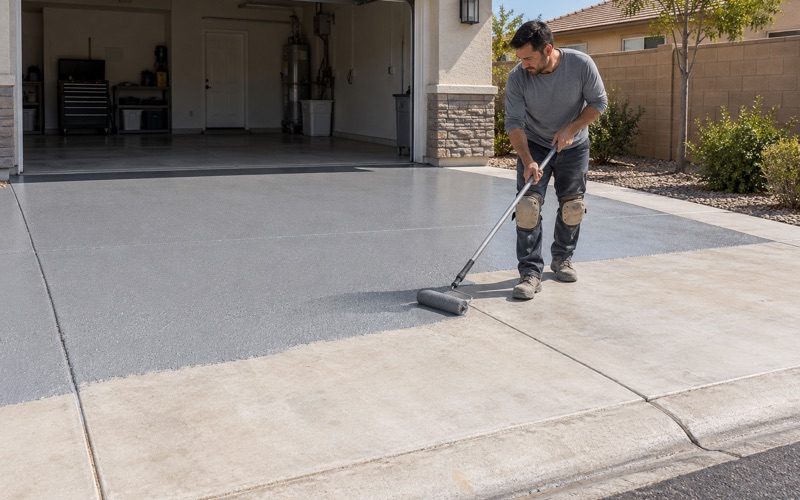
Because essentially every building here sits on residential or rural land, the product selection is decided by South Coast AQMD Rule 1113’s floor-coating category at 50 g/L VOC rather than by the industrial maintenance category. That is not a limitation on performance — high-solids and 100% solids epoxies carry little solvent by design — but it does mean the specification is written once, correctly, rather than borrowed from a commercial job across the county.
Land-Rich and Income-Modest
An Unusual Pair of Numbers
The economic signature here is worth naming because it changes how a quote should be written. Median owner-occupied home value in Lake Mathews runs around $760,900, against a median household income of roughly $94,444. That is high-value property held against a moderate income, which is what decades of large rural acreage looks like in the data, and both figures carry meaningful margins.
Scope Honesty Over Premium Packaging
A buyer in that position is not looking for the most dramatic system on the sample board. They are looking for a floor that is right for the building and priced so the decision is defensible. That argues for a clear scope, an explicit list of what is included and what is not, and a willingness to recommend the smaller job — grinding and densifying a shop slab and leaving it as polished concrete, for instance, where a coating is not the better answer.
Phasing a Big Building
An eighteen-hundred-square-foot shop does not have to be done in one go. Where budget is the constraint rather than intent, we will happily coat the working half now and leave a clean, planned edge for the rest later, in a control joint rather than mid-panel. That is a better outcome than a thin system stretched across the whole floor to hit a number.
Driving to a Job With Nothing Else Nearby
The Driveway Is the Hard Part
Access here is the most demanding of anywhere we work. Parcels are measured in acres, buildings sit hundreds of feet back from the road, driveways are long and frequently decomposed granite rather than paved, and the county itself describes the area as majority hilly with rolling foothills and rugged rock outcroppings. Moving a planetary grinder, a dust extractor, a generator and material up that drive is a genuine mobilization cost and we quote it as one rather than absorbing it and making it up elsewhere.
Power You Should Not Assume
Three-phase service is unlikely on a rural residential parcel out here, so equipment planning starts from single-phase or generator power rather than hoping for a panel that is not there. That is a reasoned expectation from the land use pattern rather than something we have confirmed against a utility map, which is exactly why we ask rather than assume — arriving with a machine the building cannot feed wastes your day as well as ours.
One Trip, Planned Properly
There is no supply house around the corner and no second job down the street to absorb a forgotten item. Everything a job needs comes on the truck, which means the walkthrough has to be thorough: slab dimensions, existing coatings, crack and spall extent, drain locations, door openings and the turning space at the end of the drive. A careful hour at the estimate is worth a wasted day later.
The Residential Work That Does Exist
The Outbuilding, Not the Garage
The realistic target here is the detached building rather than the attached two-car bay. County designations across this area run to Rural Residential at a five-acre minimum and Rural Mountainous at ten, and the rural community designations state outright that intensive equestrian and animal keeping uses are expected. Shops, hay and tack barns, equipment buildings and RV structures are the buildings people actually want coated, and they carry loads a passenger-car garage never sees.
Two Different Duty Cycles
A shop slab takes point loads from jack stands, dropped tools, hydraulic fluid and solvent, and wants impact resistance and a surface that releases oil. A barn slab takes hoof traffic, urine, manure and daily wash-down, and wants chemical resistance, real texture underfoot when wet, and a coved junction at the wall so the floor-to-wall corner can actually be cleaned rather than collecting soil. Specifying one for the other is the common mistake.
Test the Outbuilding, Not the House
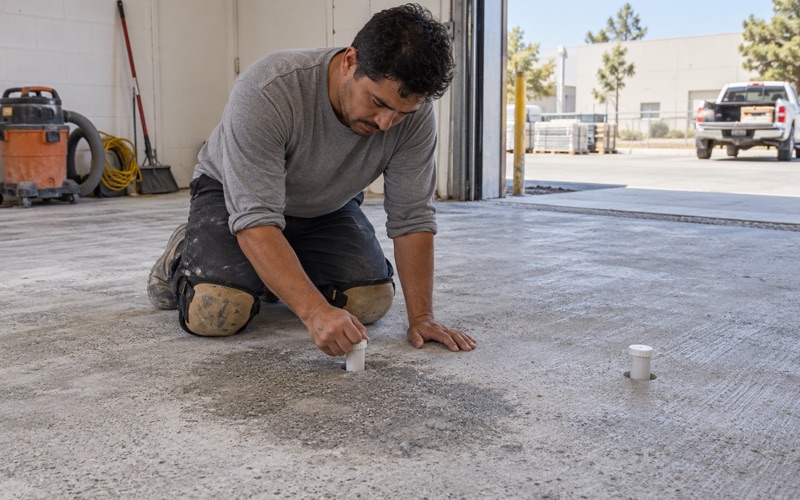
Only about nine percent of the housing stock here predates 1970 and roughly five percent predates 1960, so most residential slabs went in after under-slab retarders became routine practice. Agricultural buildings are the exception that matters: a barn or equipment slab may have been placed to farm practice at any date, with an unknown subgrade underneath it. We test the building being coated — in-situ relative humidity to ASTM F2170 or a surface emission rate to ASTM F1869, read against the thresholds in ASTM F710 where those numbers actually live — rather than inferring from the house next to it. ASTM D4263, the taped plastic sheet, fails a slab on a positive and proves nothing on a negative, so it is a first look and never a clearance.
Heat With Nothing to Buffer It
An uninsulated barn or open-sided shop is a harder cure environment than an attached garage, because there is no conditioned wall against any side of it. Elevation here moderates nothing meaningful in summer. Pot life on one published product runs about sixty minutes at 55 degrees, forty at 72 and twenty at 95, with the recoat minimum collapsing from twenty-four hours to six, so we read surface temperature off the slab, start early and mix small.
Who Issues the Permit
There is no city government here. Permits and inspections for unincorporated Riverside County run through the county’s Building and Safety Department within the Transportation and Land Management Agency at 4080 Lemon Street in Riverside, filed through the county’s online portal, and the governing land use document is the Lake Mathews/Woodcrest Area Plan. Most coating work does not require a permit on its own, but knowing whose jurisdiction a parcel sits in is the first question rather than the last.
- 20+ Years on Inland Empire Concrete
- Every Slab Moisture Tested
- Free Written Proposals