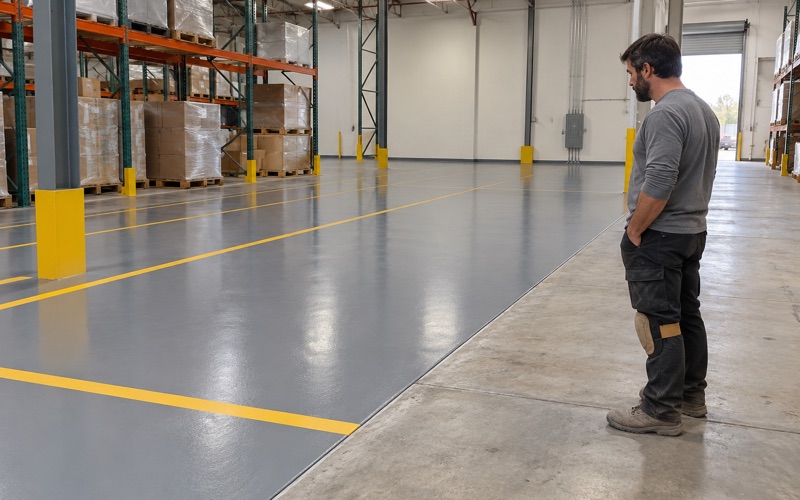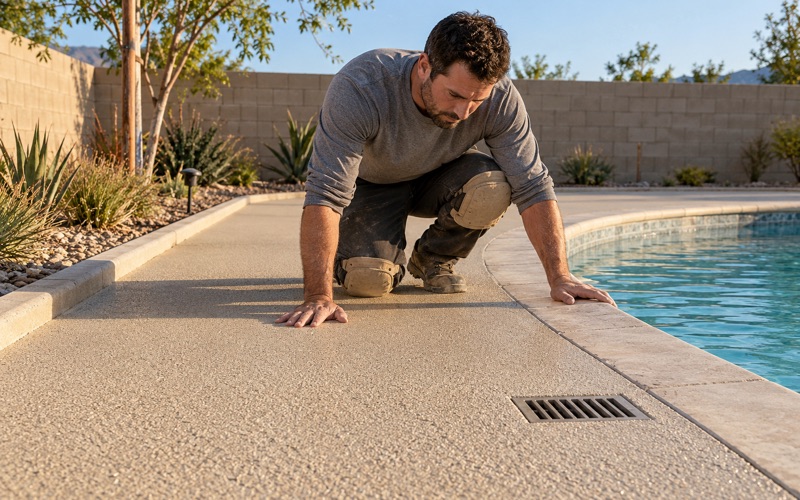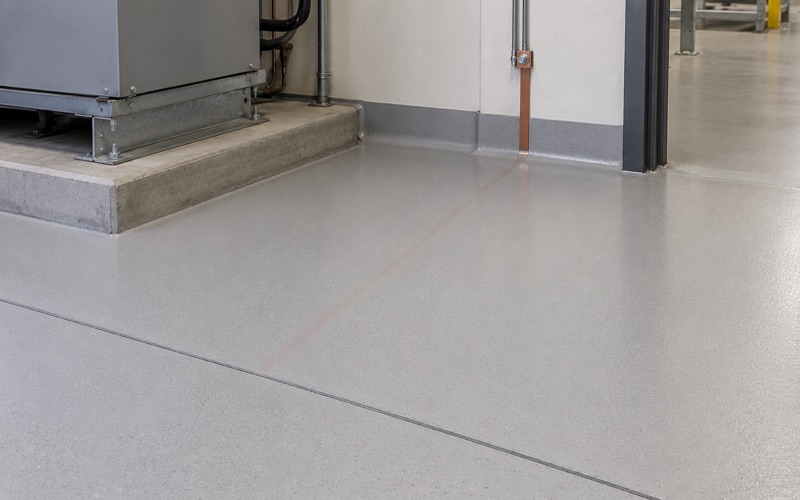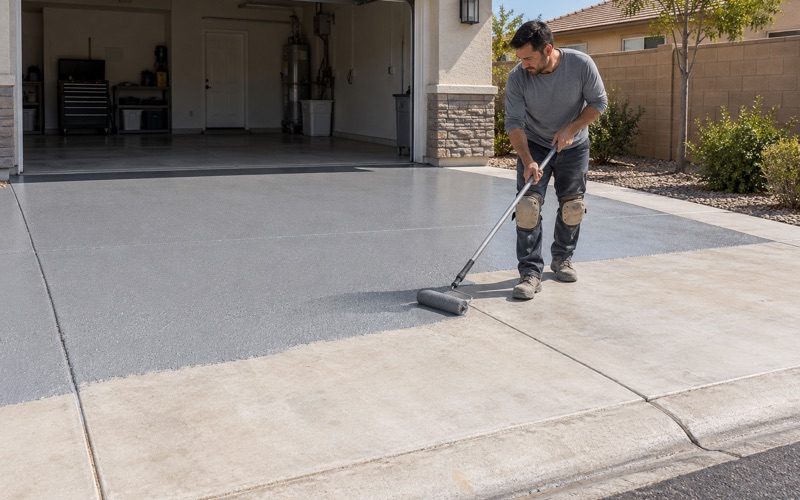
Redlands Epoxy Floors has been putting down industrial epoxy flooring in Jurupa Valley, along with residential garage systems, for more than twenty years, and this is the one city in our service area where two jobs booked for the same day routinely need opposite preparation. One slab is seventy years old and needs a moisture reading and patient crack routing. The other was power-troweled recently and is too tight to bond to until diamond tooling opens it.
That is not a scheduling quirk. It is what the housing and industrial data actually say: more than half the residential slabs here predate 1980 and roughly a fifth predate 1960, in a city that also holds some of the newest industrial floor area in the region. Quoting either one off a citywide average produces a number that is wrong for the specific address.
We install epoxy, polyaspartic, polyurea and urethane cement systems, and residential and commercial work come from separate product lines. Every proposal carries the moisture reading we measured, the surface profile we will grind to, and the mil build as a number with the product data sheet attached.
One City, Seven Former Communities
A 2011 Merger, Not a Single Suburb
Jurupa Valley incorporated on July 1, 2011 by combining seven formerly unincorporated communities — Rubidoux, Glen Avon, Mira Loma, Pedley, Sunnyslope, Indian Hills and Sky Country. They were built at different times, for different purposes, on different lot sizes, and incorporation did not homogenize any of that. The city name is newer than most of the concrete under it.
The Drive Between Two Jobs
A morning appointment can be a small-lot postwar house on the Rubidoux side and an afternoon appointment a 2010s tract, with the estimate in between passing through large-lot rural residential where the building we are being asked about is a detached shop rather than an attached garage. Those are three different scopes, three different access problems and three different prep sequences. We measure each one on site rather than carrying the first reading across town.
The Rural Edge of the Same City
Toward Indian Hills and Sky Country the lots get large and the building in question is often not a tract garage at all — a detached shop, a covered equipment bay, an outbuilding with a slab poured to whatever practice the owner used at the time. Those floors take point loads, dropped steel, hydraulic fluid and solvent rather than two cars, and the parking area outside them is frequently unpaved. Both the specification and the equipment plan change, and neither is something to work out on arrival.
What Stays Constant
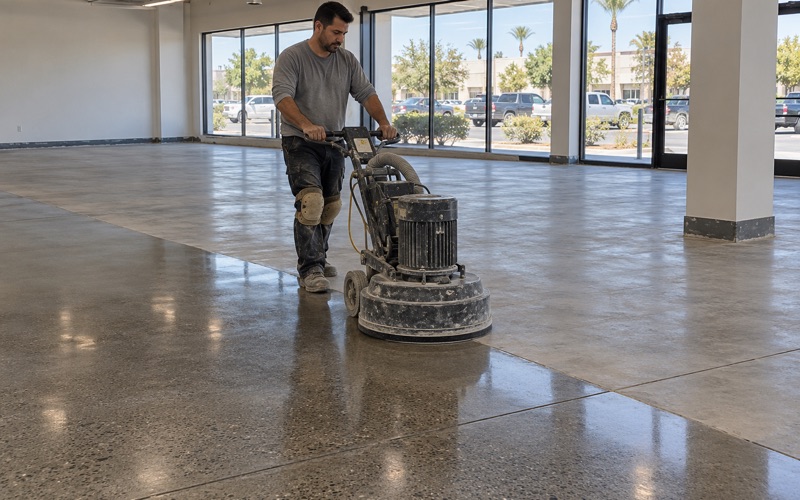
What does not change by neighborhood is method. No floor here is opened with acid, because a coating over a chemically softened skin keys into a layer that releases in sheets under a warm tire. Every slab is opened with diamond tooling to a named ICRI concrete surface profile, with grit sequence and diamond segment bond hardness matched to the concrete in front of us.
Looking for epoxy flooring closer to Beaumont? See Beaumont Epoxy Flooring.
Why the Drive Between Two Jobs Changes the Quote
Old Concrete Wants Repair Before It Wants Resin
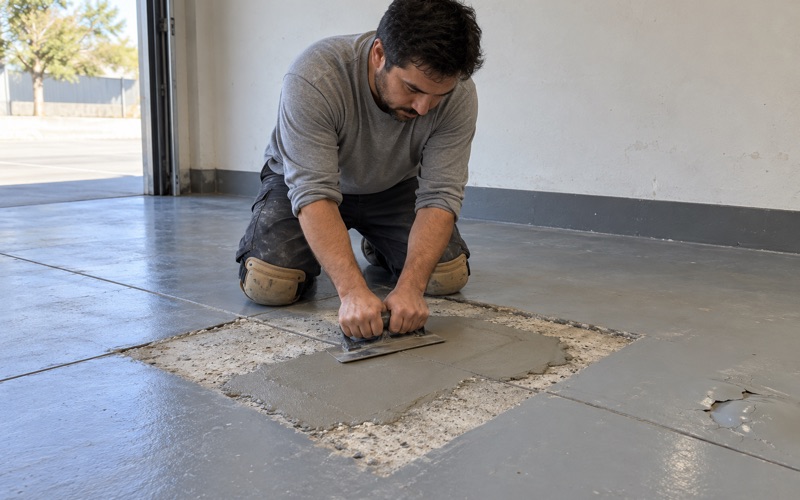
On the older side of the city the work in front of the coating is the real work: chasing static cracks open and filling them with a semi-rigid filler so the repair carries traffic, honoring moving joints instead of bridging them, rebuilding spalls and trench cuts back to grade, and drawing decades of oil out of the parking positions. Resin will not bond through contamination, and a film stretched across a live joint telegraphs and splits.
New Concrete Wants Aggression Before It Wants Anything
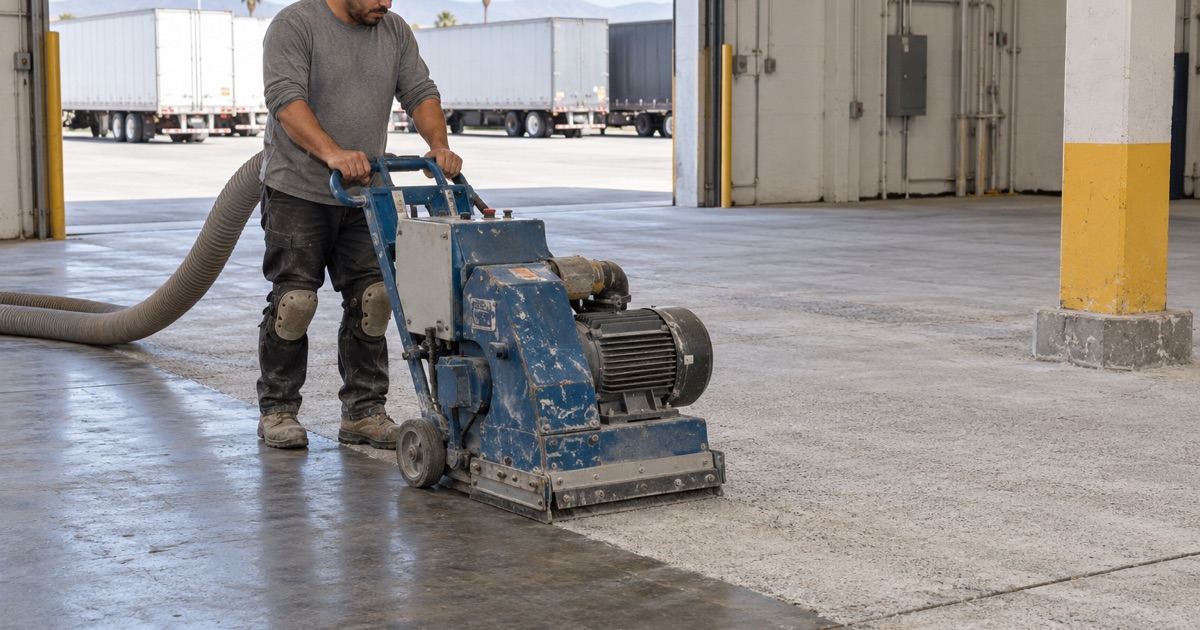
A recent power-troweled industrial slab is the opposite complaint. It is dense, closed and burnished, and a light pass leaves a surface with nothing for a coating to key into. Those floors take real tooling and a profile we can name, commonly around CSP 3 for a thin-film system and coarser where a heavier build is going down. The counterintuitive part is that hard concrete calls for a soft bond diamond — the wrong pairing polishes the slab rather than cutting it.
Why the Same Number Cannot Cover Both
A square foot price that averages those two conditions is either overcharging the new floor or underfunding the old one, and it is usually the second. We price after reading the specific slab, and where an older floor needs coating removal, crack work or a moisture vapor barrier primer, those appear as their own lines rather than being absorbed into a rate that quietly runs out partway through the job.
Old Slabs and New Industrial Floors on the Same Day
Moisture Testing as a Line Item, Not an Upsell
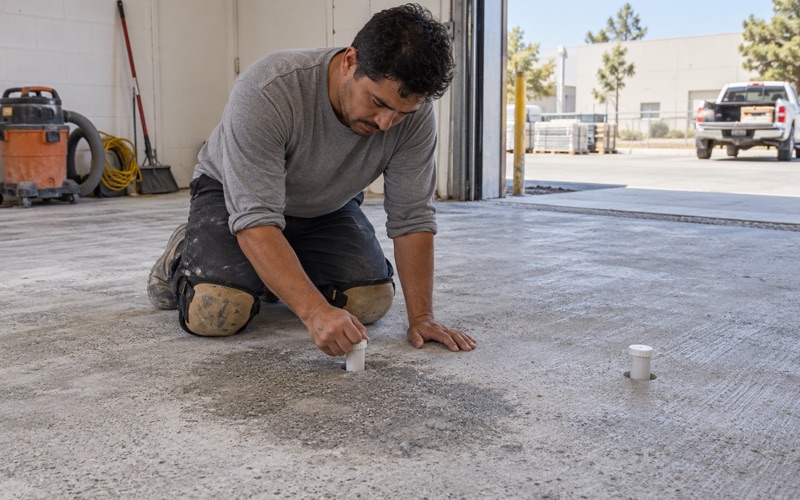
Roughly 6,300 housing units in this city date from before 1960, and slabs of that age were commonly poured with no vapor retarder between the concrete and damp soil. On the older Rubidoux and Crestmore side, a moisture reading belongs in the scope by default. We use in-situ relative humidity probes to ASTM F2170, or calcium chloride to ASTM F1869 where the surface emission rate is the better question, and read both against the thresholds in ASTM F710 — the standard where those numbers actually live, rather than in either test method.
The Plastic-Sheet Test and Its Honest Limit
ASTM D4263, taping a sheet of plastic down and looking for condensation under it, gets offered as proof more often than it deserves. It is asymmetric: a positive result fails a slab outright, while a negative proves nothing at all, because the method is not sensitive enough to clear one. It is a reasonable first look on a walkthrough and worthless as a clearance test.
Why the Reading Goes in Writing
Moisture is the dominant failure mode in this trade and it is also the failure almost every coating warranty specifically excludes. That is the reason the number goes into the proposal before material is ordered rather than into a conversation after a floor blisters. If the reading calls for a moisture vapor barrier primer, that changes the price and the schedule, and you find out while you are still choosing.
Staging on a Truck Route
Etiwanda Avenue and the Dock Aprons
The Mira Loma industrial complex — where Costco’s mid-1980s warehouse was the first building and pulled the whole area over from dairies and pastureland — now carries constant big-rig traffic out to the freeways along Etiwanda Avenue and the streets around it. Street parking for a crew vehicle near a dock apron is not a safe assumption, and a grinder, a dust extraction rig and material staged in the wrong place become somebody’s turning radius. We plan staging against truck flow before the day starts.
Somebody Else’s Schedule Defines the Window
Industrial work here routinely runs alongside pallet racking installation and tenant improvement sequencing, which means the coating window is frequently defined by a trade that is not us. Confirming the racking and equipment install order before committing to a cure date is the difference between a floor released on time and a floor walked on before it has reached the strength to take a wheel.
The Joints Fail Before the Field Does
On an industrial floor carrying hard-wheel traffic, the coating in the middle of a panel is rarely what gives up first. Unfilled control joints break down from the arris inward, and once that edge crumbles the surrounding film goes with it. A semi-rigid joint filler supports the edges so a wheel rolls across the joint instead of dropping into it, which is why joint filling is written into the system here rather than treated as the line to trim when a bid gets tight.
Heat Against Pot Life on a Large Floor
Inland summers compress working time sharply — roughly sixty minutes of pot life at 55 degrees against about twenty at 95 on the same product. Across a large open floor that is not a start-time adjustment, it is a crew-size and batch-size decision. We mix small, keep the wet edge moving, and read surface temperature off the slab rather than off the air.
Testing Rather Than Carrying an Assumption Across Town
Residential and Commercial Are Separated by Law Here
South Coast AQMD Rule 1113 caps floor coatings at 50 g/L VOC and industrial maintenance coatings at 100 g/L, treats the two as mutually exclusive categories, and in subsection (c)(6) prohibits applying or soliciting the application of an industrial maintenance coating for residential use. In a city split this evenly between warehouse floors and older houses, that boundary gets tested weekly, and it is why the two halves of our work are quoted from separate product lines rather than from one price sheet.
Recoat or Remove
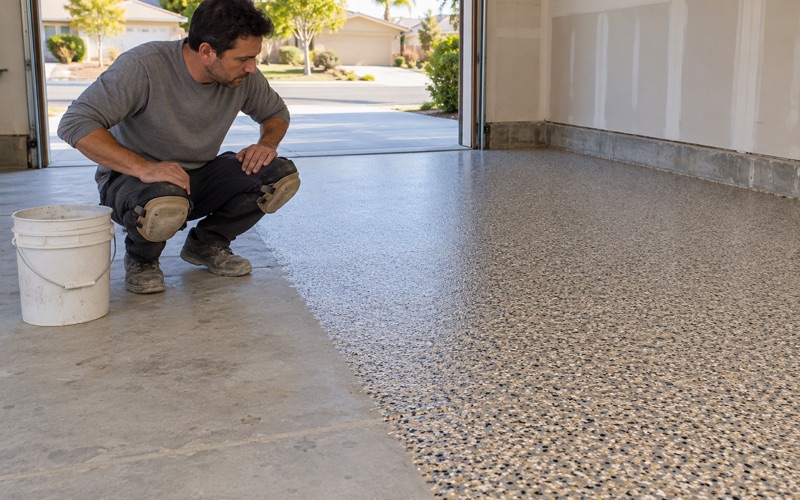
Plenty of garages here already carry something — a one-part paint, a big-box kit, or a previous contractor’s system. Where the existing film is sound, well bonded and compatible, abrading and recoating is genuinely cheaper. Where it is lifting or blistering anywhere, a recoat simply inherits the failure underneath it. We test adhesion instead of taking the existing floor at face value, and we say plainly when removal is the real scope.
Choosing the Look on Your Own Floor
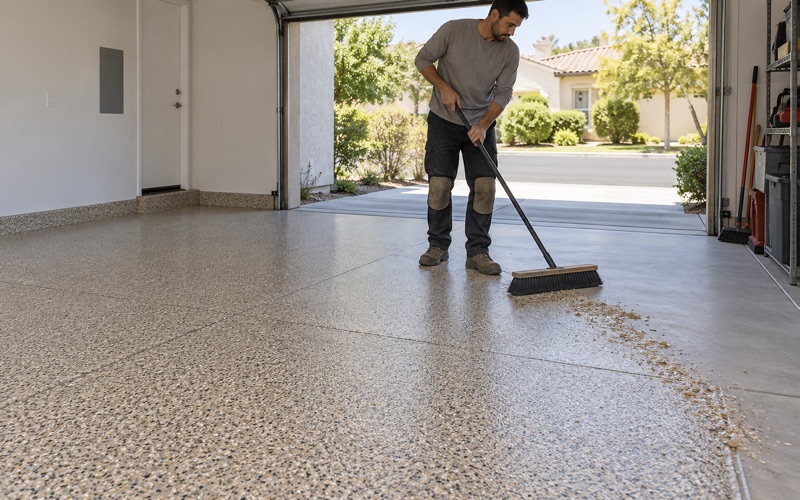
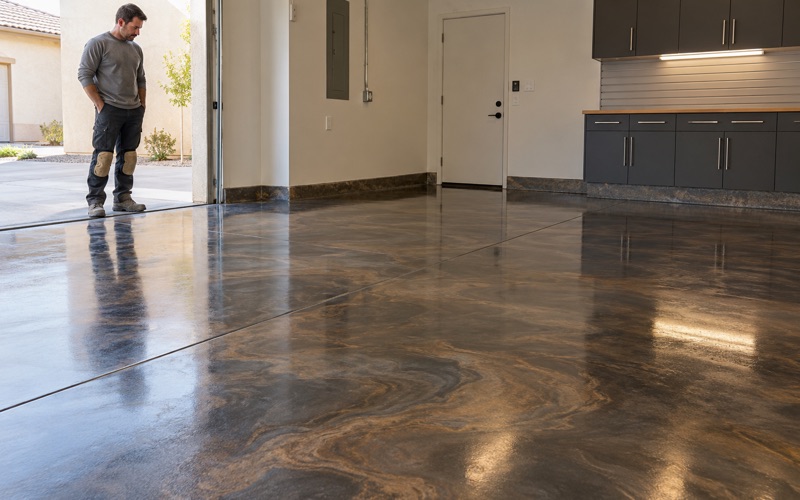
On the residential half, flake blends and metallic samples get shown as boards laid on your own slab under your own lighting rather than as chips passed across a table. A two-inch chip cannot tell you how a blend reads across twenty feet, and screen color is not floor color. Metallic in particular is worked into the wet film by hand, so no two pours match — that is the appeal and also the risk, and we would rather you see the technique on a board than discover it on your garage.
Permits and the County Line
Building permits here are issued by the City of Jurupa Valley Building & Safety Department, with intake and processing running through Accela, and the city sits in Riverside County and inside South Coast AQMD’s jurisdiction. Most residential garage coatings do not require a permit on their own; commercial work attached to a tenant improvement generally does, and the coating then sits inside somebody else’s inspection sequence. We confirm which of those a job is before we put a date on it.
- 20+ Years on Inland Empire Concrete
- Every Slab Moisture Tested
- Free Written Proposals