Redlands Epoxy Floors has been installing epoxy flooring in Highland for more than twenty years, and there is one thing about working here that no other city in our service area asks of us: before we can quote a commercial floor, we have to establish which government the building answers to. Two separate building authorities operate inside the same set of street signs.
That is not a technicality that shows up at inspection. It changes who reviews the work, who issues a permit, who the inspector is, and how the job is bid and paid. A contractor who assumes a Highland address automatically means a City Hall permit will eventually quote a job they cannot legally deliver on the terms they promised.
Everything else we do is the same in Highland as anywhere: a moisture reading written into the proposal before material is ordered, a mechanical profile opened by diamond grinding rather than acid etching, a mil build stated as a number with the product data sheet attached, and one crew from grind to topcoat. What changes here is the paperwork path in front of all of it.
Two Building Authorities Inside One City
The city side, and a week that ends on Thursday
For work on ordinary Highland parcels, the authority is the City of Highland Building Division, inside the Community Development Department, at City Hall, 27215 Base Line. The department that would normally be a background detail matters more than usual here because of the calendar: City Hall runs a four-day week, Monday through Thursday, 7:30 AM to 5:30 PM.
There is no Friday counter. That is unusual in this region, and it has a real consequence for scheduling — any question, correction or same-week permit interaction has to land by Thursday afternoon or it waits until Monday. We build that into a commercial timeline rather than discovering it on a Friday morning with a crew standing by.
The reservation is federal trust land
The San Manuel Reservation adjoins Highland, and it is federal trust land. It is not under City of Highland building jurisdiction and it is not under San Bernardino County building jurisdiction. The reservation was established in 1891, has grown from 658 acres to roughly 800, and the Yuhaaviatam of San Manuel Nation employs more than 7,000 people across the Inland Empire.
The practical version of that fact is simple. A floor on Base Line and a floor at 777 San Manuel Boulevard are in two different regulatory worlds, and the correct answer to “who pulls the permit” is different for each.
Why the wrong assumption is the expensive kind
Getting jurisdiction wrong is not a paperwork inconvenience — it is a schedule and liability problem. A contractor who files with the wrong authority has not merely lost a week; they have a crew mobilized against an approval that does not apply to the building they are standing in.
We establish the authority at the walk rather than at the quote, because the answer changes what the proposal has to contain. It is a five-minute question that prevents a five-figure mistake.
Looking for epoxy flooring closer to Loma Linda? See Loma Linda Epoxy Flooring.
What The San Manuel Building and Safety Act Changes
A tribal code chapter with its own building official
The Nation enacted its own San Manuel Building and Safety Act as Chapter 11 of the tribal code, established June 9, 2015 and amended October 10, 2023. It establishes a tribal building official and a tribal permitting process. That is the authority for construction work on the reservation.
We state that as the fact it is and go no further. What that office charges, how long it takes and what it wants submitted are not things we have confirmed, so we do not quote them, imply them, or build a schedule around a number we invented. When a client on the reservation asks how long approval runs, the honest answer is that the Nation’s building department is the office that can say, and we plan the work around what it tells them rather than around what we would prefer.
A different bid path, not just a different inspector
Work on tribal land typically runs through tribal or enterprise procurement rather than through the bidding pattern a city commercial job follows. That affects insurance and endorsement requirements, badging, background checks, invoicing and who is authorized to approve a change. None of it is difficult, but all of it takes lead time, and a contractor who treats it as a normal tenant improvement will be late on the first day.
Where the floor work actually is
The concentration on that side of the line is substantial. Yaamava’ Resort & Casino has a 290,000-square-foot gaming floor with over 7,200 slot machines, a 17-story 432-room hotel tower opened in 2021 as part of a $760 million expansion, and the 3,000-seat Yaamava’ Theater, which opened in April 2022. Six named restaurants operate inside it, and the Nation also runs Bear Springs Hotel about two miles away.
None of that is a one-time install. Back-of-house is where resinous flooring lives in a property like that — kitchens, dish and prep areas, service corridors, laundry, loading docks — and every one of those floors sits on a renovation and maintenance cycle rather than a build date.
Hospitality Floors And The Hours They Can Be Worked
Specified on what the floor has to do
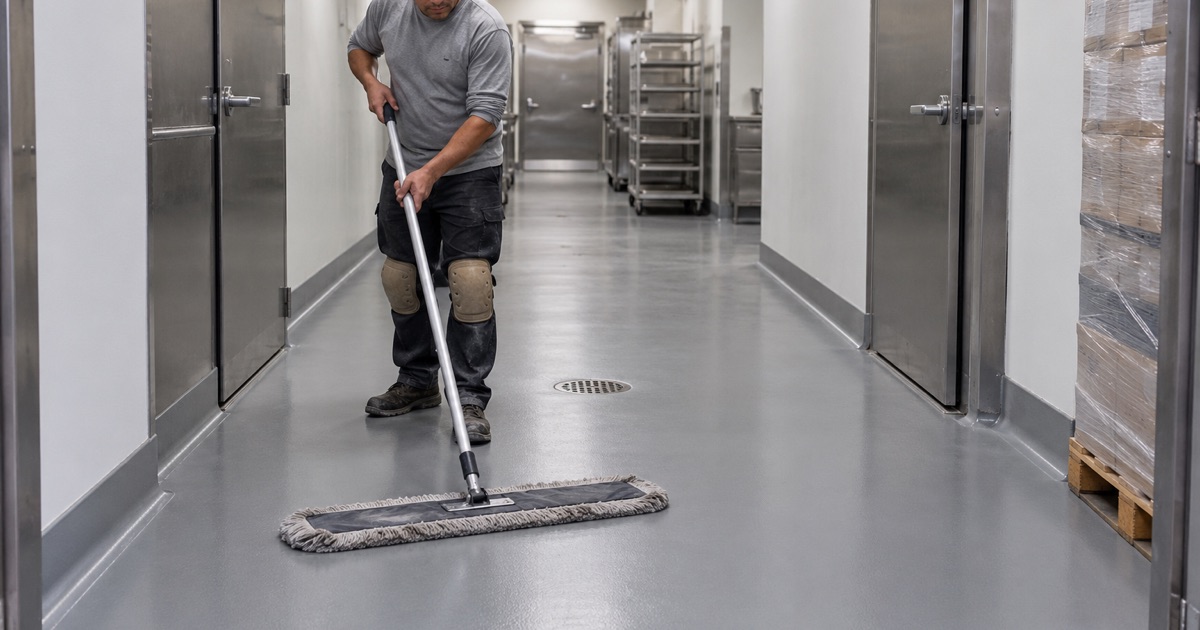
A commercial kitchen floor is sold on properties, not on labels. There is no federal approval list for flooring products — 9 CFR 416.2(b)(2) is written in performance terms, describing surfaces that can actually be cleaned — so any contractor offering you a federally approved floor is offering you something that does not exist.
What we specify against instead is concrete: a seamless surface with an integral coved base so the floor-to-wall joint has no seam to trap soil, a texture that holds DCOF slip resistance underfoot when the floor is wet and greasy, and enough film and thermal tolerance for the areas where hot water and steam hit the slab. Urethane cement earns its place in a dish room for exactly that reason, where a thin-film epoxy would not.
The building never closes
A resort floor cannot be taken out of service for three days, so the work happens in the hours the space is not earning — overnight, or in a phased shutdown of one line or one corridor at a time. That makes the recoat window the governing variable in the schedule rather than a line on a data sheet.
It also makes the cure curve a scheduling input. On one published product, pot life runs roughly sixty minutes at 55 degrees, about forty at 72 and about twenty at 95, and the recoat minimum drops from twenty-four hours to six across that range. Warm conditions shorten the working time and shorten the wait, which is useful in a phased job as long as the batches are sized for it. We mix small and place against a slab temperature reading rather than an air temperature reading.
Containment, not just cleanup
Grinding a floor inside an occupied hospitality building means dust containment and negative-pressure separation from spaces that stay open, plus a plan for odor during the resin placement. That is a coordination problem more than a technical one, and it belongs in the proposal rather than in a conversation on the second night.
The Homeowner Side Of Highland
The most single-family city in the region
Highland is more residential than its reputation suggests. Single-family detached houses are 75.2 percent of the housing stock at 12,623 units, the highest detached share of any city we work in around here, against 16,265 occupied units total and 10,420 of them owner-occupied. On the order of eight thousand of those are owner-occupied detached houses, which is the pool that actually buys a garage floor.
The corollary is that the property-management side here is proportionally small. Only about 2,800 units sit in multifamily structures of any size, including 916 in buildings of fifty or more. Parking deck and common-area work exists in Highland, but it is not the volume story it is in bigger cities nearby.
A slab that has usually been painted at least once
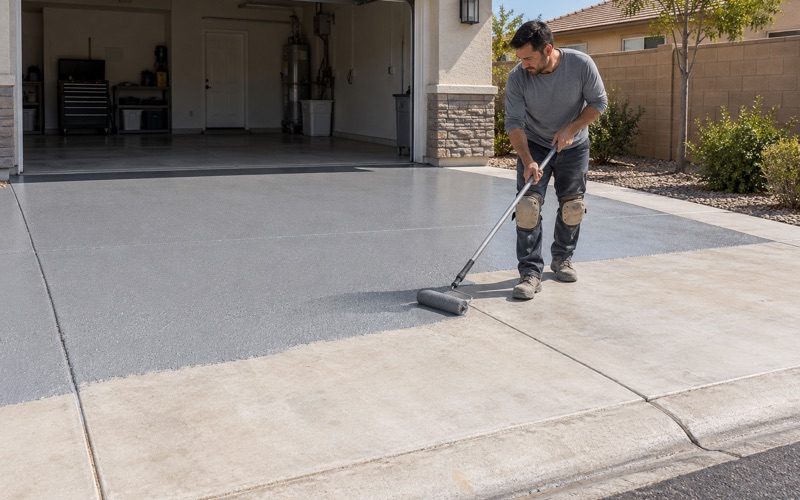
More than half of Highland’s housing — 8,992 units, 53.5 percent — was built between 1980 and 2009. That is the defining number for residential scope here, because a thirty-to-forty-five-year-old garage slab in this market has usually been coated before, most often with a one-part floor paint that has since released in patches under a warm tire.
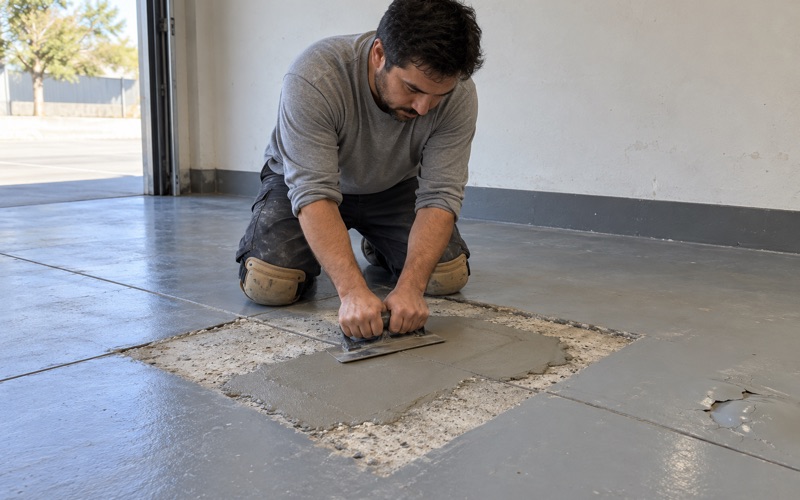
Removing that failed coating is the actual job, and it is where the skill is. Grit sequence and diamond segment bond hardness get matched to the concrete and to what is sitting on top of it, and the counterintuitive rule holds: hard concrete takes a soft bond. The wrong pairing burnishes the slab instead of cutting it, and you end up with a polished surface a new coating cannot key into.
The older tail nobody expects
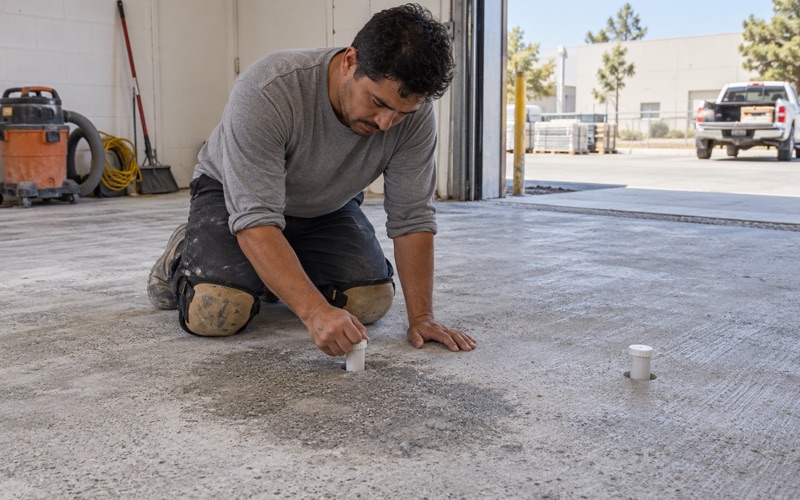
About 22 percent of Highland’s housing predates 1960, including 713 units built in 1939 or earlier and an unusually large 1,167 built during the 1940s. On that tier we test rather than assume — in-situ relative humidity to ASTM F2170 or calcium chloride to ASTM F1869, read against the thresholds in ASTM F710 rather than against the test methods, which is where that citation usually drifts. The ASTM D4263 plastic sheet test is indicative only and asymmetric: a positive fails a slab, a negative proves nothing.
New units are not the market here
Highland has a large entitled pipeline on paper — Greenspot Village and Marketplace, the Harmony Specific Plan approved in 2016, Mediterra at East Highlands — but only 348 units were built during the 2010s and 97 since 2020. We treat Highland as a recoat and repair market, because that is what has actually been built.
Getting The Product Category Right Too
South Coast AQMD Rule 1113 holds floor coatings to 50 g/L VOC and industrial maintenance coatings to 100 g/L, and the categories are mutually exclusive rather than a range. Subsection (c)(6) prohibits applying, or soliciting the application of, an industrial maintenance coating for residential use.
That boundary shows up here in a specific and awkward way. Highland climbs toward the mountains, and its older and eastern lots run to larger parcels with detached workshops and outbuildings whose floors take genuinely industrial wear. The parcel is still residentially zoned, so the residential product line is what may lawfully go down, and we quote it that way instead of borrowing a commercial product and calling it an upgrade.
- 20+ Years on Inland Empire Concrete
- Every Slab Moisture Tested
- Free Written Proposals