Redlands Epoxy Floors has been installing epoxy flooring in Grand Terrace for more than twenty years, and a large share of what we quote here is not bought by the person who parks on it. It is bought by a property manager or an association board that is responsible for a parking deck, a stairwell, a laundry room and a trash enclosure, and has to keep all of them serviceable without displacing the residents who use them daily.
That is a different sale from a garage floor, and it is specified differently. Common-area work is priced against a maintenance calendar, a phasing plan and a liability exposure, not against a look. The questions that decide it are how long a section can be closed, what happens to the residents whose cars live in it, and how the surface performs wet at the bottom of a stairwell.
We bring the same discipline either way: a moisture reading written into the proposal before material is ordered, a mechanical profile opened by diamond grinding rather than acid etching, a mil build stated as a number with the product data sheet attached, and one crew from grind to topcoat. On a shared structure, the sequencing plan matters as much as the system.
What The Housing Mix Changes About This Market
Roughly three thousand houses, not thirteen thousand residents
Grand Terrace is small and worth describing precisely. Ownership runs 64.4 percent — 3,051 of 4,736 occupied units — and 59.6 percent of the housing stock is single-family detached, about 3,021 units. That, not the city’s population, is the size of the residential market, because the person signing for a garage floor has to own the property it belongs to.
A meaningful share of the city therefore lives without a garage slab of its own: in apartments, condominiums and the 373 manufactured homes that make up 7.4 percent of housing here.
The multifamily share is the distinctive part
Roughly 1,470 units sit in multifamily structures, including 499 in buildings of fifty or more and 473 in three- and four-unit structures. In proportional terms that is a larger property-management layer than most cities of this size carry, and it is the thing that genuinely differentiates the work here.
Those buildings have shared concrete that nobody’s homeowner insurance covers and nobody’s weekend project fixes. Parking structures, podium decks, stair landings, corridors, laundry rooms, mechanical rooms and trash enclosures all wear on a schedule, and they all belong to an owner who reports to somebody.
A city that is effectively built out
There is no new-construction pipeline to plan around here. Of 5,069 housing units, just 11 have been built since 2020 and about 11.5 percent date from 2000 or later. The Barton Plaza commercial project — four buildings totaling 37,700 square feet with 1,800 square feet of outdoor seating — is the kind of scale this city adds.
What that means practically is that almost everything we do in Grand Terrace is repair, removal and recoat on concrete that is already in service. Nobody here is coating a slab that has never been used.
Looking for epoxy flooring closer to Highgrove? See Epoxy Flooring in Highgrove.
Parking Decks, Stairwells And Trash Enclosures
A deck is a different structure from a slab on grade
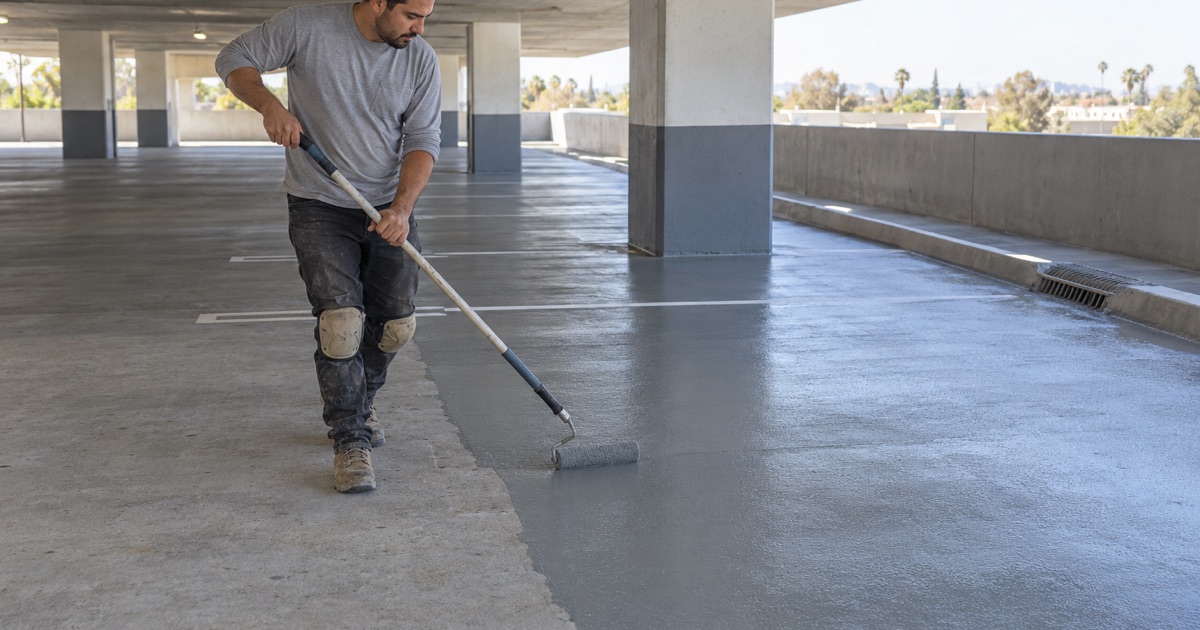
An elevated or podium deck is a suspended structural slab, not a floor sitting on soil, and that changes almost everything about how it is treated. It moves and deflects under load, it has joints that are alive rather than static, and any coating on it is part of a waterproofing assembly protecting the structure and whatever is parked underneath.
So joints get honored rather than bridged. A film stretched across a moving joint will telegraph and split, and on a deck that split is a leak into the level below. Crack routing, joint detail and the transition at a curb or a wall are where a deck coating succeeds or fails, and they take more of the schedule than the field coat does.
Stairs, landings and where people actually slip
Stairwells are the highest-liability concrete in a residential property and the most often ignored. Nosings take the wear, landings take the water, and the surface has to hold DCOF slip resistance when it is wet without becoming impossible to keep clean.
That is a genuine tradeoff and we set it deliberately. Enough aggregate to be safe underfoot, a defined nosing detail rather than a coating feathered over a chipped edge, and a color break where the tread meets the riser so the step reads clearly to someone carrying groceries.
Trash enclosures, pads and the unglamorous concrete
Trash enclosures, compactor pads, dumpster aprons and equipment pads take standing organic liquid, weight and heat, and they are usually the worst concrete on a property. They are also cheap to address relative to what a manager spends on the same repair a second time.
Ramps and drive aisles are the same story. Where a deck ramps, the traffic is turning and braking on the same square footage every day, and that area gets specified and often textured differently from the flat field rather than being treated as more of the same.
Coating Around Residents Who Cannot Move Their Cars
Phasing by stall block
Nobody in a fifty-unit building has a second place to park. So the plan is a block of stalls at a time, with a written schedule showing which stalls are down on which days and where those cars go instead. That plan is part of the proposal, not a conversation the manager has to have alone after the contract is signed.
Fast-cure systems earn their money in this work. A polyaspartic or polyurea topcoat with a recoat window measured in hours is what makes a block of stalls a two-day closure instead of a five-day one.
Notice, hours and the reality of towing
Common-area work runs on notice periods, posted signage and, eventually, somebody’s car being towed. We would rather build the schedule to absorb one late mover than to depend on perfect compliance, and we say up front how much slack the plan has in it.
Work hours are usually constrained too, by the association’s rules and by simple courtesy in a residential building. Grinding is loud, and a plan that has the noisy hours in the middle of the day rather than at seven in the morning creates fewer problems than it costs.
Cure time is the constraint, not dry time
The number that matters to a resident is when they can drive on it, and that is later than when it is walkable. Foot traffic often returns the same day on a fast-cure system; a vehicle takes longer, because the floor has to reach full cure rather than just being dry to touch — that is the point at which a warm tire will not mark it.
Inland heat cuts both ways on that. On one published product, pot life runs roughly sixty minutes at 55 degrees and about twenty at 95, with the recoat minimum dropping from twenty-four hours to six across the same range. Warm slabs shorten the wait and shorten the working time, so summer work here means early starts, small batches, and readings taken off the slab rather than the air.
The Nineteen-Seventies Garage That Is Still The Volume Work
Two decades, more than half the city
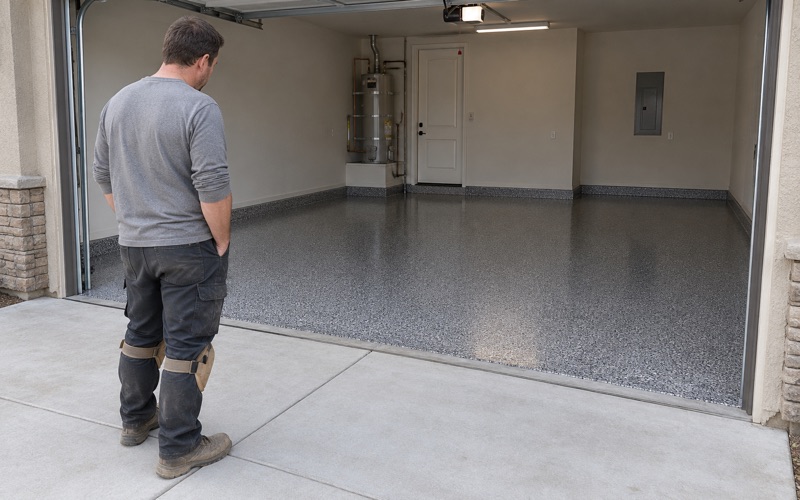
The residential side of Grand Terrace is unusually consistent. The 1970s account for 1,399 units and the 1980s for 1,373 — together 54.7 percent of every housing unit in the city — so the modal job is a thirty-five to fifty-five year old attached two-car garage.
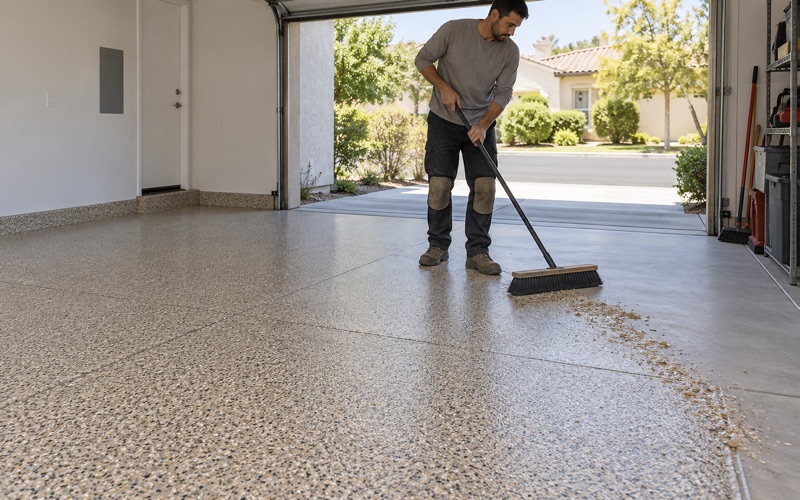
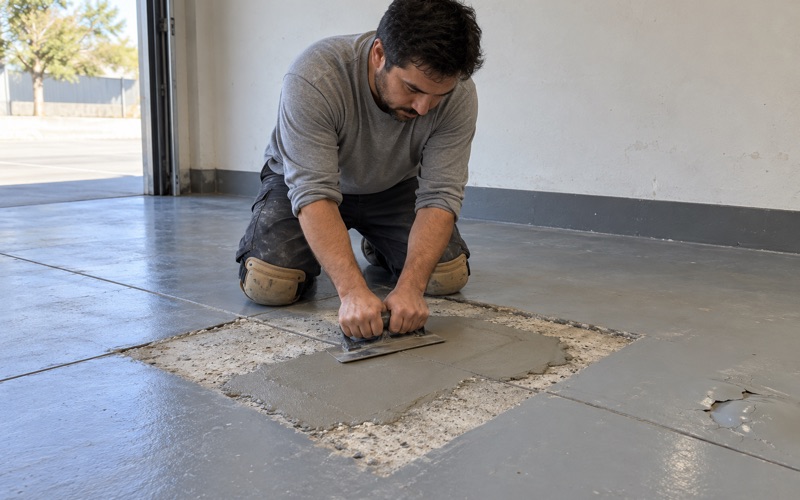
Expect control-joint cracking, some settlement, decades of oil, and very often a failed one-part floor paint or a hardware-store kit that has released in patches under a warm tire. Removing that coating is usually the actual scope, and the price is driven by the removal rather than by the new system.
Getting the removal right
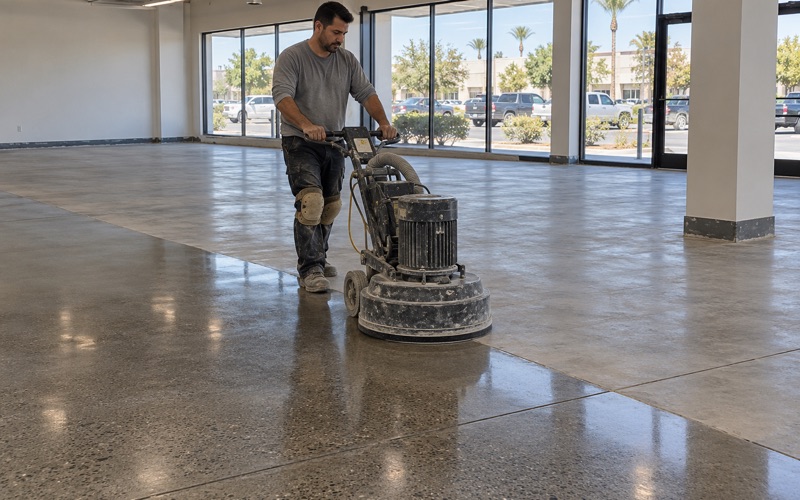
Grit sequence and diamond segment bond hardness get matched to the concrete and to what is sitting on it. The rule that surprises people holds: hard concrete takes a soft bond, and the wrong pairing burnishes the slab instead of cutting it, leaving a polished surface that a new coating cannot key into.
The outcome we are working toward is a named ICRI concrete surface profile, commonly around CSP 3 for a thin-film system. Nothing gets opened with acid here. An etched slab leaves a chemically softened skin, and the skin is what releases.
The older tier where moisture is scope
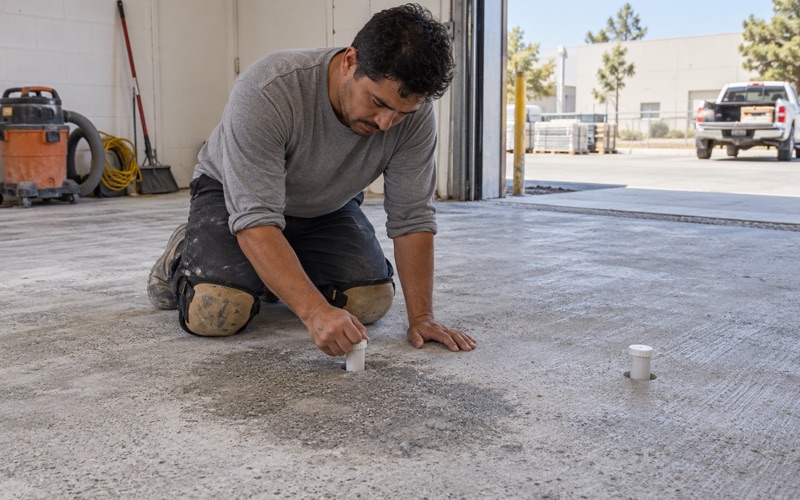
Only about 430 units in Grand Terrace predate 1960, but roughly 1,430 predate 1970, and under-slab vapor retarders were not routine practice on the early end of that. There we measure rather than assume: in-situ relative humidity to ASTM F2170 or calcium chloride to ASTM F1869, read against the thresholds in ASTM F710 rather than against the test methods, which is where that citation usually drifts. ASTM D4263 plastic sheet is indicative only and asymmetric — a positive fails a slab, a negative proves nothing. The number goes into the proposal before material is ordered, because moisture failure is the one thing almost every coating warranty in this trade excludes.
Who Signs, And What They Are Signing For
Manager, board or owner
Common-area work usually has three parties: a management company that runs the property day to day, a board or owner that approves the spend, and residents who live with the disruption. Each needs something different from us — a phasing plan, a written scope with the system and mil build named, and clear notice.
We put the specification in writing precisely because it travels between those three. A proposal that says “epoxy floor” is unusable to a board comparing bids; one that names the system, the profile, the mil build and the schedule can actually be compared.
Rule 1113 on a residential parking structure
South Coast AQMD Rule 1113 caps floor coatings at 50 g/L VOC and industrial maintenance coatings at 100 g/L, and makes the two categories mutually exclusive. Subsection (c)(6) prohibits applying, or soliciting the application of, an industrial maintenance coating for residential use.
That subsection lands directly on this work. An apartment community’s parking structure is residential property however industrial the wear on it looks, so the restriction still applies and the product has to be chosen deliberately rather than borrowed from a commercial job because it wears better. Anyone offering to bring the tougher product over is offering a rule violation as an upgrade.
The corridor is next door, not here
Grand Terrace sits between two ridges — Blue Mountain to the east and the La Loma Hills to the west — and the I-215 and Agua Mansa industrial corridors run immediately outside it. We work in that corridor and it is minutes away, but it is not inside this city and we are not going to pretend otherwise.
What Grand Terrace has instead is small-format commercial: a supermarket, pharmacies, an auto parts store, a bank branch, a fast-casual restaurant and a handful of distributors and manufacturers, with about 2,719 jobs located inside the community. Restaurant kitchens, grocery and pharmacy back-of-house, and modest distributor floors are the realistic commercial work here — specified on cleanability, coving and slip resistance, since there is no federal approval list for flooring products and 9 CFR 416.2(b)(2) is written in performance terms rather than as a registry.
One scheduling detail worth knowing
The city’s Building & Safety Division sits within Planning & Development Services at 22795 Barton Road, and its permit hours are narrower than its counter hours — permits run 1:00 to 4:30 PM against an 8:00 AM to 5:00 PM counter. For anything that does need a permit, that afternoon window is the one to plan around.
- 20+ Years on Inland Empire Concrete
- Every Slab Moisture Tested
- Free Written Proposals