Redlands Epoxy Floors has spent more than twenty years on warehouse floor coating in Fontana, and in this city the hard part is almost never the concrete. It is the calendar. A distribution building that ships around the clock cannot hand a contractor forty thousand square feet on a Monday and take it back on Thursday, so here the specification and the sequence get written at the same time.
We install epoxy, polyaspartic, polyurea and urethane cement systems, and commercial work is quoted from a different product line than residential work. Before any of that, what we want from you is the dock schedule, the racking layout, and an honest answer to how many consecutive hours the building can genuinely give up.
Access itself is rarely the constraint. Industrial parcels built for fifty-three-foot trailers swallow a grinder, a dust extraction rig and a material trailer without anyone having to think about it. What is scarce is floor time, and floor time is what a proposal in this city is really buying.
Coating a Floor That Is Still Working
The Question That Comes Before the Price
The first thing we ask on an operating warehouse is not square footage. It is which aisles can be emptied, for how long, and where the pallets that were in them are going to sit. A coating priced without that answer is a number that will move, because the sequence drives crew size, the number of mobilizations, and which chemistry we can even specify.
Cure Is the Occupancy Cost, Not the Install
Grinding and rolling a bay is fast. Waiting for it to carry a loaded pallet jack is not. Full cure, the point at which a hard-wheel forklift will not print the surface, runs well past dry to touch, and it is governed by the product data sheet read against the temperature the slab is actually sitting at. We put return to service in the proposal as a date and an hour, because that is the number your operation is planning around.
Reading the Slab Without Emptying the Building
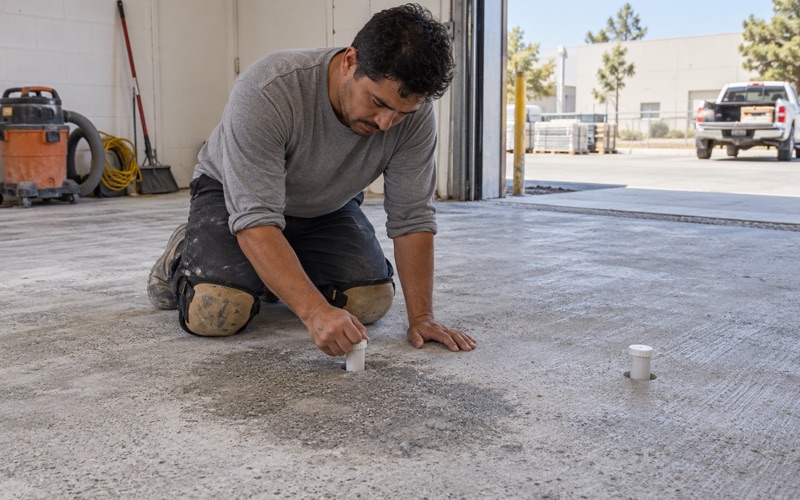
Moisture testing does not require a vacant building. In-situ relative humidity probes to ASTM F2170 go into drilled holes and sit through their equilibration period while work carries on around them, and calcium chloride to ASTM F1869 reads an emission rate at the surface. Both threshold numbers live in ASTM F710 rather than in either test method, which is where most quotes get the citation wrong. Taking those readings early means a moisture vapor barrier primer is a line in the proposal rather than a change order discovered at ten on a Saturday night.
Looking for industrial epoxy flooring closer to Jurupa Valley? See Industrial Epoxy Flooring Services in Jurupa Valley.
Aisle by Aisle, Bay by Bay
Sequencing Against the Dock Schedule
Phasing means the building keeps working while one part of it temporarily does not exist. We lay phases out against your dock doors and inbound windows rather than against a tidy grid, so the aisles feeding the busiest doors come out of service when those doors are quietest. On the high-cube product along Slover Avenue between I-15 and I-10, where clear heights reach thirty-six feet and a single building can carry twenty-nine dock-high doors, that mapping is most of the job.
The Containment Line and What Lives On It
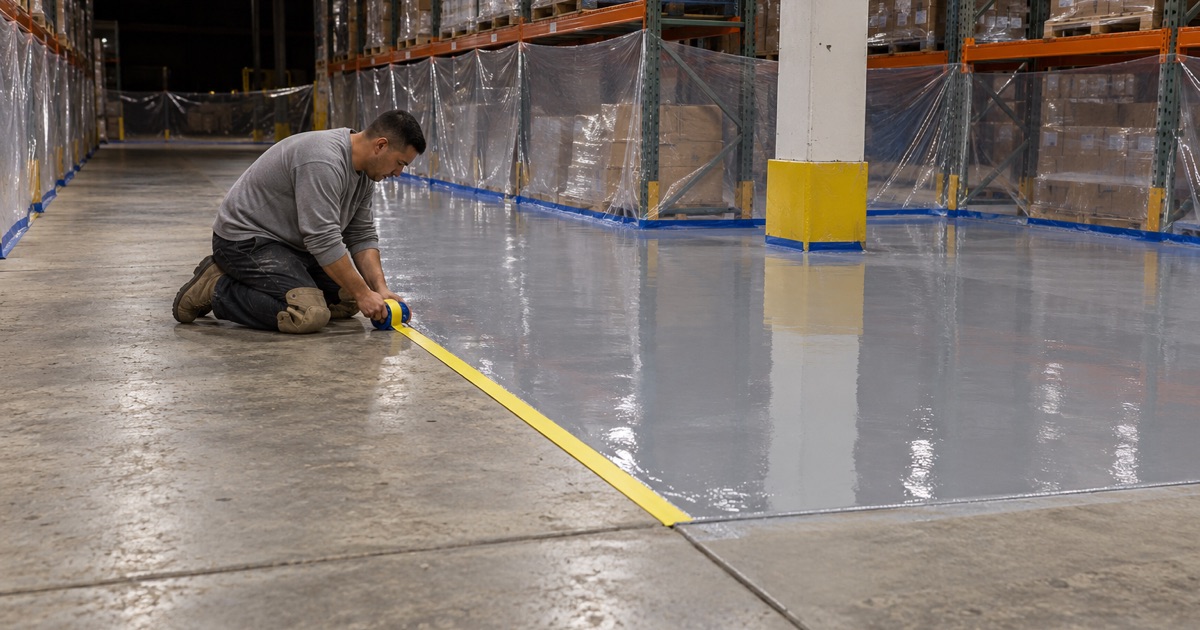
A phase boundary is a physical thing: poly, tape, negative air, and a hard edge where the coating stops. We put that edge into a control joint or a saw cut wherever the layout allows, because a phase break landing mid-panel leaves a cold joint in open floor that a forklift wheel will find within a week. Dust extraction next to live racking is quoted as equipment on the job rather than assumed as good manners.
Racking, and What Has to Move Before We Arrive
Coating stops where an upright baseplate sits, so a floor done around standing racking is a floor with a grid of uncoated islands in it. That is sometimes the correct trade, and sometimes it is the reason to wait for a reconfiguration that was already scheduled. Either way it is a decision to make with a drawing in front of us rather than on the morning of the grind, and it belongs in the proposal as an explicit inclusion or an explicit exclusion.
Marking, and the Standard That Was Never Written
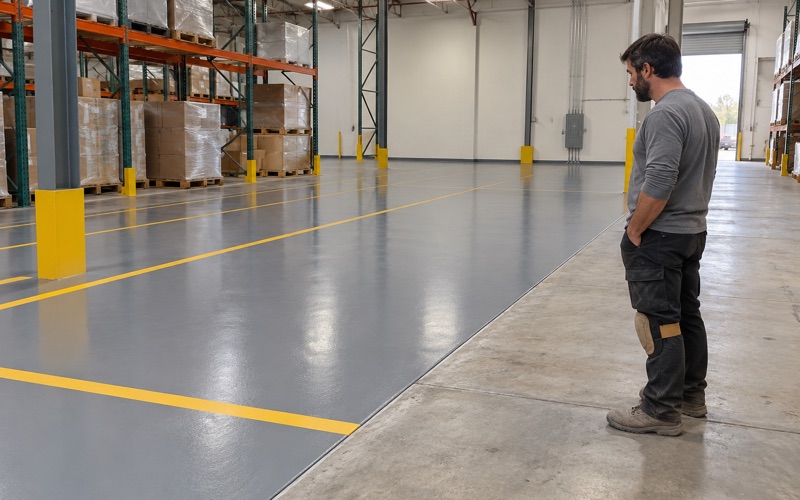
Aisle marking usually gets reinstated as phases reopen, and it is worth being precise about what governs it. OSHA 1910.176(a) requires that aisles be kept clear and appropriately marked. It specifies no stripe width and no color whatsoever — the familiar figure everyone repeats comes from an interpretation letter and long convention. We mark to what your traffic pattern and your safety program actually call for.
The Weekend Window and What Fits Inside It
Why a Full Shutdown Is Often the Only Clean Window
In a tight building running multiple shifts, phasing eventually costs more than it saves: more mobilizations, more containment, more edges to detail. A genuine weekend shutdown, floor cleared Friday night and released Monday morning, is frequently the only window that gives a coating an uninterrupted run. That is a conversation to have before the quote is written, because it is a decision about your operation rather than about our schedule.
What Fast-Cure Chemistry Buys, and What It Costs
Polyaspartic and polyurea systems have recoat windows measured in hours, which is the only reason a two-day turnaround exists at all. They also have short working times and no patience for a thin crew, so a weekend job means more people, tighter batching and a decided plan for every bay before the first pail is opened. Where the window is longer, a 100% solids epoxy base under a polyaspartic topcoat buys more mil build for the money.
Batch Discipline When the Slab Is Hot
Fontana summers push pot life to the short end of the published range — roughly sixty minutes at 55 degrees against about twenty at 95 on the same material. Across an open warehouse floor that changes crew size and batch size, not merely the start time. We mix small, keep the wet edge moving, and read surface temperature off the slab rather than off a thermostat on the office wall.
Trailer Stalls, Dock Plates and the Edges
Where a Warehouse Floor Actually Fails
Not in the middle. It fails at the joints, at the leveler pits, at ramp transitions and in the first ten feet inside every door. Hard-wheel traffic destroys an unfilled control joint from the arris inward, and once the edge has broken down the surrounding coating goes with it. Semi-rigid joint filler is part of the system here rather than the line item cut to win a bid.
The Threshold Where Inside Becomes Outside
Dock aprons and trailer stalls are exterior concrete carrying tractor traffic, standing water and UV, and they are a different specification from the floor behind them. An aliphatic system holds color outdoors where an epoxy ambers, and the transition gets detailed at the door line rather than allowed to feather out exactly where a dock plate lands on it.
What Actually Gets Spilled, and How Long It Sits
A chemical resistance chart is a starting point rather than a specification, because concentration, temperature and dwell time all move the answer. The useful question on a distribution floor is what leaks out of a damaged carton, how hot it is when it lands, and how long it sits before somebody gets to it. A system that shrugs off a quick splash can still soften under a puddle left through a night shift, and that is the case worth designing for.
Tight New Concrete Needs Real Tooling
The buildings on the former Auto Club Speedway site, where the two-mile oval came down beginning in October 2023 and warehouses went up across the old turns and parking, sit on recent power-troweled slabs. That concrete is dense, closed and completely unmoved by an acid etch. We open it with diamond tooling to a named ICRI concrete surface profile, matching grit sequence and diamond segment bond hardness to the slab itself, since hard concrete takes a soft bond and the wrong pairing polishes a floor instead of cutting it.
The Kaiser-Era Slabs on the Other Side of Town
The Opposite Problem, in the Same City
South and central Fontana holds the old townsite, and close to thirteen percent of the city’s roughly 59,500 housing units date from before 1960 — the same city whose Kaiser Steel site has carried California Steel Industries’ 430-acre plant since 1984. Those garage slabs are the inverse of a new distribution floor: sixty-five years old, often with nothing underneath them, and carrying decades of drips from home mechanic work. We test moisture on them as a matter of course and treat oil saturation as a substrate question, because resin will not bond through contamination and a film placed over an active moisture path is pushed back off from below.
Two Product Lines, and the Line Between Them
South Coast AQMD Rule 1113 holds floor coatings to 50 g/L VOC and industrial maintenance coatings to 100 g/L, makes the two categories mutually exclusive, and in subsection (c)(6) prohibits applying or soliciting the application of an industrial maintenance coating for residential use. In a city where the same crew may be quoting a distribution floor on Monday and a two-car garage on Saturday, that is a live compliance line rather than a technicality, and it is why a hard-worked workshop garage still does not get the warehouse product.
Permits, and Whose Schedule the Coating Sits Inside
Permits and plan check here go to the City of Fontana Building & Safety Department within the Community Development Department at 8353 Sierra Avenue, submitted through the Build Fontana portal. A floor coating rarely pulls a permit on its own, but the tenant improvement it sits inside usually does, and the coating window then belongs to somebody else’s inspection sequence. We ask where a job sits in that order before committing to a cure date, because a floor released on time into a building that is not ready helps nobody.
- 20+ Years on Inland Empire Concrete
- Every Slab Moisture Tested
- Free Written Proposals