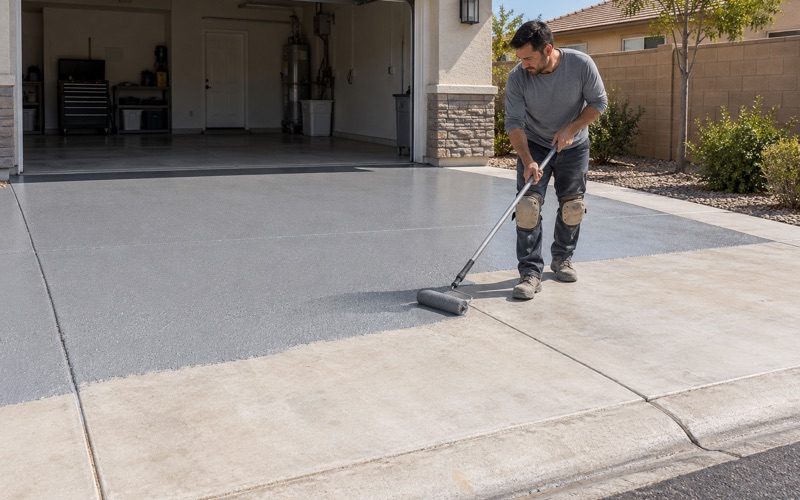
Redlands Epoxy Floors has been installing epoxy flooring in Crestline for more than twenty years, and the concrete here is older than anything we work on down the hill. That single fact governs the whole job. Before we talk about a system or a color, we are looking at what eight or nine decades of water freezing and thawing inside a slab have left behind, because on this stock the substrate is the variable and the coating is the easy part.
The failure we are most often called to look at is not a coating defect at all. A modern floor coating bonds to sound concrete harder than weak surface mortar bonds to the concrete beneath it, so when the top layer of a deteriorated slab lets go, the coating leaves with it and takes the blame. Diagnosing which of those two things happened is the difference between a floor that lasts and a second failure at the owner’s expense.
So every slab here gets read before anything is quoted: how deep the surface deterioration runs, whether the concrete underneath is sound, what the moisture reading is, and whether repair, an overlay or replacement is the honest answer. The proposal states the system by name with its data sheet attached, the mil build as a number, the profile we will grind to and the reading we measured — and where the answer is that a slab is finished, we write that down too.
The Oldest Cabin Slabs We Work On
A Summer City in the Pines, Platted in 1906
San Bernardino County’s adopted Crest Forest Community Plan records that by 1906 Henry Guernsey had developed fifty-foot by hundred-foot lots for a summer city in the pines, a second-home area which is now Crestline. Completion of the Rim of the World Highway in 1915 improved access, and by 1928 the area was being advertised as a summer retreat for San Bernardino businessmen. The concrete that went in behind those cabins is the concrete we are still asked to coat.
Nearly Two-Fifths of the Housing Predates 1960
Of 7,593 housing units here, 1,248 — 16.4 percent — were built in 1939 or earlier, and 2,077 units, 27.4 percent, predate 1950 altogether. A total of 2,803 units, 36.9 percent, went in before 1960, and 77.8 percent of everything standing predates 1980. Only 233 units, 3.1 percent, have been built since 2000, and none at all since 2020. This is not a market where new slabs arrive to dilute the old ones.
Detached Buildings on Steep, Awkward Lots
The stock is 93.1 percent single-family detached, 7,069 of 7,593 units, with no structures of ten or more units anywhere in the community. Getting equipment to those buildings is its own constraint: the local street grid is twisty and curvy with corners that are not square, County Service Area 18 maintains 17.5 miles of road in the Cedarpines Park area by grading, and on a steep site material is carried rather than wheeled. That changes crew size and batch size before it changes anything else.
Looking for epoxy flooring closer to Lakeview? See Lakeview Epoxy Flooring.
What Freezing Water Does Inside Concrete
Scaling Is a Defined Failure, Not a Figure of Speech
The National Ready Mixed Concrete Association defines scaling as local flaking or peeling of a finished concrete surface caused by cycles of freezing and thawing. Moderate scaling exposes aggregate and can involve the loss of an eighth to three-eighths of an inch of surface mortar. On a slab that has been through seventy-five to a hundred winters, that is not a hypothetical condition — it is what we find when we open the floor and start grinding.
Concrete Poured Before the Rules Existed
Concrete meant to survive freezing and deicing chemicals is specified with about six percent total air content and 4,000 psi strength. Nothing placed behind a 1930s cabin was batched to that standard, because the practice did not exist yet. An unentrained slab has no internal void structure to absorb the expansion when water in the pores freezes, so the damage accumulates from the surface downward, season after season, and the top layer is always the weakest part.
Why the Coating Gets Blamed for the Slab
A published epoxy floor coating can pull 350 psi in adhesion over concrete with a hundred percent concrete failure by ASTM D4541 — meaning the concrete tears before the bond does. That number is reassuring on a sound floor and merciless on a deteriorated one. If the top eighth to three-eighths of an inch of mortar has already been weakened by scaling, a perfectly installed coating simply lifts that weakened layer off with it, and the owner sees a failed floor rather than a failed slab.
Salt Off the Highway, Onto the Garage Slab
Every Car Brings Some Home
Deicing chemicals make freeze-thaw damage worse rather than merely accompanying it, by increasing surface saturation and raising the number of freeze-thaw cycles a surface goes through. The mechanism has a specific route into a mountain garage: magnesium-based salts used for pre-snow road deicing get tracked by cars and accumulate on concrete surfaces. Every vehicle coming up the mountain in winter is carrying some of it onto your slab.
Where the Damage Concentrates
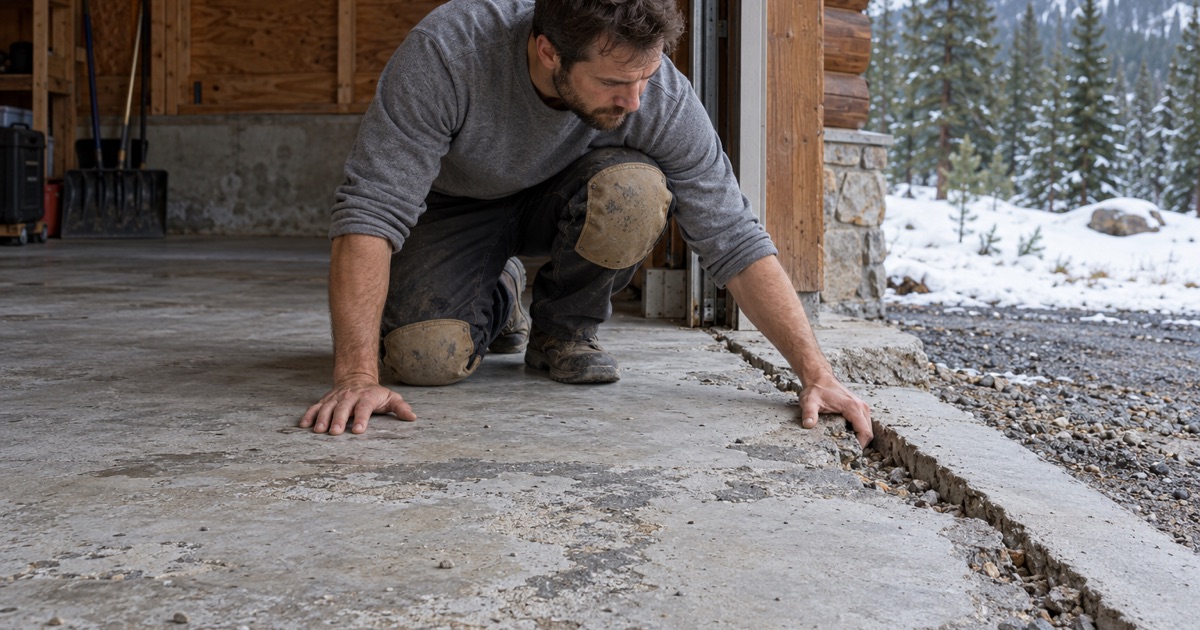
It shows up first where meltwater sits longest and cycles most: the threshold and apron, the strip where tires stop, the low corner a floor drains toward, and the outer edge of an uncovered parking pad. That distribution is diagnostic. Surface damage in exactly those places, with sound concrete in the middle of the bay, is a freeze-thaw and chloride pattern rather than a wear pattern or a contamination pattern.
Ninety-One Inches in One Season
The volume of water involved is not trivial, and Crestline’s own recent history makes the point. In early March 2023 the National Weather Service recorded 91 inches of snow here, the roof of the community’s only full-service grocery store collapsed under the load and destroyed the interior, the Governor declared a state of emergency covering thirteen counties, and the National Guard arrived the following day. Average snowfall for the town is poorly constrained — the local records are short and drought-weighted, and a defensible figure is a rough range of roughly twenty-five to thirty-five inches a year rather than a single number — but a single season can deliver several times that.
A Slab That Sits Cold Inside an Unheated Building
The Concrete Is Colder Than the Thermometer
An uninsulated cabin garage slab is a thermal mass. It lags air temperature by a wide margin and holds cold long after a room feels comfortable, so the surface temperature of the concrete is the number that governs the work rather than what the air says. We measure the slab rather than the room, which routinely produces a different answer than a homeowner expects on a mild afternoon.
The Condensation Film Nobody Can See
The rule that catches people out here is the dew point one. A surface has to sit at least five degrees above the dew point before material goes down, and a cold slab in a humid mountain garage after a storm can be below that while the air feels perfectly fine. The condensation film that results is invisible, and it destroys adhesion just as completely as contamination would. That is a measurement, not a judgment call, and it is why we carry instruments rather than opinions.
Moisture Testing Is Scope on This Stock, Not an Upsell
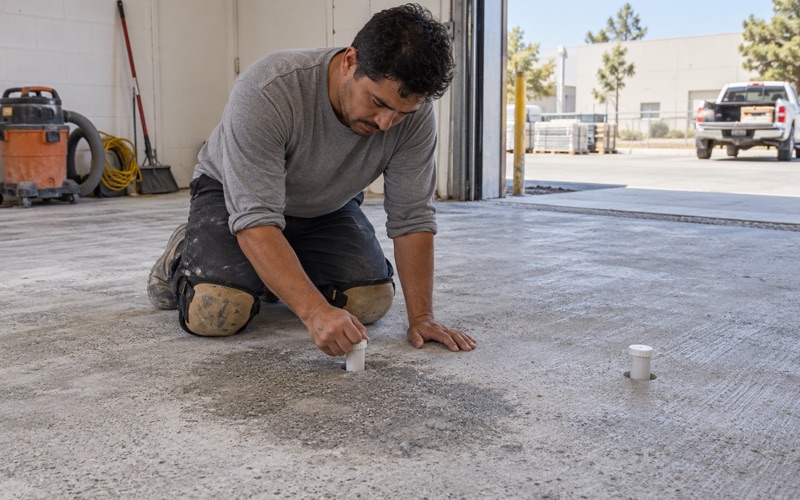
Nearly 2,800 units here were built before under-slab vapor retarders were routine, so a great many of these floors sit directly on damp ground with nothing between. We measure in-situ relative humidity to ASTM F2170, which reads the state inside the slab, or calcium chloride to ASTM F1869, which reads a rate at the surface, and compare the result against the thresholds — which live in ASTM F710 rather than in the test methods themselves. Taping down a plastic sheet, ASTM D4263, is worth doing as a first look and cannot clear a slab: a positive result fails it, a negative result proves nothing.
Repair First, and When We Say the Slab Is Finished
The Grinder Is a Diagnostic Tool
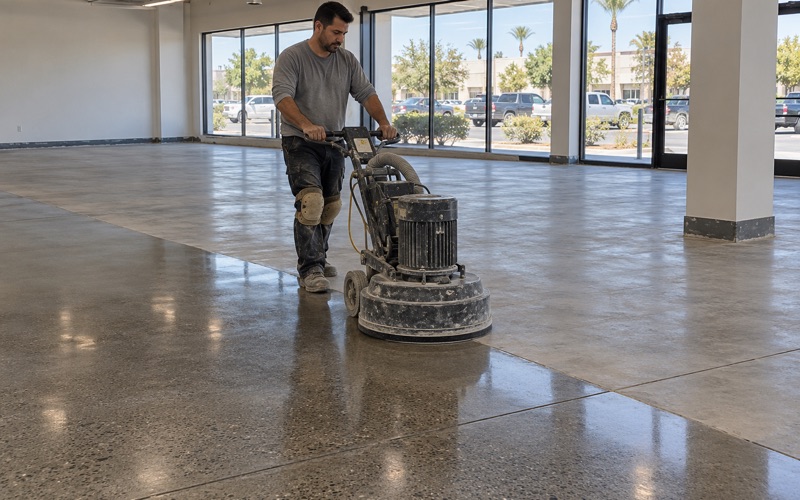
Every floor is opened with diamond tooling to a named ICRI concrete surface profile — the scale runs from CSP 1 through CSP 10 since the 2013 revision, and a thin-film system commonly wants something around CSP 3. Grit sequence and diamond bond hardness are matched to the concrete, with hard concrete taking a soft bond, which is the part most people get backward. On a scaled slab, the first pass also tells us how far down the weakness runs, because sound concrete cuts differently from mortar that has been freeze-damaged.
Cutting Out What Cannot Be Saved
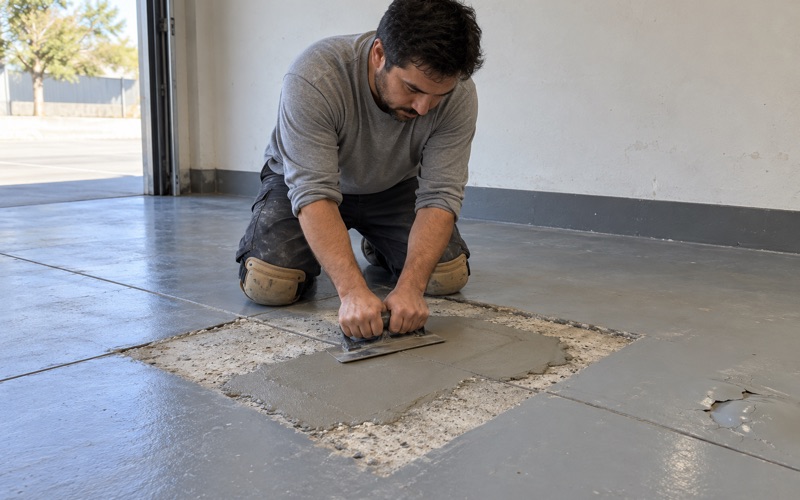
Where scaling has taken the surface, the deteriorated layer comes off rather than getting coated over. Spalls are cut back to sound concrete and rebuilt, static cracks are chased open and filled with a semi-rigid filler so the repair carries traffic instead of reopening, and a moving joint is honored rather than bridged. The constraint on all of it is simple and worth stating plainly: a repaired surface will only ever be as strong as the base surface it is bonded to.
Coating, Overlay, or Neither
Some of these slabs are not coating candidates, and saying so is the most useful thing we do here. A pre-war cabin slab placed on grade with no vapor retarder, no air entrainment and eight decades of freeze-thaw behind it may want a bonded overlay that rebuilds a working surface, or may genuinely want replacement. We put that read in writing, including the case where coating it is the wrong money, because the alternative is a floor that fails in a season and an owner who paid for the privilege of finding out.
The Product Still Has to Be Legal Here
Crestline sits inside the South Coast Air Basin, so South Coast AQMD Rule 1113 governs product selection exactly as it does in the valley: 50 g/L VOC for floor coatings, 100 g/L for industrial maintenance coatings, the two categories mutually exclusive by definition, and subsection (c)(6) prohibiting applying or even soliciting the application of an industrial maintenance coating for residential use. A mountain cabin is residential under that rule regardless of what its garage has been through. Permits, where any are needed, run through San Bernardino County Land Use Services, since Crestline is an unincorporated community with no city government of its own.
- 20+ Years on Inland Empire Concrete
- Every Slab Moisture Tested
- Free Written Proposals