
Redlands Epoxy Floors provides concrete surface preparation across Redlands, CA, serving surrounding cities including Mentone, Highland, Loma Linda, Yucaipa and Calimesa, and after more than twenty years on Inland Empire concrete we can tell you that almost nobody calls and asks for it by that name.
What people call about is a symptom. The garage floor is wet in the morning and nothing has been spilled. The last coating came off in sheets. The slab throws gray dust no matter how often it is swept.
Or there is old carpet glue welded to it, or a white bloom that keeps coming back after it is scrubbed away. Every one of those is a preparation question wearing a different costume.
So this page is arranged by the symptom rather than by the process, because that is the shape the problem actually arrives in. Preparation is the invisible half of a resinous floor, it is where nearly every failure we are called out to began, and it is the half that gets cut when a bid needs to look cheaper.
“Why Is My Garage Floor Sweating?”
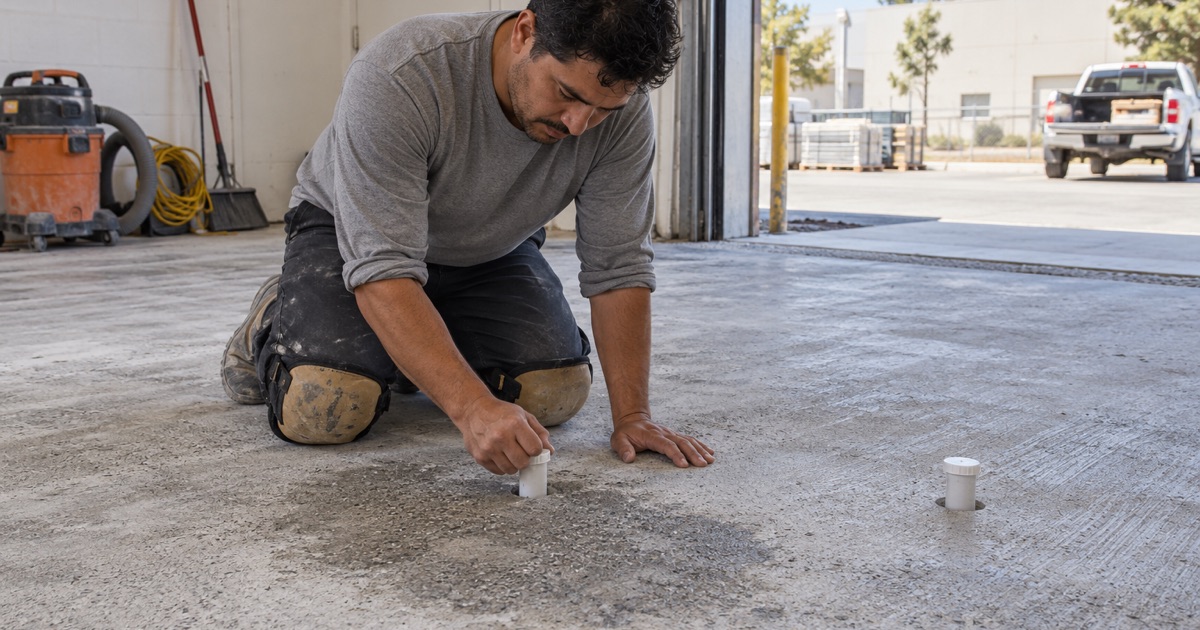
There are two completely different things behind a damp slab, and the fix for one is useless against the other. The first is condensation: warm humid air meets a slab that is still cool, and water forms on top of the concrete the way it forms on a cold glass. It shows up on particular mornings, it affects the whole floor evenly, and it dries as the day warms.
The second is moisture moving up through the slab from the ground beneath it. That one is persistent rather than seasonal, it is often worse in specific areas, and it frequently arrives with a white mineral bloom or with dark patches that never quite disappear. Older slabs are the usual candidates, because under-slab vapor retarders were not routine practice for a long stretch of the last century, so a good deal of local concrete sits directly on soil with nothing between.
Telling them apart is a measurement, not a judgment call. We take in-situ relative humidity with probes to ASTM F2170, or a moisture vapor emission rate to ASTM F1869, and read the result against the thresholds in ASTM F710 — the numbers live in F710 rather than in the test methods themselves, which is where most people citing them go wrong. The taped plastic-sheet test in ASTM D4263 is asymmetric and worth knowing about: condensation under the sheet fails a slab outright, while a dry sheet proves nothing at all.
A failed reading does not mean the floor cannot be coated. It means a moisture vapor barrier primer sized to the number, which costs money and a day, rather than a coating placed over water and pushed back off a year later.
“The Last Floor Peeled Right Off”
A coating does not stick to concrete chemically. It keys into an opened surface mechanically, which is what a profile is: a measurable roughness, deep enough for the system going over it and no deeper. The ICRI concrete surface profile scale runs from 1 to 10 — not 1 to 9, a version that is still quoted everywhere despite the tenth being added years ago — and a thin-film system commonly wants something around CSP 3, with heavier builds wanting more.
Acid etching is the usual reason a floor comes off. Acid does not cut concrete so much as dissolve the paste, leaving a chemically softened layer that feels rough to a hand and behaves like a loose skin under a coating. The system bonds beautifully to that skin and then leaves with it. We open every floor with diamond tooling instead, to a profile we can name in the proposal.
The tooling itself is matched to the concrete, and the relationship is the opposite of what people expect: hard concrete takes a soft-bond diamond segment and soft concrete takes a hard bond. Get that pairing backwards and the machine polishes the slab rather than cutting it, which produces a smooth floor and no profile at all. Grit sequence follows the same logic, and on large open areas shot blasting is often faster than grinding while still leaving edges, corners and thresholds for the grinders.
“It Dusts, and Nothing Gets It Clean”
A slab that keeps producing fine gray powder usually has a weak surface layer — laitance brought up during finishing, or paste that was overworked or cured badly. Sealing that layer in place does not fix it; it just puts a film over something that is already failing, and the film comes off with it.
Grinding takes the weak layer off and gets down to sound concrete. Where the goal is a coating, that is exactly the preparation the coating wants anyway. Where the answer is not a coating at all — a warehouse floor that simply needs to stop dusting, a slab in a building nobody wants to shut down — a lithium silicate densifier reacts into the surface and hardens it, with no film to peel later.
“There Is Old Glue, Paint and Mastic On It”
Removing an existing floor covering is a tooling problem before it is a labor problem. Carpet adhesive and tile mastic gum up ordinary diamonds, coatings shear best under PCD tooling that lifts a soft film without gouging the concrete beneath, and hard old paint wants something different again. Matching the tool to what is actually on the slab is most of the difference between a clean removal and a scarred one.
Dust is the other half of it, and it is worth asking any contractor about before they arrive. Grinding concrete generates respirable silica, so our work runs through vacuums and containment rather than open into the building. In an occupied space that is the difference between preparation being a nuisance and preparation being a shutdown for everybody around it.
One thing preparation does not do is level a floor. Grinding knocks down high spots and can improve a surface considerably, but a slab that slopes or dishes across a room is a flatness problem solved with a self-leveling underlayment, not with a machine. Anyone who tells you a grinder will flatten a wavy slab is describing a much longer job than they are quoting.
What You Actually Get From a Preparation Visit
You get numbers. The moisture reading and the method used to take it, the concrete surface profile we will open the slab to, what repair the cracks and joints need, and what the slab can and cannot support. Those go into the proposal in writing, so a quote can be compared against another quote on the same basis rather than on total price alone.
You also get a straight answer where the answer is unwelcome. Some slabs are not candidates — moving, contaminated through their depth, or deteriorated past the point where a surface fix means anything — and a written repair-or-replace read is more useful than a cheerful proposal. Finding that out before material is ordered is the whole point of measuring first.
We also do this work on its own. General contractors, flooring installers and facility managers bring us in to prepare a slab for somebody else’s finished product, or simply to test one and report on what it will take, and that is a normal job for us rather than an exception.
- 20+ Years on Inland Empire Concrete
- Every Slab Moisture Tested
- Free Written Proposals