Redlands Epoxy Floors has spent more than twenty years installing epoxy flooring in Colton, and this is the city where we most often get asked the hardest question in the trade: can you coat a floor that is kept below freezing. The answer is yes, but not with the system that went into the ambient warehouse next door, and not on the same schedule.
A freezer floor is a different technical problem from a dry-goods floor sitting twenty feet away under the same roof. The substrate is far below the minimum application temperature any conventional resin lists, the slab expands and contracts through every defrost and every door cycle, and the work has to be staged around a controlled thaw and a plant shutdown rather than around a calendar.
Everything underneath that is the same discipline we bring anywhere: a moisture reading written into the proposal before material is ordered, a mechanical profile opened with diamond tooling rather than acid, a mil build stated as a number with the product data sheet attached, and one crew from grind to topcoat. In cold storage, temperature is simply the variable that governs all of it.
A Rail Town With A Cold Chain
Where the refrigerated floor actually sits
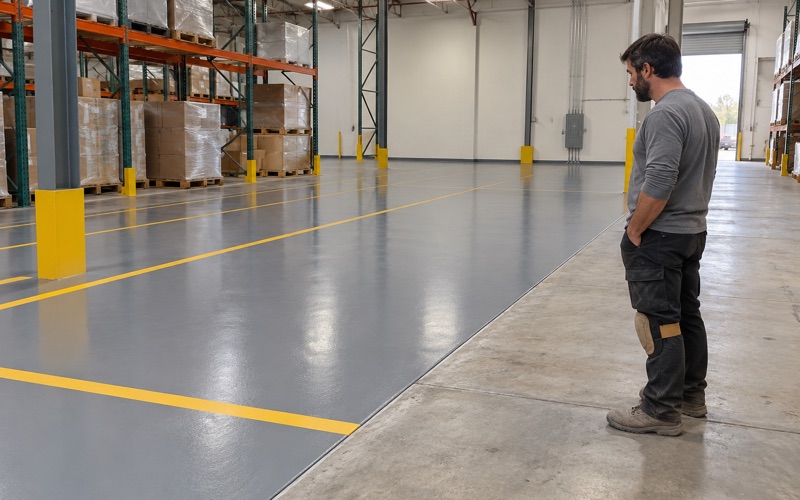
The Agua Mansa Industrial Corridor Specific Plan, prepared in 1986, covers roughly 4,285 acres, and inside it are Lineage Logistics — described as the world’s largest refrigerated warehousing company, and about 450 jobs here — and C.R. England, described as the nation’s largest refrigerated truck company. There is also a Walmart-owned high-tech consolidation center of roughly 340,000 square feet, a Walmart distribution center employing around 961 people, and Ashley Furniture on Ashley Way at about 585. That is a genuine industrial belt inside the city limits rather than a corridor somewhere nearby, and the cold portion of it is what makes the work here distinctive.
The largest employer is a hospital, not a warehouse
The number that surprises people about this rail-and-logistics town: Colton’s single largest employer is Arrowhead Regional Medical Center, with 4,867 employees — 19.16 percent of all employment in the city. It is a 456-bed county-owned teaching hospital on a 70-acre campus at 400 N. Pepper Avenue, with a Level II trauma center, the Edward G. Hirschman Burn Center, a comprehensive stroke center, a behavioral health center and five family health centers.
Add the Colton Joint Unified School District at about 2,300 employees and the picture changes shape: the ten largest employers total 10,403 people, nearly 41 percent of city employment, and the top two are public institutions. Institutional and healthcare floors are as much of this market as distribution floors are, which is the opposite of the assumption most people bring to Colton.
Rail as a routing constraint
Two Class I lines, BNSF and Union Pacific, intersect here, and Colton Crossing — installed in 1882 and one of the busiest at-grade rail-to-rail crossings in the country, handling more than a hundred trains a day — was grade separated by a flyover completed on August 28, 2013, roughly 2.2 kilometers long.
Worth understanding what that project did and did not do. It lifted one railroad over the other. It did not separate the railroads from the street network, so surface-street crossings still stop traffic and freight movement through the city is continuous. Routing a grinder trailer here means planning the approach rather than trusting a mapping app.
Looking for garage floor coating closer to Moreno Valley? See Moreno Valley Garage Floor Coating.
Why A Freezer Floor Is Not A Warehouse Floor
The slab is below the temperature the product needs
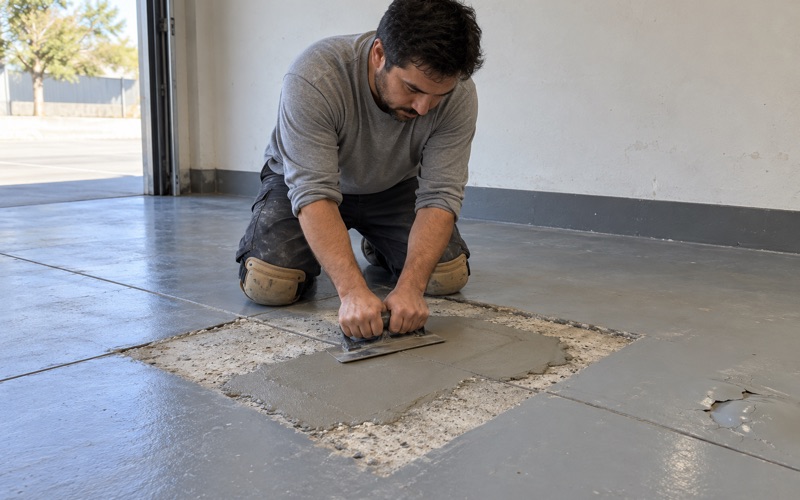
Most resinous systems list a minimum application temperature of 50 degrees for air, surface and material alike. A freezer slab is nowhere near that. Placing a conventional epoxy on cold concrete does not produce a slow cure; it produces an incomplete one, and an undercured film never develops the properties on the data sheet no matter how long you leave it.
So the substrate has to be brought up, held there through placement and through cure, and brought back down in a controlled way. That is a mechanical and scheduling exercise before it is a coating exercise, and it is most of what makes cold-storage work expensive relative to square footage.
Cold concrete carries its own water problem
A slab that has been below freezing for years and is then warmed collects condensation as ambient air hits a cold surface, and keeps collecting it until the concrete catches up with the room. Resin placed onto that surface bonds to water rather than concrete.
We measure rather than assume — slab surface temperature against dew point, holding the 5-degree margin, with an 85 percent ceiling on relative humidity in the space during placement. In a thawing freezer those numbers move hour to hour, which is exactly why they get read hour to hour rather than once in the morning.
Thermal Cycling And What Fails First
The failure is at the bond line
The intuitive worry about a cold floor is that the coating gets brittle and wears out. The actual failure mode is usually delamination, and it happens underneath rather than on top. Concrete and a resin film expand and contract at different rates, so every temperature swing puts shear stress into the bond line between them.
One cycle is nothing. Thousands — every defrost, every dock door opening onto a summer afternoon — accumulate, and the film releases at the interface while the wear surface still looks fine. That is why profile matters more here than anywhere: a mechanical key with real depth resists that shear in a way a thin etched surface cannot.
Where the cycling is worst
The transitions are the hot spots, literally. A dock apron between a refrigerated room and outside air, the strip just inside a freezer door, and the floor around a blast cell see the widest and fastest swings on site, and they frequently justify a heavier build or a different system than the middle of the same room.
Joints do too. A slab that moves seasonally needs its joints honored rather than bridged, because a film stretched across a moving joint will telegraph and split — and in cold storage that split becomes an ice line.
Where urethane cement earns its place
Urethane cement is the answer to most of this, and it earns the specification on physics rather than on marketing. It is placed at a heavy build, it tolerates thermal shock far better than a thin-film epoxy, and its coefficient of thermal expansion sits much closer to concrete’s — which is the whole point, because the closer those two numbers are, the less shear ends up in the bond line every time the room changes temperature.
It also handles hot-water and steam wash-down, which is why the same product family shows up in food-plant kitchens and dish areas as well as in cold rooms. A 100% solids epoxy still has a place as a base or a body in the right conditions, and polyaspartic and polyurea do topcoat work where fast return to service matters. The specification names which is which and why.
Coating A Plant That Cannot Simply Warm Up
The shutdown window is the real scope
Refrigerated space that comes down comes down with product moved out of it, and that cost dwarfs the flooring. So the schedule works backwards from the shutdown: how long the room takes to thaw, how long the floor needs at temperature to be prepared and placed, how long to cure, and how long to pull back down. That sequence goes in the proposal as a timeline rather than as a duration, because a plant manager comparing bids needs the hours, not a promise.
Food plant floors, described honestly
Chino Valley Ranchers runs an organic and specialty egg facility on West Citrus Street here and is an FSIS-inspected establishment, which makes it the right anchor for this conversation. And the conversation has to start by correcting a claim this trade makes constantly: there is no federal approval list for flooring products. The relevant language at 9 CFR 416.2(b)(2) is written in performance terms — floors have to be built of durable, cleanable material and kept in sanitary condition — not as a registry of approved goods.
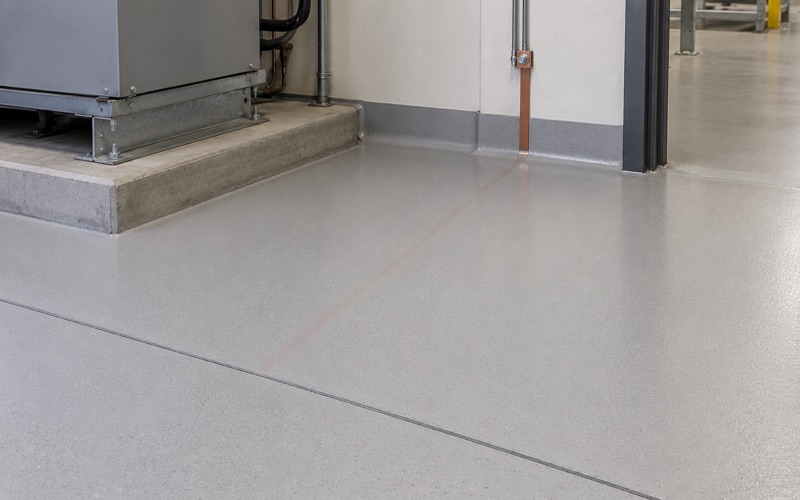
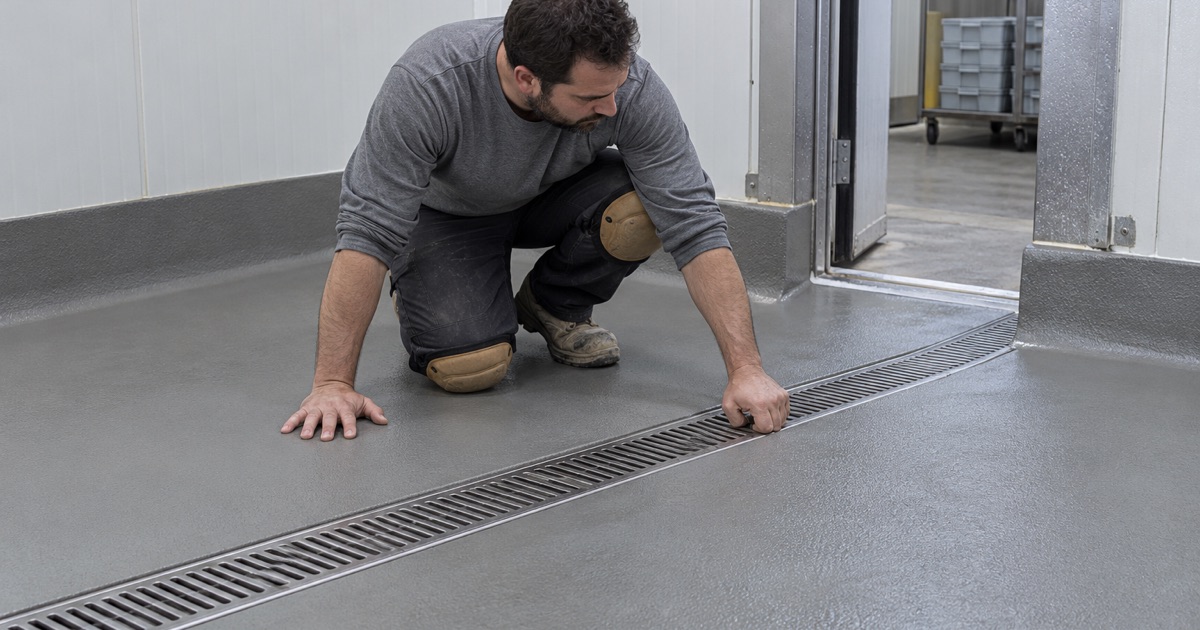
What we can specify against is the performance itself: a seamless, non-porous surface with no joints for organic soil to sit in, an integral coved base at the floor-to-wall junction, a texture that holds DCOF slip resistance when the floor is wet, drains detailed with the coating turned into the drain body rather than stopped at the flange, and enough thermal tolerance for the wash-down protocol in use.
Not everything on this corridor is cold, either. High-cube distribution floors, racking aisles under forklift traffic, battery-charging rooms and dock aprons take a different specification again, and we do not pretend a single product covers a whole building.
The Oldest Residential Slabs In This Part Of The Valley
Two eras, two different jobs
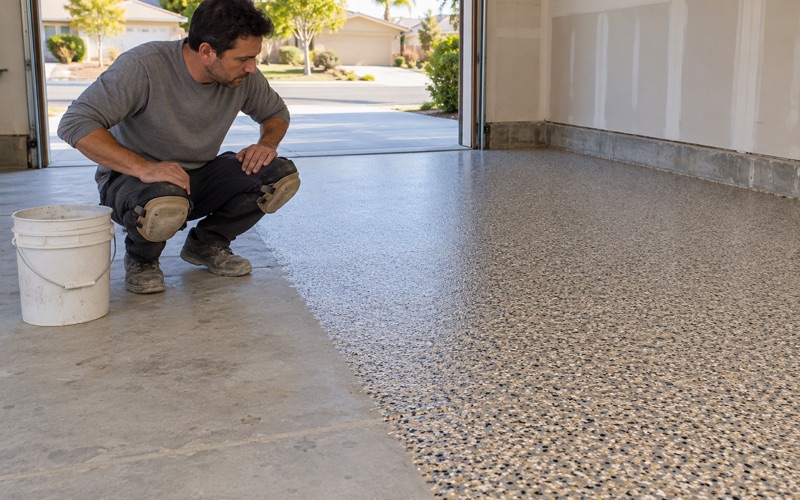
Colton is also the volume residential market around here, and it is the oldest incorporated city in it. Of 17,856 housing units, 5,296 — 29.7 percent — predate 1960, and 1,431 predate 1940. Roughly 39.2 percent, some 7,003 units, predate 1970. At the other end, the 1980s are the largest single decade at 4,539 units, and only about 9.6 percent of the stock was built in 2000 or later.
That produces a genuine two-era split. A 1980s tract garage on the north side and a 1930s detached garage in the older south end are different jobs with different preparation, different moisture risk, different access and different prices. Quoting one and pricing the other is how a bid goes wrong here.
Moisture is scope on the older tier
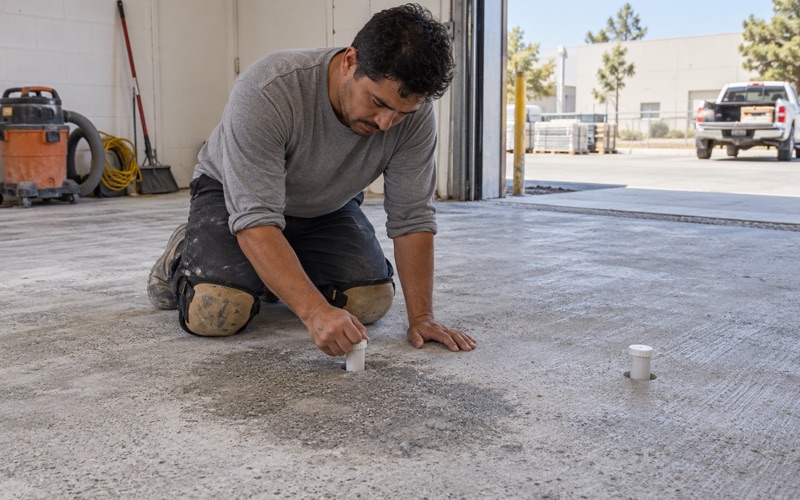
Under-slab vapor retarders were not routine practice before roughly the 1960s, and a large share of Colton’s stock predates that. On those houses we measure rather than assume: in-situ relative humidity to ASTM F2170, which reads the state of moisture inside the slab, or calcium chloride to ASTM F1869, which reads the rate coming out at the surface. Both threshold numbers live in ASTM F710 rather than in either test method, which is where that citation usually drifts. ASTM D4263 plastic sheet is indicative only and asymmetric — a positive fails a slab, a negative proves nothing.
The reading goes in the proposal before material is ordered, because moisture failure is the one thing almost every coating warranty in this trade excludes. Where the answer is that the slab is not a candidate, we say that in writing too.
Who actually owns the garage
Ownership here runs 52.8 percent, the most evenly split of any city we serve, with 7,977 of 16,897 occupied units rented. The published pool that matters is 7,820 owner-occupied single-family detached houses. Another 2,440 detached houses are rentals, where the decision gets made at turnover on durability and turnaround rather than on appearance. There is also a real multifamily layer — 6,175 units in structures of two or more, including 2,001 in buildings of fifty or more.
Category, Counter And The City As A Client
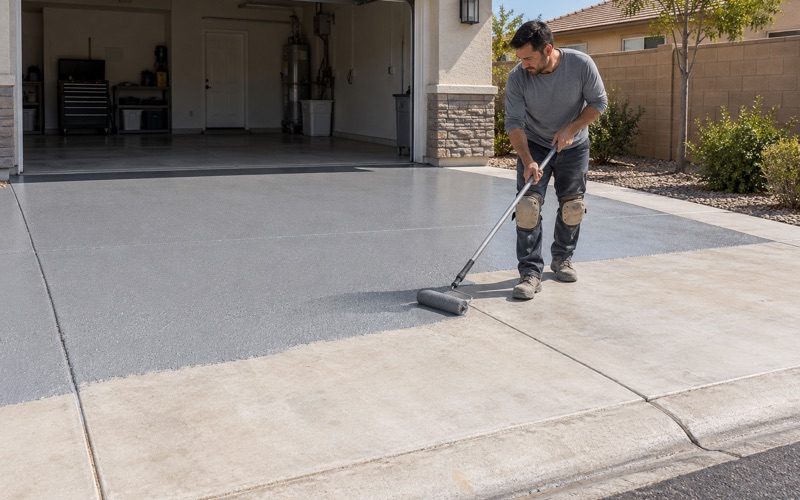
South Coast AQMD Rule 1113 caps floor coatings at 50 g/L VOC and industrial maintenance coatings at 100 g/L, and the two categories are mutually exclusive by definition. Subsection (c)(6) prohibits applying, or soliciting the application of, an industrial maintenance coating for residential use.
That rule bites harder in Colton than in a bedroom community, precisely because this city has both halves of the market inside it. A product that is entirely legal on a distribution floor on the corridor is not legal in a Colton garage, and we quote residential and commercial work from separate product lines for that reason rather than as a preference.
Colton is also unusual in owning its electric, water and wastewater utilities under the Colton Utility Authority, with the City Council as the governing board. That makes the city itself a floor client: substations, the Agua Mansa Power Plant, pump stations, treatment facilities and corporation yards are public assets procured through a public agency rather than a private landlord.
One note on paperwork. The Building and Safety Division sits within Development Services at 659 N. La Cadena Drive, and the city runs a four-day week — the front counter is open Monday through Thursday, 7:30 AM to 5:00 PM, with phones running to 6:00 PM. Friday is not a permit day, and the city’s online portal is the practical route for anything that needs one.
- 20+ Years on Inland Empire Concrete
- Every Slab Moisture Tested
- Free Written Proposals