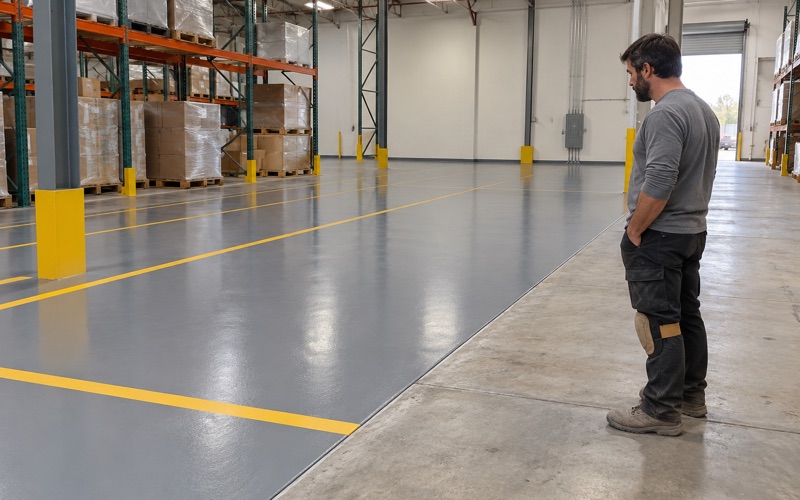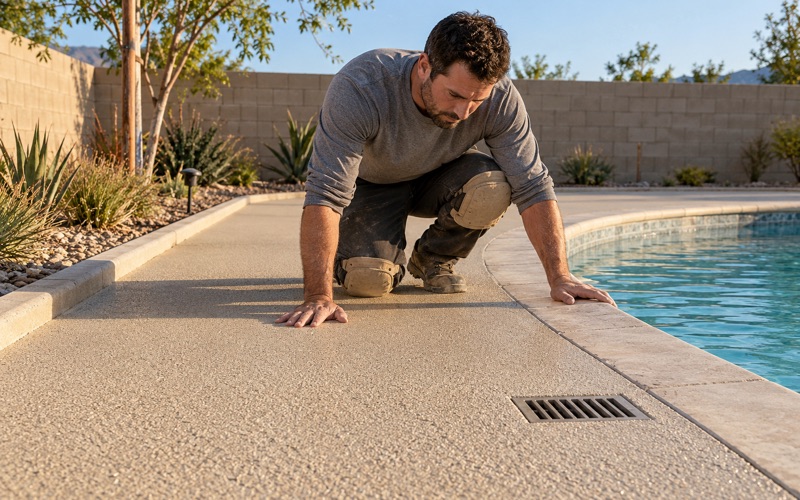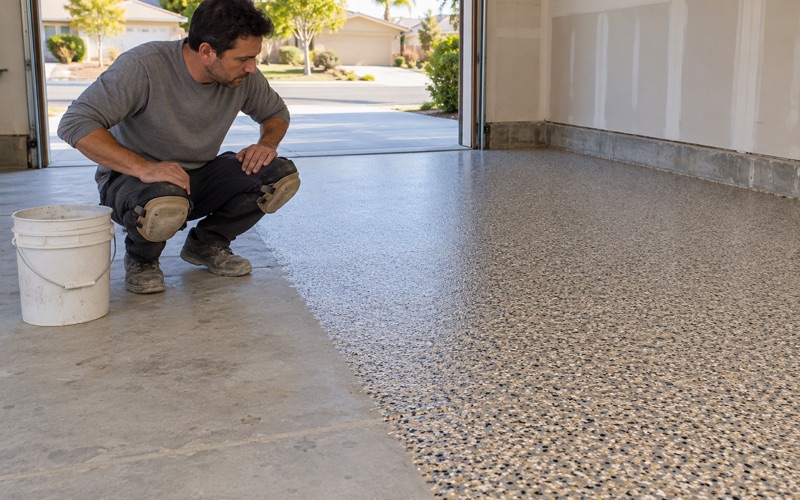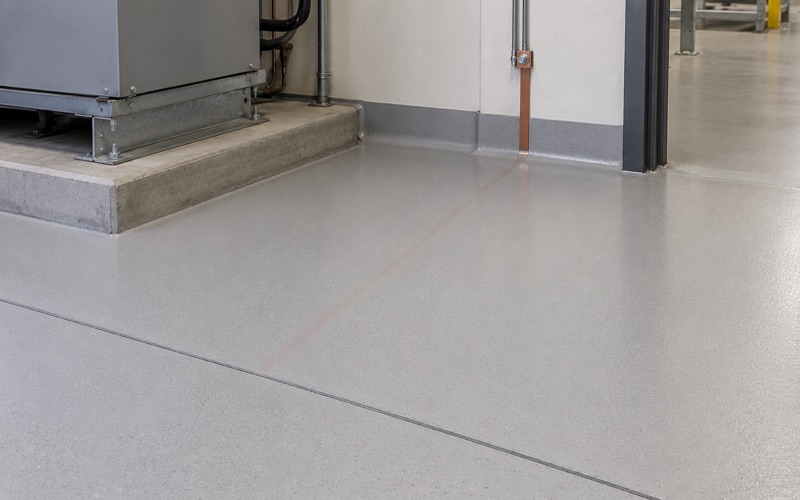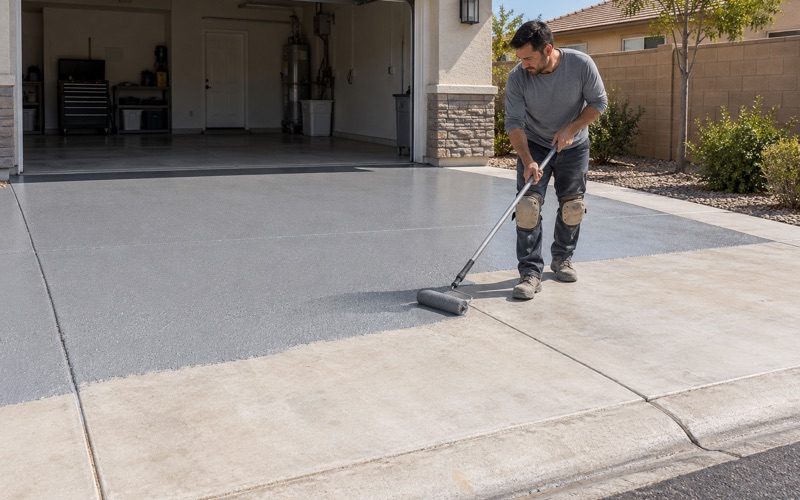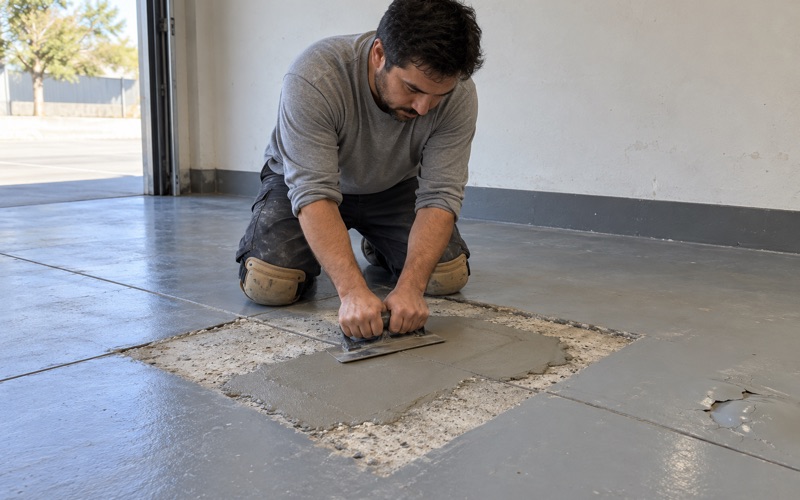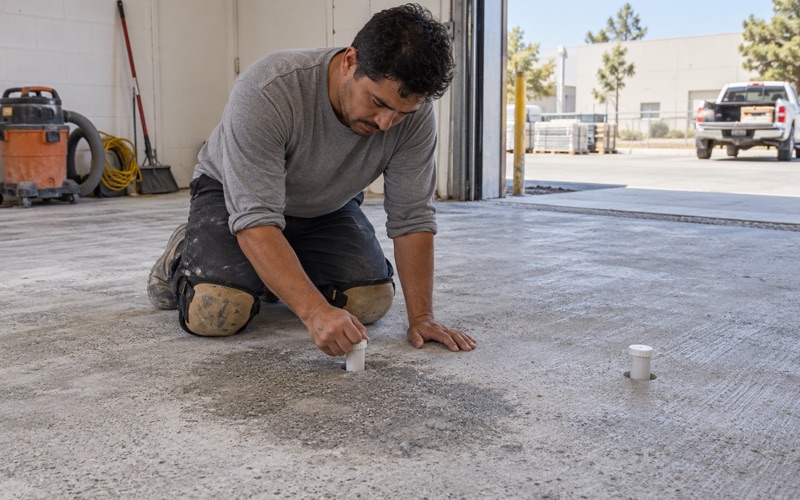
Redlands Epoxy Floors installs epoxy flooring in Cherry Valley, and more often than not the slab in question is not under the house. It is in a barn, a tack room, a feed room, a wash rack or a shop building several hundred feet down the drive, and those floors carry requirements a two-car garage never has to meet.
The method is the same one we have used on Inland Empire concrete for twenty-plus years. The slab is measured for moisture before material is ordered, opened mechanically with diamond tooling to a named ICRI concrete surface profile rather than acid-etched, and the mil build goes into the proposal as a number with the product data sheet attached. One crew takes the job from grind to topcoat, so the person who saw what the concrete looked like when it was opened is the person calling the primer and the recoat timing.
What changes on horse property is everything downstream of the slab itself: where the water goes, how much grip the floor needs wet, what chemistry lands on it daily, and whether the building can be emptied at all. Those are answered before a product is chosen, not after.
Horse Property and the Floors That Come With It
Cherry Valley sits at 2,980 feet at the northwestern point of the San Gorgonio Pass, on multi-acre parcels that support animal keeping, with listings running up to fifteen-acre equestrian estates. The housing pattern follows from that, and it is unusually simple.
Owner-Occupied Housing Here Is Two Categories
Of 2,451 occupied units, 2,038 are owner-occupied — 83.1 percent — and that owner-occupied stock consists of exactly two things: 1,523 single-family detached houses and 515 mobile homes. Nothing else at all. There is no apartment stock either: across every structure class from three units up to fifty or more the count is zero, with just seven units in two-unit buildings.
Nearly a Third of the Housing Has a Carport
805 of the 2,690 housing units here are mobile homes — 29.9 percent — and a manufactured home generally has a carport rather than an enclosed garage. That matters for anyone estimating this market off a population figure, because it takes almost a third of the housing units out of the garage-floor conversation before any other adjustment. A carport slab is an exterior floor with UV exposure and a different product answer, and we quote it as one.
Getting the Rig to the Barn
Multi-acre parcels mean long drives, often unpaved, with gates set well back from the road. A planetary grinder, a dust-extraction rig and material have to travel from the truck to a building that may be hundreds of feet off pavement, sometimes on ground that will not carry a loaded vehicle after rain. We walk that route and price it, because on a ranch property staging is a real line item rather than an afterthought.
Looking for epoxy flooring closer to March ARB? See March ARB Epoxy Flooring.
A Wash Rack Is Not a Garage
Wet-service floors are the part of this market that almost nobody writes about, and they are where a generic garage specification fails fastest. Water, grip and chemistry all have to be answered before a product name comes up.
Water Has to Leave the Floor
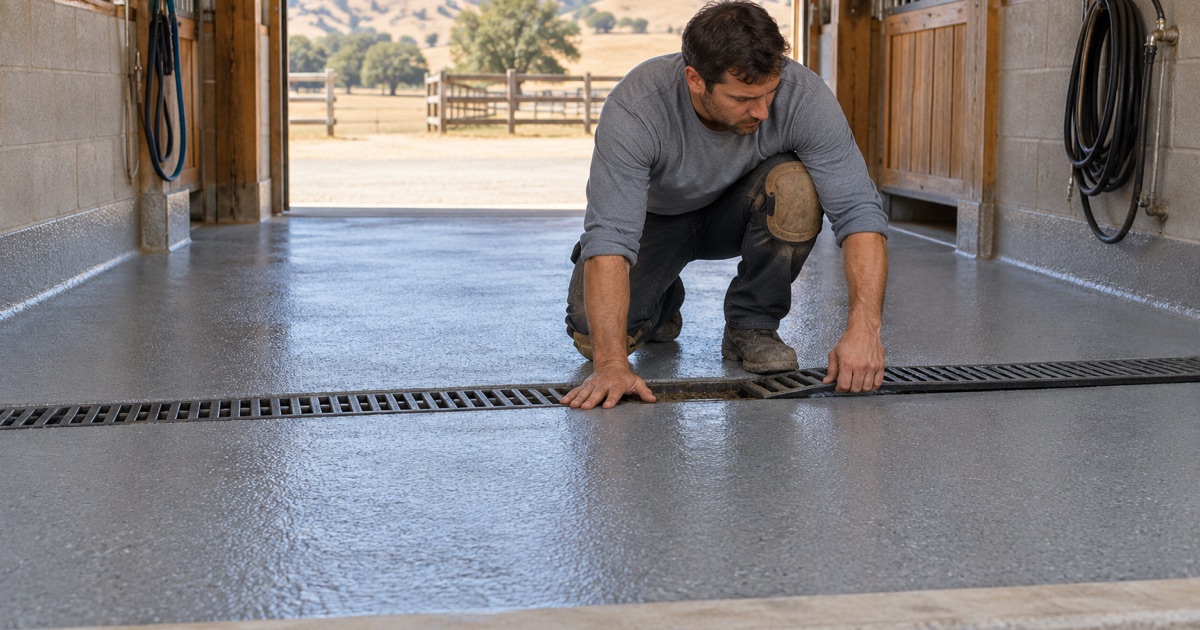
A wash rack runs standing water for long stretches, so the first question is not what coating goes on it but whether the slab drains. A floor that ponds will hold water against the coating, against the joints and against the wall junction indefinitely. Where the falls are wrong we can rebuild slope into the floor as part of the job, and where a drain is undersized or badly placed we will say so — a coating cannot fix drainage, it can only survive it or fail to.
Grip Measured, Not Promised
Slip resistance on a wet floor is a measured DCOF figure, not an adjective, and it is created by broadcast rate and aggregate size rather than by a product name. A quartz broadcast builds genuine texture that holds up under water and hoof traffic where a smooth gloss film would be dangerous. The same building usually wants two levels of grip — aggressive in the wash bay, easier to sweep and mop in the tack room — and one specification cannot serve both.
The Wall Junction and the Chemistry
Shampoo, disinfectant, hot water and manure solids all end up in the corner where the floor meets the wall, and a square junction holds every bit of it. Carrying the system up the wall in a coved radius makes that corner cleanable and keeps water out of the joint behind it. Where hot water wash-down swings the floor temperature quickly, urethane cement handles the thermal shock that will debond a conventional epoxy, and it is placed thick enough to behave like a topping rather than a film.
What a Tack Room Actually Takes
A tack room floor is a chemical problem more than a wet one: leather conditioner, oils, fly spray, hoof dressing and a permanent film of grit tracked in from outside. Grit is the underrated part, because it turns every footstep into abrasion. The useful specification question is what sits on that floor overnight rather than what gets wiped off, since concentration, temperature and dwell time change every answer on a chemical resistance chart.
Coating a Barn That Stays in Use
Animals cannot be moved off a property for a week, so barn work is sequenced rather than shut down. That constraint shapes the schedule, the product choice and the price, in that order.
One Aisle, One Bay, One Room at a Time
We work in defined areas — a run of stalls, then the aisle, then the wash bay, then the tack and feed rooms — closing each out to full return-to-service before the next opens. That means the phase boundary is designed as a joint rather than discovered as a cold seam, and it means the schedule is agreed with the owner around feeding, turnout and farrier visits before anything is priced.
Cure Time Is the Constraint, Not Application Time
On an occupied property the number that matters is not how long the coating takes to go down, it is how long before the building can be used again. That pushes the specification toward fast-cure chemistry where the schedule is tight, and it makes the difference between foot traffic and full cure a conversation worth having in detail — a floor is walkable long before it will take a shod hoof or a loaded wheelbarrow without marking.
Wind Is Not a Neutral Condition
Cherry Valley sits at the mouth of one of the windiest corridors in Southern California, and wind works against a wet film in three ways at once: it accelerates surface skinning, it carries grit and organic debris straight into the coating, and it makes dust containment during grinding considerably harder. Door management, temporary screening and choosing which end of the building to open are part of the plan on a windy day, not improvisation.
Cold Mornings and Hot Afternoons on the Same Slab
At pass elevation an unheated barn or garage slab can sit below a product’s minimum application temperature well into a January morning, and concrete lags air temperature by hours, so a mild reading on a thermometer does not mean a mild floor. Summer runs the other way: pot life on a published system falls from roughly sixty minutes at 55 degrees to about twenty at 95. The floor also has to sit at least five degrees above the dew point, with a minimum near fifty degrees for air, surface and material alike. We read the slab and set the date from that rather than from the month.
The Oldest Housing Stock in the East Foothills
Cherry Valley’s concrete skews old and unusually uniform. 85.2 percent of the housing predates 1980, with 739 units — 27.5 percent — built in the 1970s alone and another 563 in the 1980s.
One Dominant Garage Job
Where some communities give a crew three or four different eras in a week, here there is one dominant case: a forty-five to sixty-five year old attached two-car garage with control-joint cracking, some settlement, decades of oil saturation, and very often a failed one-part paint or a consumer kit that lifted years ago. Stripping that prior coating is frequently the real scope of the job. PCD tooling shears a soft film off without gouging the concrete beneath, and the step-down through the grit sequence follows the rule that catches people out — hard concrete takes a soft diamond bond.
Older Slabs Still Get a Reading
519 units here predate 1960, which puts them on concrete placed before under-slab vapor retarders were routine. Those slabs get an actual measurement: in-situ relative humidity to ASTM F2170 or moisture vapor emission rate to ASTM F1869, read against the thresholds in ASTM F710 rather than against the test methods, which is where that citation most commonly drifts. Taping plastic down under ASTM D4263 is asymmetric — a positive result fails a slab and a negative one proves nothing — so it is a first look and never a clearance.
Very Little New Concrete
Only 190 units, about 7.1 percent of the stock, date from 2000 or later, and 121 of those since 2010. This is a repair, remediation and recoat market almost end to end, which is also why a written repair-or-replace read matters here: on a badly spalled barn slab or one broken up by settlement, the honest answer is sometimes that coating it is the wrong money, and we would rather put that in writing than take the job.
A Residential Parcel, Whatever the Floor Does
SCAQMD Rule 1113 caps floor coatings at 50 g/L VOC and industrial maintenance coatings at 100 g/L, makes the two categories mutually exclusive, and in subsection (c)(6) prohibits applying or soliciting the application of an industrial maintenance coating for residential use. The common case in Cherry Valley is exactly the awkward one — a horse barn or ranch shop on a residentially zoned parcel is residential property under that rule however industrial the wear on its floor, so the higher-VOC category is off the table. We say that rather than quietly borrowing a commercial product.
Permits Come From the County, by Appointment
There is no city hall here. Cherry Valley is unincorporated, so building permits run through the Riverside County Department of Building and Safety inside the county’s Transportation and Land Management Agency, submitted through the county’s online portal, with most permit creation at the Permit Assistance Center handled by appointment rather than at a walk-up counter. That is a slower path than a city desk and it belongs in the schedule from the start.
The Commercial Work Here Is Hospitality and Farm, Not Industrial
The realistic commercial floors in Cherry Valley are event, hospitality and farm buildings — Highland Springs Ranch and Inn, established in 1884 on roughly 2,400 acres as Riverside County’s first historical landmark, with an organic farm, restaurant, inn and camp on it, and the county-operated Edward-Dean Museum and Gardens on sixteen acres. The large industrial floor work is south of here in the freeway corridor, where Beaumont Pointe is entitled at roughly five million square feet with construction reported as scheduled to begin in 2027. That corridor is adjacent to Cherry Valley, not in it, and we would rather be accurate about that than imply otherwise.
- 20+ Years on Inland Empire Concrete
- Every Slab Moisture Tested
- Free Written Proposals