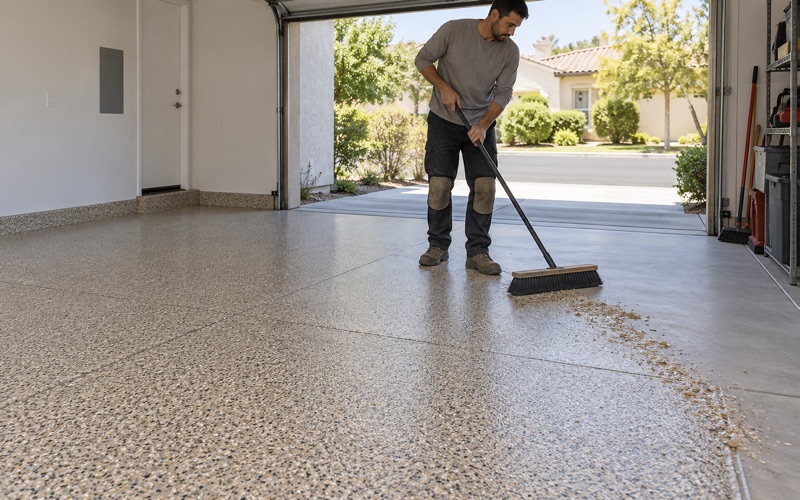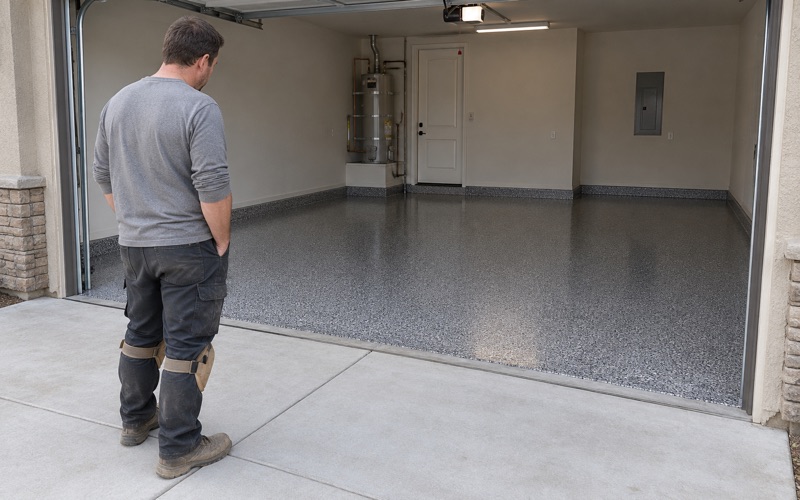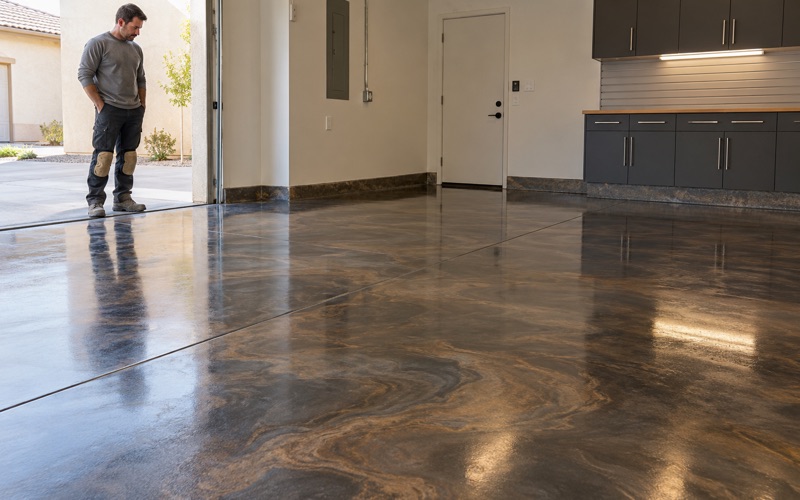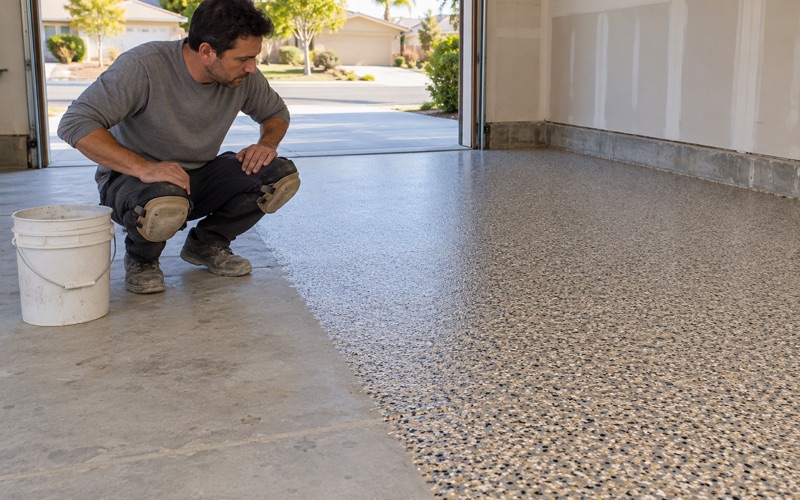
Redlands Epoxy Floors installs epoxy flooring in Canyon Lake, and here more than anywhere else we work, the rules of the community decide how a job runs. Canyon Lake is a privately gated city. Access is permitted only to residents and their guests, a contractor gets in as a registered service provider rather than by turning up, and the hours a crew is allowed to work are set by association rule with fines attached.
There is also a reason to coat a driveway here that does not exist in an ordinary city. The Property Owners Association enforces driveway condition as a maintenance standard: rule PC.4.11 requires driveways to be kept in good repair and free from cracks that present a lifting or tripping hazard, and free from grease, oil, stains and other debris. Elsewhere an oil-stained driveway is a neighbor’s opinion. Inside the gates it is a citable violation with a monthly penalty behind it.
We have more than twenty years on Inland Empire concrete and install epoxy, polyaspartic and polyurea systems. What follows is what we have read in the association’s own rules and posted access policies, and one caution before any of it: the rule set we worked from was Version 54, dated May 2021, and it may have been amended since. Treat every figure below as the version we read rather than as today’s schedule, and confirm the current one with the association before relying on it.
A City Entirely Behind a Gate

Three Gates, and Only Two of Them Are Yours
Canyon Lake has three access points: the Main Gate off Railroad Canyon Road, the East Gate off Goetz Road, and the North Gate off Greenwald Avenue. A coating crew cannot use the Main Gate. The association’s own wording is that all commercial, oversize and recreational vehicles must access the community through the East and North gates, and that commercial and oversized vehicles are not allowed entry at the Main Gate. A grinder trailer, a box truck or a dust extraction rig routes to Goetz Road or Greenwald Avenue, and that is a dispatch instruction with real drive time behind it rather than a courtesy note.
The Homeowner Lets Us In, Not the Other Way Around
Contractors are classified as service providers in the association’s visitor system, and access is pre-authorized by the member — through the app, the website or the association’s 24-hour line — rather than arranged by the contractor at the gate. The driver presents a valid driver’s license on arrival, service provider access is limited to a ten-day span, crews have no access to community amenities, and vehicles are expected to park near the address being served. We ask the homeowner to authorize the crew before the day rather than while a truck idles at a gatehouse.
Windshield Passes and Who Is Liable
Separately from the visitor system, rule PC.7.4b requires contractors to obtain passes through Member Services and to display worker passes conspicuously on vehicle windshields, with a penalty listed per occurrence in the version we read. The part homeowners are often surprised by is PC.7.4, which makes the property owner responsible for the contractor’s conduct and compliance. A crew that cuts a corner here creates a problem for the customer, not for itself, which is precisely why we treat the pass step as part of the job rather than as paperwork.
Dates the Gate Is Effectively Closed
Service provider access is additionally restricted around Memorial Day weekend, the Fourth of July, Labor Day, Halloween, the Parade of Lights and New Year’s Eve. A resinous floor needs consecutive days, so booking a multi-day install with a cure period landing on one of those dates is how a crew arrives and cannot get in. We check the calendar against those dates before proposing a start.
Looking for epoxy flooring closer to Mentone? See Epoxy Flooring in Mentone.
The Hours Work Is Allowed to Happen
The Posted Window, and What Breaking It Costs
Working hours are fixed by rule PC.7.3g and apply to contractors, owners and residents alike: from October 1 through April 30, 7:00 a.m. to 6:00 p.m.; from May 1 through September 30, 6:00 a.m. to 6:00 p.m.; and Saturdays year round, 7:00 a.m. to 6:00 p.m. PC.7.3h adds that no work happens at all on Sundays or on association holidays — New Year’s Day, Memorial Day, the Fourth of July, Labor Day, Thanksgiving and Christmas. In the version we read, a first offense carried a fine and a second carried a larger one plus a stop-work order. A stop-work order partway through a coating is not an administrative inconvenience; it is a floor left in a state it cannot be left in.
The Summer Start Is an Advantage, Not a Restriction
The 6:00 a.m. summer start is genuinely useful in this trade rather than merely permissive. Pot life on a two-part system collapses with slab temperature — roughly sixty minutes at 55 degrees down to about twenty at 95 on one published product — so an inland summer install wants the earliest legal start it can get. Canyon Lake allows an hour more than it does the rest of the year, and we use it: early mobilization, small batches, surface temperature read off the slab rather than off the air, and the wet edge kept moving.
Planning a Cure Around a Closed Sunday
With Sundays off the table entirely, a multi-day system has to be laid out so that no recoat window falls on one. A polyaspartic topcoat with a recoat window measured in hours is a very different scheduling animal from an epoxy base needing an overnight, and the choice between them here is partly a calendar decision. We build the sequence backward from the days work is permitted rather than forward from the day we would like to start.
Site Conditions Are Also Ruled
PC.7.3b prohibits storing materials, tools, supplies and equipment on the street and requires the job site, the street, the gutters and the curb area to be kept clean, with a daily penalty in the version we read. PC.7.3d requires dust to be controlled during construction. On a grind-and-coat job that makes containment and dust extraction contract conditions rather than a selling point — and since the association maintains these streets, grinding dust or slurry tracked into a gutter is damage to the association’s own asset.
A Stained Driveway That Is a Violation
What PC.4.11 Actually Says
The rule text is short and specific: driveways shall be maintained in good repair and free from cracks that constitute a lifting or tripping hazard, and free from grease, oil, stains and other debris. The schedule we read attached a monthly amount to it. A monthly penalty is a different kind of pressure from a one-time fine, because it accrues until the condition is fixed, and that is what turns a cosmetic complaint into a reason to actually book the work.
Coating a Driveway Versus Cleaning One
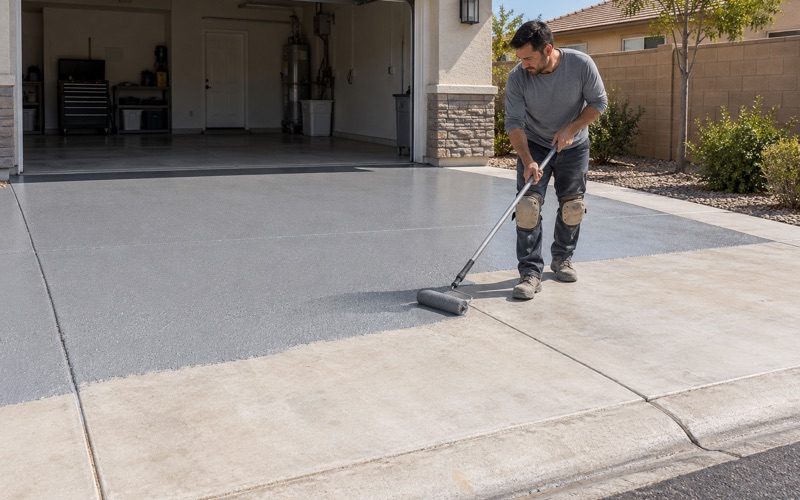
Degreasing buys time on a stained driveway; it does not stop the next drip. A coating changes the surface from porous concrete that absorbs oil into a film that releases it, which is the difference between a repeat problem and a solved one. Exterior concrete is its own specification, though — an aliphatic polyaspartic holds color under sunlight where an epoxy ambers — so a driveway is quoted as a system in its own right rather than as an extension of whatever went into the garage.
Cracks Have to Be Repaired, Not Painted Over
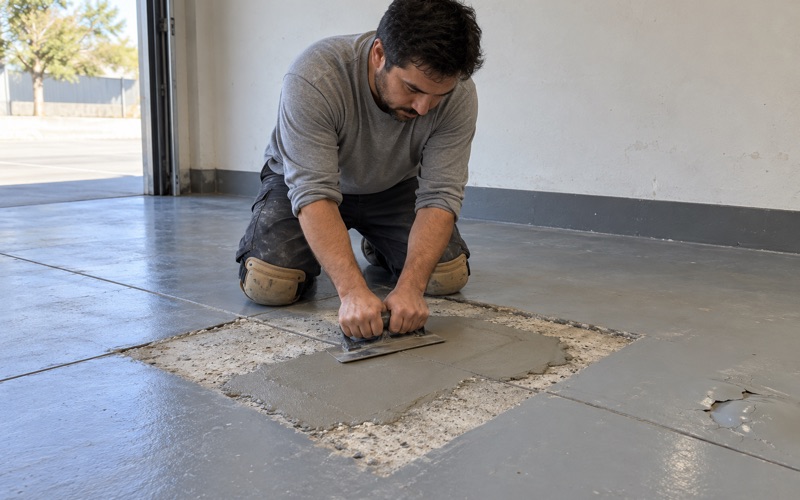
The rule names cracks that lift or trip, and a coating film stretched across a moving crack telegraphs it and splits within a season. Static cracks get chased open and filled with a semi-rigid filler so the repair carries traffic; moving joints get honored rather than bridged. Where the concrete has failed structurally we will say that a coating is the wrong money and that the panel wants replacing, because a compliant-looking floor over a failing slab satisfies nobody for long.
Concrete and Pavers Only
Rule PC.5.10 permits only concrete or paver driveways and additional parking, and additional parking installed for an RV, trailer, boat, car or truck comes with a front-yard landscaping condition attached. Rule GR.5.3f requires wheeled vehicle storage to sit on concrete slabs or runners designed and approved for the purpose, and GR.5.3b forbids parking on any unpaved part of a property. In practice, that means boat and RV pads are ordinary here in a way they are not in a standard tract city, and they are exposed concrete taking a wet hull, a trailer tongue and a jack foot.
Two Approvals, Not One
The City and the Association Are Separate Bodies
Canyon Lake incorporated as a city in December 1990, and the association’s own history notes that everything outside the gates falls under the city council. Building permits come from City of Canyon Lake Building and Safety on Railroad Canyon Road, whose counter runs Monday through Thursday and closes over the lunch hour. The city states that before it issues a permit, the applicant must supply association approval for any project involving exterior work. So where a permit is in play, the order is association first, city second.
Whether a Floor Coating Needs Architectural Review Is a Question to Ask
This is the part we will not pretend to have settled. The CC&Rs establish a three-person Architectural Control Committee and provide that no improvement may be installed, placed, moved, altered or modified on a lot without its written approval, with an exception for softscape and for remodeling of the internal approved habitable structure. A garage is not habitable space and a driveway is not softscape, so that exception does not plainly cover either — but we found no rule in the version we read that addresses floor coatings by name.
Our advice is to call Planning and Compliance and ask about your specific job before it starts, since PC.1.2 requires approval prior to commencement of work and PC.7.6 sets escalating fines for failing to obtain a permit where one was needed. We would rather hand you a question to ask than a determination we cannot support.
Every Dwelling Has a Two-Car Garage by Rule
Rule PC.5.11 requires all dwellings to have an enclosed garage capable of at least two-car storage, with garage door detail shown on plans and conversions to habitable use prohibited unless a new garage is built first, subject to a named tract exception. That is an unusual market fact: the addressable garage floor here is not a share of the housing stock, it is essentially all of it — around 4,500 units, roughly 87 percent detached and about 85 percent owner-occupied.
A Uniform Stock and a Consistent Scope
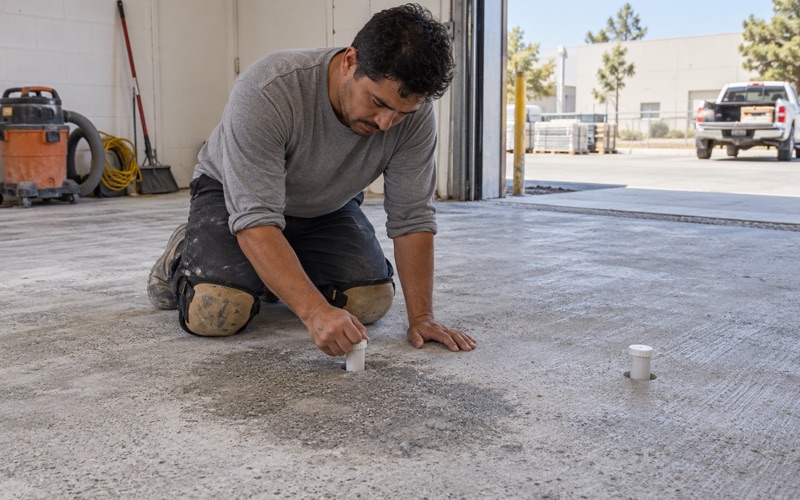
The housing here is remarkably consistent. No unit predates 1960, and close to 72 percent of everything in the city went up in the 1970s and 1980s. That means the typical job is a two-car attached garage on a slab in the four-to-five-decade range, and the scope is repeatable: a hard power-troweled surface that has to be opened mechanically, oil at the parking positions, control joints wanting filler, and frequently an older one-part paint or kit that has to come off first. Nothing here is opened with acid — every slab is ground with diamond tooling to a named ICRI concrete surface profile, with grit sequence and diamond segment bond hardness matched to the concrete.
Residential Almost End to End
South Coast AQMD Rule 1113 holds floor coatings to 50 g/L VOC and industrial maintenance coatings to 100 g/L as mutually exclusive categories, and in subsection (c)(6) prohibits applying or soliciting the application of an industrial maintenance coating for residential use. Canyon Lake is overwhelmingly residential, so the floor-coating category is the operative one on very nearly every job inside the gates. The exception worth naming is the association’s own amenity buildings — a country club kitchen and its back of house, for instance — which are commercial-use floors sitting under a single owner with a maintenance budget, and effectively the only recurring commercial account behind the gate.
- 20+ Years on Inland Empire Concrete
- Every Slab Moisture Tested
- Free Written Proposals