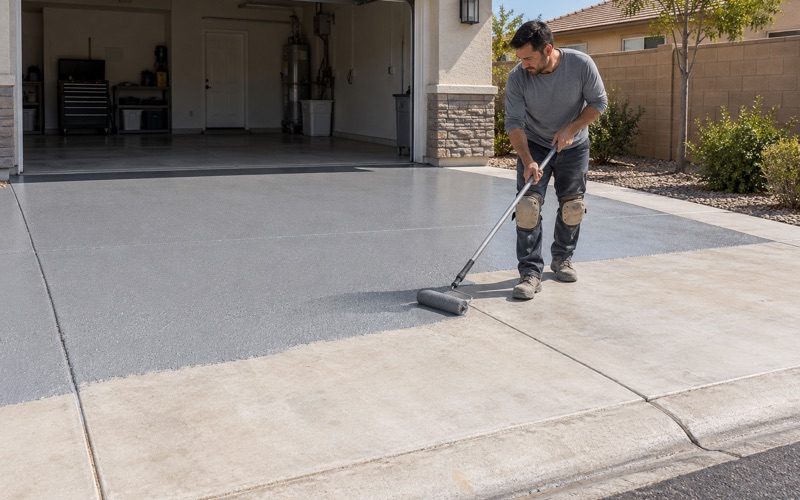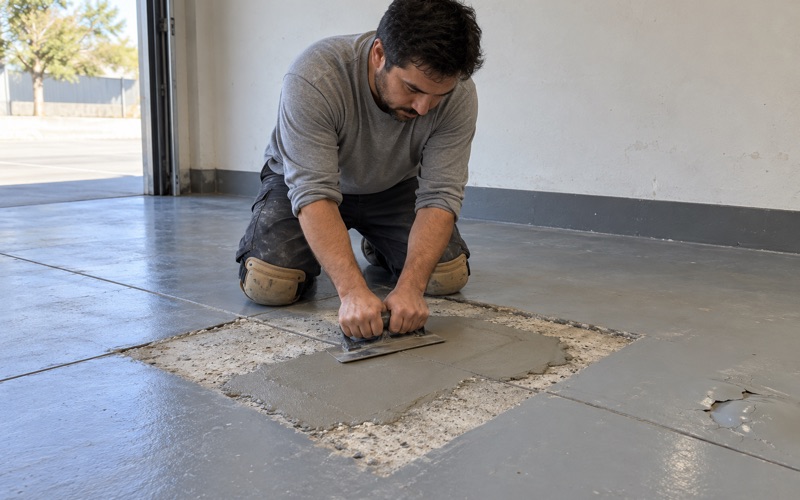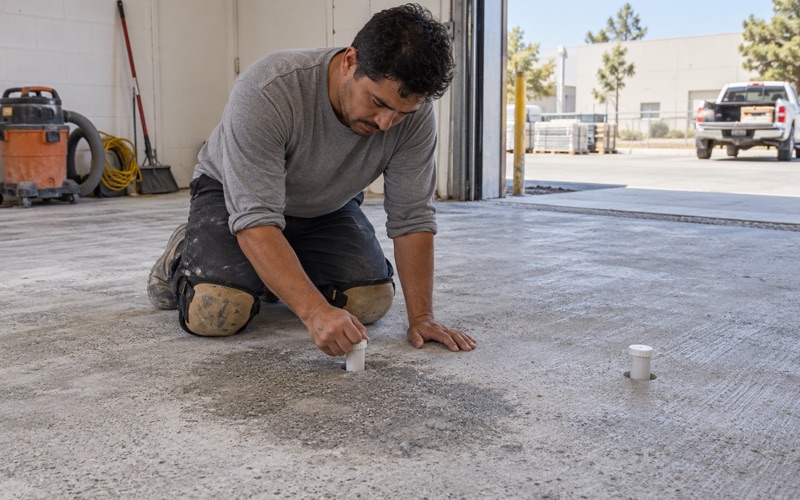
Redlands Epoxy Floors has spent more than twenty years installing epoxy flooring in Calimesa and across the Inland Empire, and Calimesa is the city where we most often have to explain that a brand-new garage slab is not automatically an easy one. The usual story in this trade is an old floor with a problem. Here the technical question is younger concrete that has not finished giving up its water yet.
That is a real distinction, not a sales angle. A slab poured in the last several years can be flat, clean, uncracked and completely sound, and still hold enough internal moisture to push a coating back off itself. Nothing about the surface tells you which one you are standing on.
So the sequence here is the same as everywhere else, with the emphasis moved: we read the slab, put the moisture number in the proposal before any material is ordered, open the surface with diamond tooling to a named profile rather than acid, and state the mil build with the product data sheet attached. On a young slab, the number is the part that decides the whole specification.
The Newest Housing In These Foothills
Almost a third of the stock is this century
Of 4,204 housing units in Calimesa, 352 were built in 2020 or later and another 604 during the 2010s — 22.7 percent of everything here is under about fifteen years old, and 8.4 percent is under six. Add the 386 units built between 2000 and 2009 and 1,342 units, 31.9 percent of the city, date from this century.
That share is dramatically higher than anywhere else in these foothills, where the common pattern is a town whose newest tract went in decades ago. Treating Calimesa as another aging foothill community gets the technical problem exactly backwards.
An owner in almost every house
Ownership here runs 89.3 percent — 3,540 of 3,965 occupied units — which is the highest rate in this part of the county. The published pool of owner-occupied single-family detached houses is 2,465, with only 213 detached houses rented.
That is a small market in absolute terms, in a city of roughly ten thousand people. What it has going for it is that nearly every one of those houses contains the person who decides, which makes the conversation shorter and the scope honest from the first visit.
A quarter of the city is manufactured housing
Calimesa has 1,117 manufactured homes, 26.6 percent of all housing units, and 988 of them are owner-occupied against just 14 that are rented. That ratio is the signature of the resident-owned 55-plus park, and it describes this city accurately — Plantation on the Lake alone is a 557-site community on Desert Lawn Drive, built in 1983, with two pools, two spas, a library, a billiard room, a craft room, an orchard, a vineyard and a dog park.
Those homes have carports rather than garages, so they sit outside the garage-coating market entirely. The buildings around them do not. Clubhouses, laundry rooms, activity and craft rooms, and pool decks are all coating work, and they are bought by a park or an association on a maintenance schedule. The city runs its own Mobile Home Rent Stabilization Program and Board, which is a fair signal of how central that housing type is here.
Looking for epoxy flooring closer to Grand Terrace? See Grand Terrace Epoxy Flooring.
Why A New Slab Can Still Fail A Moisture Test
The vapor retarder works by keeping water in the slab
A modern residential slab is placed over a vapor retarder, and that sheet does exactly what it is supposed to: it stops moisture from the soil moving up into the concrete. What it also does is stop the slab’s own mix water from draining downward. Every bit of water that is not consumed by hydration has one way out, and that way is up through the top surface.
So on new construction the moisture question is a cure-age question. It is about how much water is still in the concrete and how long the slab has had to release it upward, not about anything missing underneath. A young slab in a well-built tract garage can read high for a genuinely mundane reason.
Dry to the touch is not dry
This is where a lot of coatings fail on newer houses. The top of the slab dries first and reads dry to a hand, a broom or a cheap surface meter, while the concrete two inches down is still well above the threshold that matters. Place a low-permeability coating over that and the water has nowhere to go except into the bond line, where it collects until it lifts the film in blisters.
Fresh concrete needs weeks of cure before it can take a coating at all, and even then the calendar is a rough guide rather than an answer. Mix design, slab thickness, ambient conditions and how long the garage sat closed all move the number.
What a high reading actually costs you
It does not mean the floor cannot be coated. It means the specification changes — normally a moisture vapor barrier primer sized to the reading, which adds cost and usually a day. The alternative is placing a system over a slab that will push it back off, and moisture failure is the one thing almost every coating warranty in this trade excludes.
We would rather quote the primer than the callback. When a reading is borderline we say so plainly, including when the honest recommendation is to wait a season rather than spend money now.
Testing Concrete That Is Still Curing
Reading inside the slab, not just off the top
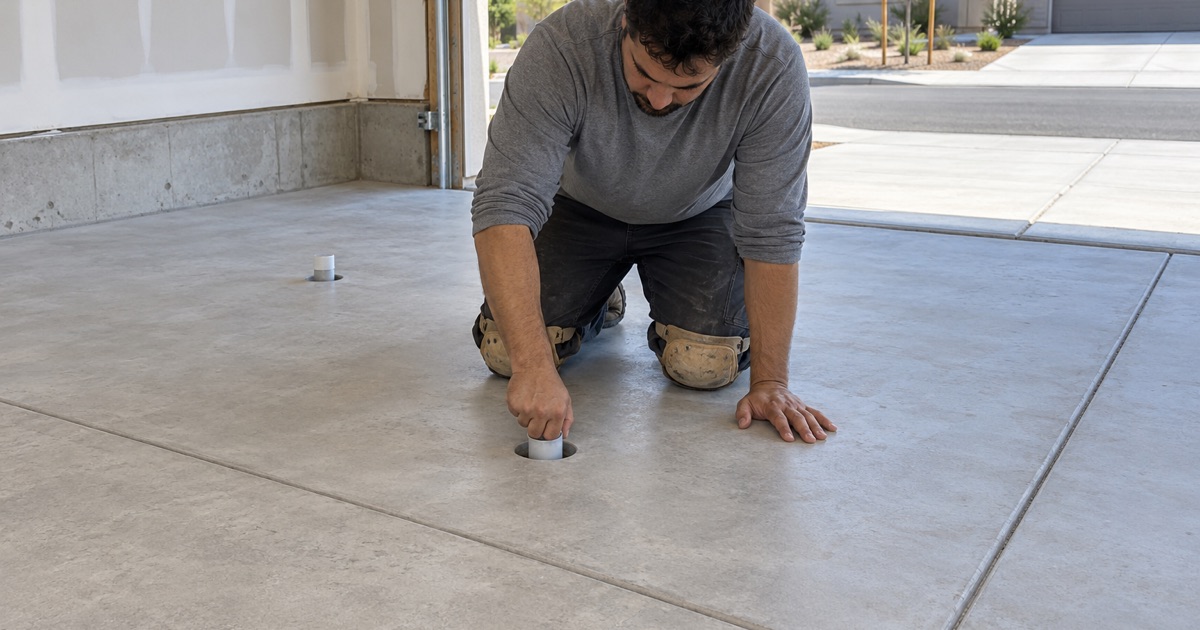
For young concrete the useful test is in-situ relative humidity to ASTM F2170, which drills into the slab and reads the humidity of the concrete itself at depth rather than what has already escaped at the surface. That is the whole point on a new floor: the surface is the part that has finished drying, and the interior is the part that has not.
Calcium chloride to ASTM F1869 measures the rate coming out at the surface instead, which is a different question and a useful cross-check. Both threshold numbers live in ASTM F710 rather than in either test method, which is the citation people most often get backwards — the methods tell you how to measure, and F710 tells you what the number has to be.
The test that only works in one direction
ASTM D4263 — taping a plastic sheet down and looking for condensation — gets used as a shortcut on new houses because it is free. It is asymmetric and needs to be treated that way: a positive result fails a slab, and a negative result proves nothing at all. We use it as an indicator and never as clearance.
The number belongs in writing
Whatever the method, the reading goes into the proposal before material is ordered, next to the mil build and the system being proposed. On a five-year-old tract garage that is not a formality — it is the difference between a floor that holds and a warranty conversation neither party enjoys.
Coating In A Master-Planned, Age-Restricted Community
Gloss is a safety decision, not a taste one
A large share of Calimesa’s newer product is 55-plus, and that changes the specification in a concrete way. A high-gloss finish that reads as premium to a younger buyer reads as glare and as a fall risk to an older one, particularly in a garage lit by one fixture and a bright doorway.
DCOF slip resistance is a real conversation here rather than a technicality. We will show the tradeoff honestly: the texture that makes a floor safe underfoot when wet is the same texture that makes it slightly harder to sweep clean, and we would rather set that dial with you than default to the finish that photographs best.
The gate comes before the slab
Master-planned means an association. Gated entry and guest access for a crew truck and trailer, restrictions on work hours, rules about staging equipment or a dumpster in a driveway or on the street, and in some communities architectural review of anything visible from the street.
A grinder and a dust-extraction rig have to get through a gate before they get to a floor, and in Calimesa the scheduling call is often with a management company rather than with the homeowner. We sort that out before the date is set rather than at seven in the morning at a call box.
Being licensed to be in the city at all
Calimesa requires a city business license of any business conducting business inside the city, and the ordinance names contractors and delivery companies based in other cities specifically. That applies to us, and it is a checkable compliance item rather than a general reassurance. It is also the kind of thing an unlicensed operator working out of a truck will not have.
What The Builder Left, And What The Weather Does To It
Builder-grade is a starting point, not a defect
A tract garage slab is typically flat, sawn on a sensible control-joint grid and structurally fine. What it usually has is a hard, dense troweled surface that will burnish under the wrong tooling before it opens.
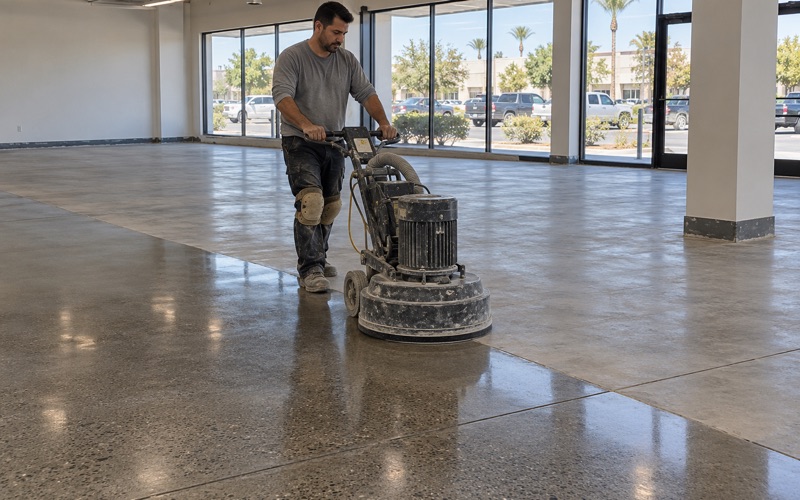
Grit sequence and diamond segment bond hardness get matched to that concrete, and the counterintuitive rule holds: hard concrete takes a soft bond. Pair them the wrong way and you polish the slab instead of cutting it, which produces a surface no coating can key into. The deliverable is a named ICRI concrete surface profile — commonly around CSP 3 for a thin-film system — and it is never achieved with acid.
Elevation moves the working window
Calimesa averages about 2,392 feet, with terrain running from roughly 2,300 to 3,500 feet, so slab temperature can differ meaningfully across the city on the same afternoon. It is high enough that an unheated garage on a winter morning can sit below the 50-degree minimum application temperature most data sheets state for air, surface and material alike.
Heat pushes the other way. On one published product, pot life runs roughly sixty minutes at 55 degrees and about twenty at 95, with the recoat minimum dropping from twenty-four hours to six across that range. We read slab temperature rather than air temperature, hold a 5-degree margin above dew point and an 85 percent ceiling on relative humidity, mix small in summer, and start early.
Category, and a counter that closes at noon
Product selection runs against South Coast AQMD Rule 1113, which caps floor coatings at 50 g/L VOC and industrial maintenance coatings at 100 g/L and makes the two categories mutually exclusive. Subsection (c)(6) prohibits applying, or soliciting the application of, an industrial maintenance coating for residential use. In a city this residential the 50 g/L category is the operating category nearly everywhere, and an industrial product cannot be brought into a tract garage on the argument that it wears better. Calimesa also has no warehouse belt of its own, so we are not pretending the heavy industrial product line has a home here.
One practical note on paperwork: the Community Development Department at 908 Park Avenue runs its counter from 8:00 AM to noon, Monday through Thursday, and City Hall itself works a four-day week. There is no Friday counter at all. Applications go through the city’s online permit portal, which is the realistic route for anything that does need one, and we plan around that window rather than discovering it.
Multifamily is close to absent here — 223 units, 5.3 percent of the stock — so unlike denser cities there is no apartment podium deck or subterranean parking garage layer to work in. The commercial equivalent in Calimesa is the association clubhouse and the park common building, and those are quoted like the institutional floors they are: on cleanability, slip resistance, and a shutdown window that has to be met.
- 20+ Years on Inland Empire Concrete
- Every Slab Moisture Tested
- Free Written Proposals