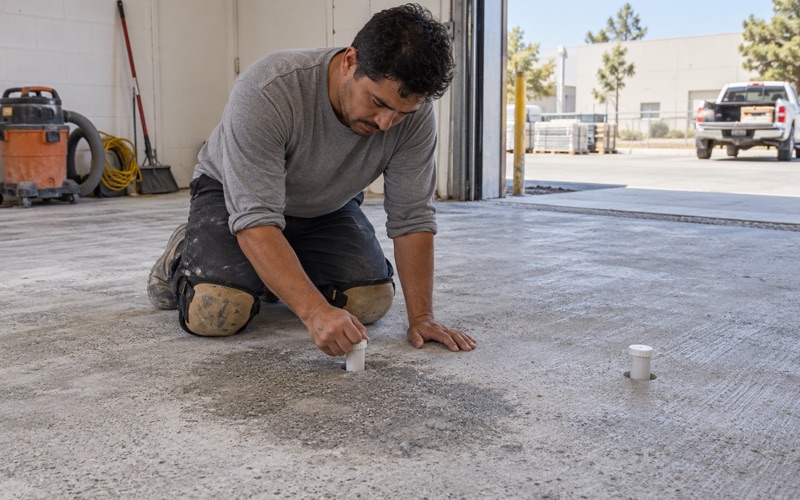
Redlands Epoxy Floors has been installing epoxy flooring in Banning for more than twenty years, and there is one site condition here that changes how we work and that almost nobody quotes for: wind. A resin floor is a liquid for a while after it goes down, and anything the air carries into that window ends up in the film permanently. In the San Gorgonio Pass the air is carrying something most days.
That is not atmosphere, it is a scheduling and containment problem with practical answers. The bay gets closed down to a working gap and the gap gets sealed.
The driveway and the approach get swept or damped before any broadcast step. Material gets staged inside rather than on an open tailgate. Batches get smaller so no mix sits open longer than it has to, and the work gets planned around the part of the day the forecast is worst rather than straight through it.
The rest of the specification is written the way we write it everywhere: the slab is measured for moisture before material is ordered, the concrete is opened with diamond tooling to a named ICRI surface profile rather than etched, and the proposal states the system, the mil build as a number and the product data sheet it comes from. One crew takes the floor from grind to topcoat, which on a job with a containment plan matters, because the plan is only as good as the people who have to keep to it at four in the afternoon.
A Pass That Does Not Go Calm at Night
The Weather Service Draws a Line Around This Place
The National Weather Service maintains a dedicated public forecast zone for this area — CAZ065, San Gorgonio Pass Near Banning — issued separately from the broad Inland Empire zone that covers the valleys. Banning’s city center maps into that pass zone, and the adjacent Inland Empire zone begins immediately west of it. Forecasters carved out the pass because it does not behave like the valley, and that boundary is the most useful single fact a floor contractor can know about working here.
What an Ordinary Day Looks Like
The difference shows up on days with nothing unusual happening. On a routine mid-August afternoon with no advisory in effect, the pass zone forecast carried wind in every single period — west 10 to 20 mph with gusts to 35 mph that night, and northwest 15 to 25 with gusts to 40 two nights later — while the same office’s same-hour forecast for the neighboring valley zone said winds becoming light in the evening. These are forecast values for particular periods rather than long-run climate figures, and that is exactly why they are useful: they describe what a crew will actually be standing in.
And What an Advisory Day Looks Like
When the Weather Service does issue a wind advisory for the pass, the criteria it typically cites are west winds of 25 to 35 mph with gusts of 50 to 60 mph, along with blowing dust and sand that may greatly reduce visibility and make travel difficult through the pass. Those, too, are advisory thresholds rather than averages. There is corroborating hardware nearby: the San Gorgonio Pass wind farm runs 667 operational turbines with a rated capacity in the range of 628 to 656 megawatts, sited here because the pass is one of the most consistently windy places in the country. The turbines and the grit in a wet film have the same cause.
Looking for warehouse floor coating closer to Fontana? See Warehouse Floor Coating in Fontana.
What Lands in a Floor Before It Skins Over
Open Time Is Exposure Time
Every resinous system has a window between the moment it is placed and the moment its surface stops accepting anything. During that window the film is still leveling and still open, and airborne dust, sand and organic debris that land on it do not sit on top — they wet out and become part of the finished surface. That is why a windy afternoon shows up in the floor as a gritty, slightly matte texture rather than as a visible layer of dirt.
Contamination Is Not Fixed by Another Coat
The expensive part is that a contaminated film cannot be cleaned off. Grit embedded in a cured coat has to be abraded back and recoated, which means an extra day, extra material and an extra recoat window, or it stays in the floor. A topcoat over the top does not bury it; it usually magnifies it, because a glossier surface reflects every irregularity underneath. Preventing it is cheap and correcting it is not.
Wind Also Speeds Up the Clock
The second effect is subtler and just as damaging. Moving air accelerates solvent flash and skins the surface before the film below has finished leveling, so the material stops flowing while it still has roller marks and lap lines in it, and air that would normally release keeps pinholes instead. An air-release roller and correct wet film thickness handle that on a still day; on a windy one, the answer is smaller batches, a tighter working sequence and more hands on the floor.
Scheduling and Containment as Part of the Quote
Closing the Building Down
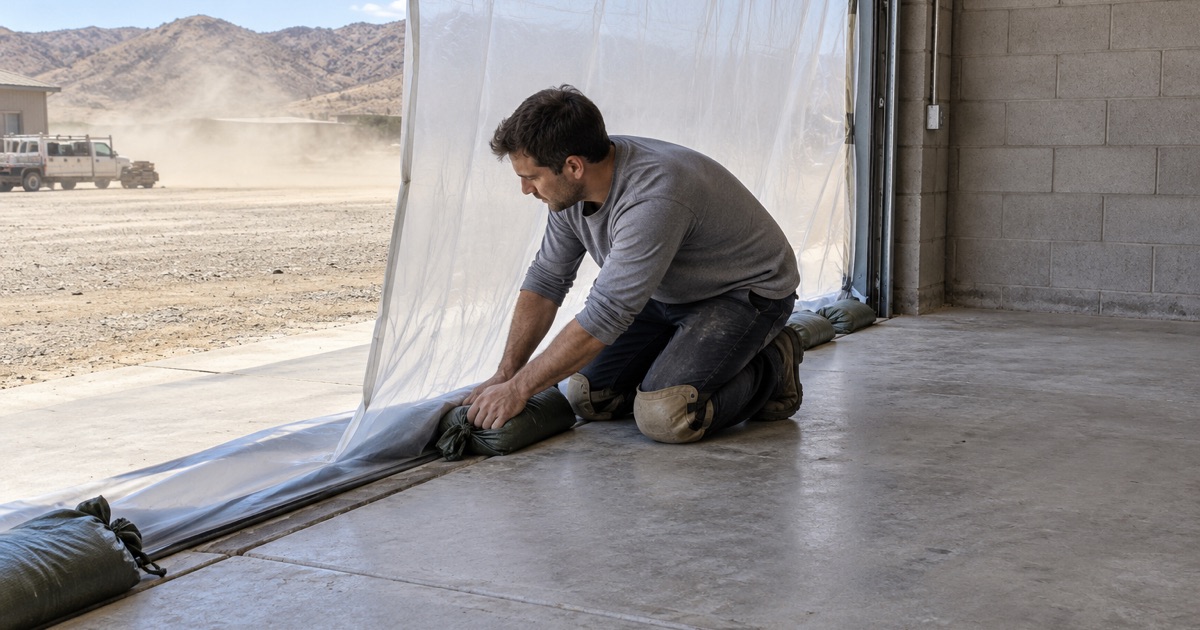
The single most effective control is a closed bay. We bring the door down to a working gap, seal the gap rather than leaving it open, and manage ventilation deliberately instead of letting the pass do it for us. Where the coating runs out through the door line, the exterior portion gets tented or screened rather than placed into open air, and that is planned before the day rather than improvised on it.
The Approach Gets Cleaned Before the Broadcast
Most of what lands in a floor comes off the ground within a few feet of the door, not from a mile away. So the driveway, the apron and the working approach get swept and damped before any broadcast step, material and tools get staged inside rather than on an open tailgate, and traffic in and out of the bay is limited while the film is open. It is unglamorous and it is most of the result.
Exterior Work Gets an Honest Warning
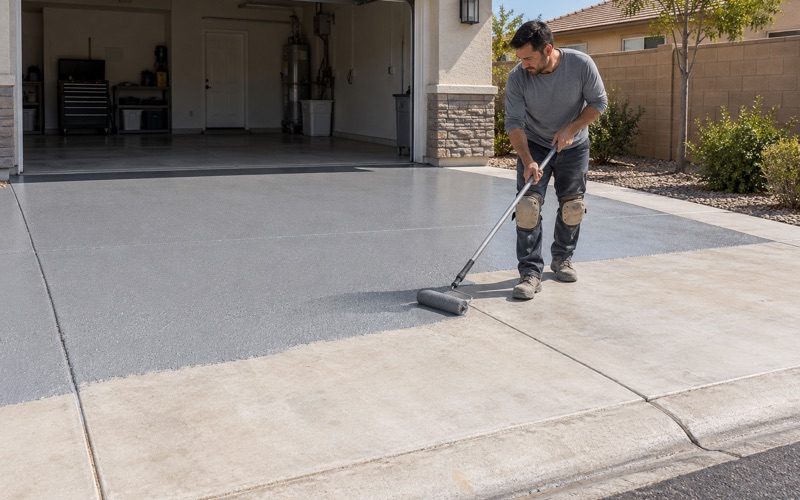
A driveway, patio or pool deck coating here is genuinely a harder job than the same coating on a sheltered valley lot, and we say so before quoting rather than after. Sometimes the honest recommendation is to move an exterior pour to a different week, and occasionally it is that a particular exposed slab is better ground and densified and left as concrete than coated at all. We would rather lose that line item than place a film into conditions that will pit it.
Heat, Dew Point and the Working Window
Pot Life Is a Curve
Banning sits at roughly 2,300 feet, cooler than the valley floor to the west, and summer still collapses working time. On one published product, pot life runs about sixty minutes at 55 degrees, forty at 72 and twenty at 95, while the recoat minimum falls from twenty-four hours to six. Combined with wind accelerating the surface, that makes small batches and an early start the default rather than a precaution.
The Numbers That Have to Be True Before Mixing
Air, surface and material all have to sit above the fifty-degree minimum, the surface has to be at least five degrees above the dew point, and ambient relative humidity has to be at or below 85 percent. We take the slab’s surface temperature rather than reading the air, because the concrete is the thermal mass and it lags. On a cold winter morning an unheated, uninsulated garage at this elevation can sit under that minimum well after the air has recovered, which moves a start time rather than a job.
Why We Book by Condition, Not by Date
Put together, that is why our scheduling here is driven by slab temperature, dew point and the wind forecast rather than by a calendar slot. It occasionally means moving a day, and we would rather have that conversation while you can still plan around it than deliver a floor with the week’s weather permanently in it.
An Older Housing Stock, and a Quarter of the City Behind a Gate
Slabs Poured Before the Vapor Retarder
Nearly one in five housing units here predates 1960, with about 605 units built in 1939 or earlier, and about 29 percent of the stock predates 1970. Those slabs went in before under-slab vapor retarders were routine practice, so a moisture reading is scope rather than an extra. We measure in-situ relative humidity to ASTM F2170 or calcium chloride to ASTM F1869 and read the result against the thresholds, which live in ASTM F710 rather than in either test method. Taping down plastic, ASTM D4263, is a ten-minute first look and works only one way: a positive fails a slab, a negative proves nothing.
The Market Is Houses, Not Headcount
The addressable pool here is roughly 6,630 owner-occupied single-family detached houses, which is a very different number from the population and a much more honest basis for how we plan work in the city. Manufactured homes are around a tenth of the stock and carry carports rather than garage bays, and there is very little multifamily of any size.
Sun Lakes Is About a Quarter of Every Home in the City
Sun Lakes Country Club is roughly 3,300 single-family and attached homes built between 1987 and 2003, gated, age-restricted and HOA-governed, with two- and three-car garages across some fifty floor plans. That puts close to a quarter of Banning’s housing units inside one community. Working there means gate access arranged in advance and contractor entry windows respected, and it means an owner priority list that runs to low odor, measured slip resistance and getting a car back in the bay quickly rather than to the most dramatic finish available.
Permits, Power and the Product That Is Legal Here
Permits and inspections run through the City of Banning Building & Safety Division within Community Development at City Hall on East Ramsey Street, open Monday through Friday from 8:00 AM to 5:00 PM, with applications filed through the city’s online permit portal. Banning also runs its own municipal electric utility rather than buying from the regional investor-owned utility, which matters on any job needing temporary power or a meter coordination step. And South Coast AQMD Rule 1113 governs the product itself: 50 g/L VOC for floor coatings, 100 g/L for industrial maintenance coatings, the two categories mutually exclusive by definition, and subsection (c)(6) prohibiting applying or even soliciting the application of an industrial maintenance coating for residential use. In a city this heavily single-family, nearly every floor we place is residential under that rule — including a hobby or workshop garage, however hard it gets used.
- 20+ Years on Inland Empire Concrete
- Every Slab Moisture Tested
- Free Written Proposals